
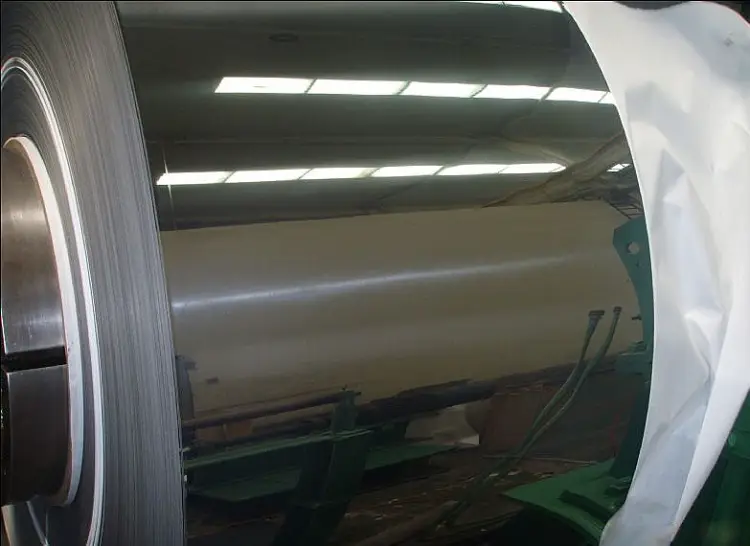
CCS DQ63 Shipbuilding Steel Coil
CCS DQ63 Shipbuilding Steel Coil - High-Strength Quenched & Tempered Offshore Grade
CCS DQ63 is a high-strength quenched and tempered steel for ship structures with minimum yield strength 620 MPa, excellent low-temperature toughness and weldability.
Quenching and tempering (Q&T), hot rolling, normalizing, cold forming (with care), welding, machining
- Phone : +8618037372205
- Email : [email protected]
- WhatsApp: Contact via Whtsapp
- WeChat: +8618037372205
CCS DQ63 Shipbuilding Steel Coil Introduction
CCS DQ63 is a high-strength quenched and tempered structural steel grade primarily intended for shipbuilding and offshore constructions, certified by China Classification Society (CCS). It belongs to the high-strength hull structural steel category and is characterized by a minimum yield strength of 620 MPa and tensile strength ranging from 720 to 890 MPa. The 'D' designates its fine-grain toughness class with impact testing at -20°C, while 'Q' indicates the quenching and tempering heat treatment. This steel offers an optimal balance of high strength, excellent low-temperature toughness, and good weldability, which is essential for critical structural components in large container ships, offshore platforms, and ice-strengthened vessels. It is typically supplied in normalized or quenched-and-tempered condition, often with coating or primer for marine environments.
CCS DQ63 Shipbuilding Steel Coil Chemical Composition
The chemical composition of DQ63 is controlled to achieve high strength and toughness after quenching and tempering. Microalloying with niobium, vanadium, and titanium ensures fine grains and precipitation hardening. Low phosphorus and sulfur contents improve notch toughness and weldability. Typical ladle analysis limits are given per GB 712-2011 and CCS Rules.
| Element | Standard Value | Remarks |
|---|---|---|
| C | ≤ 0.20 | Carbon, for strength and hardenability |
| Si | 0.10 – 0.55 | Silicon, deoxidizer |
| Mn | 0.90 – 1.60 | Manganese, for deoxidation and strength |
| P | ≤ 0.025 | Phosphorus, controlled for toughness |
| S | ≤ 0.025 | Sulphur, minimized for cleanliness |
| Cu | ≤ 0.35 | Copper, residual element |
| Cr | ≤ 0.25 | Chromium, for hardenability |
| Ni | ≤ 0.80 | Nickel, improves low-temperature toughness |
| Mo | ≤ 0.50 | Molybdenum, enhances tempering resistance |
| Nb | 0.02 – 0.05 | Niobium, grain refiner |
| V | 0.05 – 0.10 | Vanadium, precipitation strengthening |
| Ti | ≤ 0.02 | Titanium, deoxidizer and grain refiner |
| Al (acid-soluble) | ≥ 0.015 | Aluminium, for fine grain practice |
| N | ≤ 0.020 | Nitrogen, if binding elements present |
CCS DQ63 Shipbuilding Steel Coil Thermal and Electrical Physical Properties
The physical properties are typical for low-alloy quenched and tempered steels of this strength level. They are not mandatory in the product standard but are essential for engineering calculations. Slight variations may occur depending on exact heat treatment and composition.
| Property | Typical Value | Unit | Test Condition / Remarks |
|---|---|---|---|
| Density (ρ) | 7850 | kg/m³ | At 20 °C |
| Modulus of Elasticity (E) | 205 – 210 | GPa | At room temperature |
| Shear Modulus (G) | 79 – 81 | GPa | Calculated from E and ν |
| Poisson's Ratio (ν) | 0.28 – 0.30 | – | Ambient temperature |
| Thermal Expansion (α) | 11.5 – 12.5 | 10⁻⁶/K | Between 20 °C and 100 °C |
| Thermal Conductivity (λ) | 40 – 45 | W/(m·K) | At 20 °C |
| Specific Heat Capacity (cₚ) | 440 – 480 | J/(kg·K) | At 20 °C |
| Electrical Resistivity (ρₑ) | 0.20 – 0.30 | µΩ·m | At ambient temperature |
CCS DQ63 Shipbuilding Steel Coil Mechanical Properties
Mechanical tests are performed on quenched and tempered specimens. Yield strength and tensile strength values apply for thicknesses ≤ 50 mm. Elongation is measured on gauge length 5.65√S₀. Impact energy ensures ductile behaviour at low service temperatures. Bending test confirms formability without cracking.
| Property | Standard Requirement Value | Unit | Test Condition / Remarks |
|---|---|---|---|
| Yield Strength (ReH) | ≥ 620 | MPa | Thickness ≤ 50 mm; 0.2% offset if not defined |
| Tensile Strength (Rm) | 720 – 890 | MPa | Room temperature |
| Elongation (A) | ≥ 15 | % | Gauge length 5.65√S₀, longitudinal specimen |
| Impact Energy (KV₂) | ≥ 41 (longitudinal) | J | At -20 °C, D-class; transverse 27 J |
| Bend Test | 3a | – | Bend angle 180°, a = specimen thickness, no cracks |
CCS DQ63 Shipbuilding Steel Coil Fully Equivalent Material Standards & Substitutable Grades
| Country / Region | Standard | Grade | Remarks |
|---|---|---|---|
| International (IACS) | IACS UR W11 | DH63 | Identical chemistry and mechanical requirements |
| Norway / Germany (DNV GL) | DNV GL Rules | NV D63 | Same strength and impact class (-20 °C) |
| UK (Lloyd's Register) | LR Rules | DH63 | Equivalent to CCS DQ63 |
| USA (ABS) | ABS Rules | DH63 | Same yield/tensile/impact |
| France (BV) | BV Rules | D63 | Matched grade |
| Japan (NK/ClassNK) | NK Rules | KD63 | Equivalent toughness and strength |
CCS DQ63 Shipbuilding Steel Coil Application Introduction
CCS DQ63 steel coil is engineered for demanding marine and offshore environments. Its high strength reduces structural weight while maintaining safety margins, and the excellent low-temperature toughness makes it suitable for Arctic-operating vessels. Typical processing includes cutting, cold forming (with springback compensation), welding with appropriate preheating and low-hydrogen consumables, and shot blasting. The steel is commonly delivered in quenched and tempered condition with shop primer.
Product Applications: Container ships, bulk carriers and tankers (deck and bottom plates), Jack-up rig legs and spudcans, Semi-submersible platform columns and braces, Crane offshore pedestals and booms, Arctic offshore structures (ice-resistant walls)
Processed into products: Hull shell and longitudinal stiffeners, Transverse web frames and floors, Hatch corner reinforcements, Aft and fore peak structures, Offshore mooring components, Welded I- and T-beams for heavy structures
Application industries: Shipbuilding and ship repair, Offshore oil and gas platforms, Marine renewable energy (wind turbine foundations), Heavy lifting and transport equipment, Polar research and icebreaker construction
CCS DQ63 Shipbuilding Steel Coil Similar / Alternative Materials for Reference
| Country / Region | Standard | Grade | Remarks |
|---|---|---|---|
| EU | EN 10025-6 | S690Q | Quenched & tempered, min. yield 690 MPa, not specifically marine certified but similar mechanicals; extra assessment needed for marine use |
| China | GB/T 16270 | Q690D | High strength structural steel, impact at -20°C, similar strength level, ship classification approval may be missing |
| USA | ASTM A514 / A517 | Grade Q / B | Yield ~690 MPa, quenched & tempered; needs re-certification for marine structures |
| EU | EN 10225 | S460G2+M | Lower strength (460 MPa) weldable structural steel for offshore structures; alternative if lower strength is acceptable |
Notes:
- For thicknesses over 50 mm, mechanical properties may be agreed at the time of enquiry and order; Charpy impact values may be specified for transverse specimens (typically 27 J at -20°C).
- Welding: Preheating (typically 100–150°C) and low-hydrogen electrodes are recommended to avoid cold cracking. Post-weld heat treatment may be required for thick sections.
- Surface condition: Usually delivered with a temporary weldable shop primer. Coils can be supplied edge trimmed or mill edge.
- Inspection and testing: Products are normally certified according to CCS Rules; supplementary testing (ultrasonic, CTOD) can be agreed.
- The grade can also be supplied according to other classification societies' requirements (e.g., ABS DH63, LR DH63) with minor adjustments in the certificate.
- Share



