
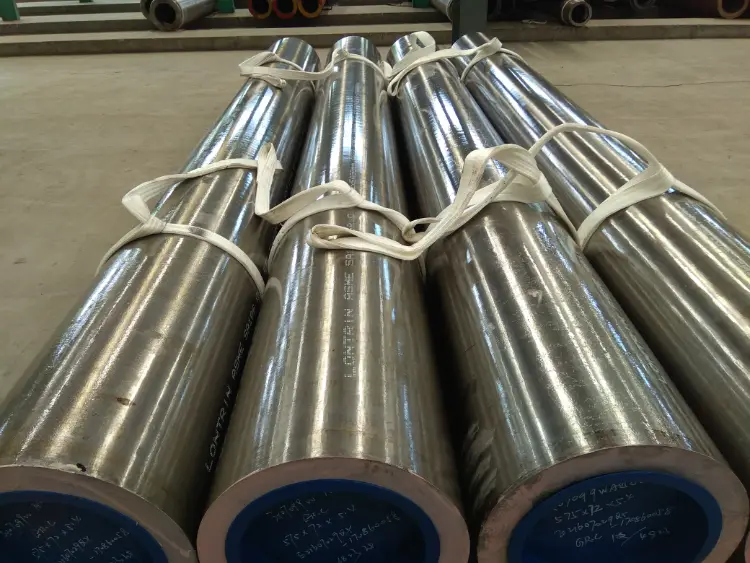
EN10219 S355MH ERW Pipe
EN10219 S355MH ERW Pipe - High-Strength Fine Grain Structural Hollow Section
Detailed material properties of S355MH electric resistance welded pipe per EN 10219. Includes chemical composition, mechanical and physical properties, equivalent grades, and application guidance.
Cold-forming and electric resistance welding from hot-rolled strip, thermomechanical rolling of base material
- Phone : +8618037372205
- Email : [email protected]
- WhatsApp: Contact via Whtsapp
- WeChat: +8618037372205
EN10219 S355MH ERW Pipe Introduction
S355MH is a thermomechanically rolled fine grain structural steel grade specified in EN 10219-1 for cold-formed welded structural hollow sections. It delivers minimum yield strength of 355 MPa (for thickness ≤ 16 mm) with excellent toughness at -20°C, making it suitable for demanding structural applications. The electric resistance welded (ERW) process ensures cost-effective production of round, square, and rectangular profiles.
- High strength-to-weight ratio
- Superior low-temperature impact toughness
- Good weldability with controlled carbon equivalent (CEV ≤ 0.39)
- Fine grain structure via thermomechanical rolling
EN10219 S355MH ERW Pipe Chemical Composition
Based on EN 10219-1:2006, Table 2 for S355MH. Maximum limits unless indicated otherwise. Total aluminium (Al total) must be ≥ 0.020%. The sum of Nb+V+Ti shall not exceed 0.22%. Carbon equivalent CEV ≤ 0.39 for thickness ≤ 16 mm ensures good weldability.
| Element | Standard Value | Remarks |
|---|---|---|
| C | ≤ 0.14 | |
| Si | ≤ 0.50 | |
| Mn | ≤ 1.60 | |
| P | ≤ 0.030 | |
| S | ≤ 0.025 | |
| Nb | ≤ 0.05 | |
| V | ≤ 0.12 | |
| Al (total) | ≥ 0.020 | Minimum |
| Ti | ≤ 0.05 | |
| Ni | ≤ 0.30 | |
| Cr | ≤ 0.30 | |
| Mo | ≤ 0.10 | |
| Cu | ≤ 0.35 | |
| N | ≤ 0.015 | |
| Nb+V+Ti | ≤ 0.22 | Sum |
| CEV | ≤ 0.39 | For t ≤ 16 mm |
EN10219 S355MH ERW Pipe Thermal and Electrical Physical Properties
Typical physical properties of structural steel at room temperature (20°C). These values are general for S355-type steels and may exhibit minor variation depending on exact composition and processing. All data are approximate and for engineering guidance.
| Property | Typical Value | Unit | Remarks |
|---|---|---|---|
| Density (ρ) | 7850 | kg/m³ | At 20°C |
| Modulus of elasticity (E) | 210 | GPa | At 20°C |
| Shear modulus (G) | 81 | GPa | Calculated |
| Poisson's ratio (ν) | 0.3 | ||
| Thermal expansion coefficient (α) | 11.5 × 10⁻⁶ | K⁻¹ | 20-100°C |
| Thermal conductivity (λ) | 50 | W/(m·K) | At 20°C |
| Specific heat capacity | 460 | J/(kg·K) | At 20°C |
| Electrical resistivity (ρₑ) | 0.22 × 10⁻⁶ | Ω·m | At 20°C |
EN10219 S355MH ERW Pipe Mechanical Properties
Mechanical properties according to EN 10219-1:2006, Table 4, for S355MH with wall thickness ≤ 16 mm.
- Tensile properties are measured in the longitudinal direction.
- Charpy V-notch impact test at -20°C with a minimum average absorbed energy of 40 J.
- Bend test requirement: 180° around a mandrel with diameter equal to twice the wall thickness without cracking.
| Property | Standard Value | Unit | Test Condition |
|---|---|---|---|
| Yield strength (ReH) | ≥ 355 | MPa | t ≤ 16 mm, longitudinal |
| Tensile strength (Rm) | 470 - 630 | MPa | t ≤ 16 mm, longitudinal |
| Elongation (A5) | ≥ 22 | % | Gauge length 5.65√S₀, longitudinal |
| Impact energy (KV) | ≥ 40 | J | -20°C, Charpy V-notch, longitudinal |
| Bend test | 180° (d=2a) no cracks | Mandrel diameter = 2× wall thickness |
EN10219 S355MH ERW Pipe Fully Equivalent Material Standards and Substitute Grades
| Country/Region | Standard | Grade | Remarks |
|---|---|---|---|
| European Union | EN 10210-1 | S355MH | Hot-finished structural hollow sections; identical steel grade and properties, different manufacturing route |
| European Union | EN 10219-1 | S355MH | Cold-formed welded hollow sections (same standard, directly applicable to ERW pipe) |
EN10219 S355MH ERW Pipe Application Introduction
S355MH ERW pipe provides an optimal combination of strength, toughness, and weldability, making it a preferred choice for dynamically loaded structures and low-temperature environments. It can be fabricated using common welding methods without significant preheating, thanks to its low carbon equivalent.
Product Applications: Structural frames, columns, and trusses, Bridge piers and deck support girders, Offshore module support beams and jackets, Crane booms, jibs, and lattice structures, Roll-over protective structures (ROPS), Scaffolding and shoring systems, Telecommunication and lighting poles
Processed into products: Welded tubular columns and beams, Hollow section joints (K, Y, T connections), Seismic-resistant bracing elements, Machinery frames and chassis components, Piling pipes and foundation cages, Exhaust stacks and ventilation ducts, Conveyor rollers and structural brackets
Application industries: Construction and civil engineering, Bridge building, Offshore and marine structures, Wind energy and tower structures, Material handling and crane manufacturing, Automotive and heavy machinery
EN10219 S355MH ERW Pipe Similar/Approximate Substitute Materials
| Country/Region | Standard | Grade | Remarks |
|---|---|---|---|
| European Union | EN 10219-1 | S355J2H | Comparable strength and -20°C impact; fine grain normalized/normalized rolled, not thermomechanically rolled. Widely interchangeable. |
| USA | ASTM A500 | Grade C | Yield 345 MPa, tensile 425 MPa, no impact requirement. Suitable for non-critical structural uses. |
| Japan | JIS G 3466 | STKR490 | Yield 325 MPa, tensile 490–610 MPa, no guaranteed impact toughness. |
| China | GB/T 1591 | Q355D | Plate/strip steel with yield 355 MPa and -20°C impact; used as feedstock for cold-formed hollow sections. |
| International | ISO 630-3 | S355M | Hot-rolled structural plates, similar chemistry and mechanical properties, but not a tubular product standard. |
Notes:
Thickness effect: For wall thicknesses > 16 mm, minimum yield strength may be reduced; refer to EN 10219-1 for thickness-dependent values. CEV control ensures good weldability under standard conditions, but thicker sections may require low-hydrogen procedures. Surface condition: ERW pipes are usually supplied with a mill finish; additional treatment (galvanizing, painting) is common for corrosion protection. Always confirm actual properties with mill test certificates (EN 10204 Type 3.1).
- Share



