
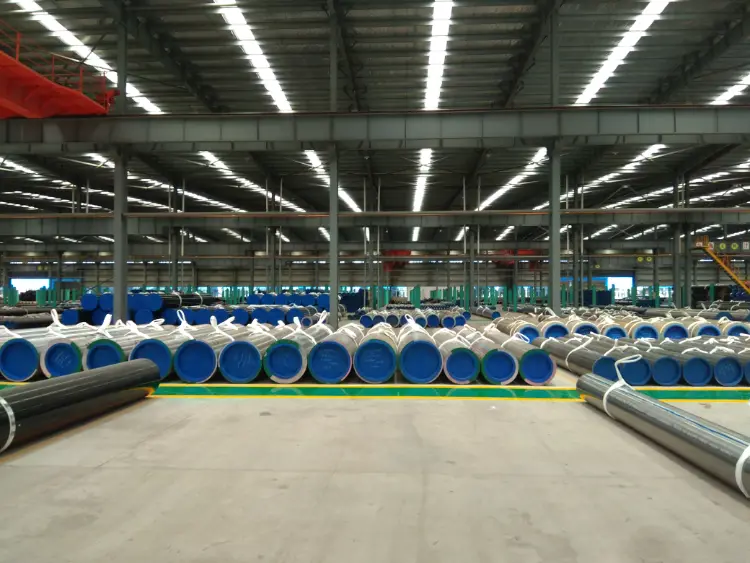
EN10219 S355MLH ERW Pipe
EN10219 S355MLH ERW Pipe: High-Strength Structural Hollow Section for Arctic Environments
Detailed material data for S355MLH electric resistance welded (ERW) pipe according to EN 10219, covering chemical composition, mechanical properties, physical performance, and international equivalents.
Cold forming, electric resistance welding (ERW), cutting, drilling, welding, galvanizing, painting
- Phone : +8618037372205
- Email : [email protected]
- WhatsApp: Contact via Whtsapp
- WeChat: +8618037372205
EN10219 S355MLH ERW Pipe Introduction
EN10219 S355MLH is a cold-formed welded structural hollow section made from thermomechanically rolled fine-grain steel. It offers a minimum yield strength of 355 MPa and excellent low-temperature impact toughness down to -50 °C (27 J longitudinal). The 'M' stands for thermomechanical rolling, 'L' for low-temperature notch toughness, and 'H' for hollow section. Delivered in the as-welded or normalized condition, this ERW pipe is widely used in demanding structural applications such as offshore platforms, bridges, and heavy-duty machinery where high strength and brittle fracture resistance are paramount. The fine-grain microstructure ensures consistent mechanical properties and good weldability with a controlled carbon equivalent value (CEV ≤0.39 for thicknesses ≤40 mm).
EN10219 S355MLH ERW Pipe Chemical Composition
Chemical requirements as per EN 10219-1:2006 for grade S355MLH (same as S355ML). Elements are controlled to ensure fine grain practice and low-temperature toughness.
- Carbon content is limited to 0.14% max for good weldability.
- Micro-alloying with Nb, V, Ti refines the grain size and improves strength.
- Total Al minimum 0.020% ensures sufficient deoxidation and grain refinement.
- CEV ≤0.39% (thickness ≤40 mm) guarantees low hardenability in the heat-affected zone.
| Element | Max/Min Value (%) | Remarks |
|---|---|---|
| Carbon (C) | ≤0.14 | Ladle analysis |
| Silicon (Si) | ≤0.50 | |
| Manganese (Mn) | ≤1.60 | |
| Phosphorus (P) | ≤0.025 | |
| Sulfur (S) | ≤0.020 | |
| Aluminium (Al total) | ≥0.020 | Minimum required for fine grain practice |
| Niobium (Nb) | ≤0.05 | Micro-alloying element |
| Vanadium (V) | ≤0.10 | Micro-alloying element |
| Titanium (Ti) | ≤0.05 | Micro-alloying element |
| Nickel (Ni) | ≤0.30 | Residual element |
| Molybdenum (Mo) | ≤0.20 | |
| Chromium (Cr) | ≤0.30 | Not specifically required but limited for weldability |
| Copper (Cu) | ≤0.55 | Residual element |
| Nitrogen (N) | ≤0.015 | Not fixed by Al; bound by micro-alloying for grain refinement |
| CEV | ≤0.39 | For thickness ≤40 mm; CEV = C+Mn/6+(Cr+Mo+V)/5+(Ni+Cu)/15 |
EN10219 S355MLH ERW Pipe Thermal and Electrical Physical Properties
Typical physical properties for low-carbon structural steel similar to S355MLH. These values are not mandatory in EN 10219 but serve as engineering references for design calculations.
- Density is standard for carbon steel.
- Elastic moduli and Poisson's ratio are average values at room temperature.
- Thermal expansion coefficient applies to the range 20–100 °C.
- Electrical resistivity is given at 20 °C and may increase with temperature.
| Property | Typical Value | Unit | Condition |
|---|---|---|---|
| Density (ρ) | 7850 | kg/m³ | At 20 °C |
| Elastic Modulus (E) | 210 | GPa | At 20 °C |
| Shear Modulus (G) | 81 | GPa | At 20 °C |
| Poisson's Ratio (ν) | 0.3 | – | At 20 °C |
| Thermal Expansion Coefficient (α) | 12.0 × 10⁻⁶ | /K | 20–100 °C |
| Thermal Conductivity (λ) | 50 | W/(m·K) | At 20 °C |
| Specific Heat Capacity (c) | 460 | J/(kg·K) | At 20 °C |
| Electrical Resistivity (ρₑ) | 0.15 – 0.25 | μΩ·m | At 20 °C |
EN10219 S355MLH ERW Pipe Mechanical Properties
Minimum mechanical properties for S355MLH hollow sections according to EN 10219-1:2006. Yield strength and tensile strength depend on wall thickness. Elongation is measured on a proportional gauge length L0=5.65√S0. Charpy V-notch impact energy is guaranteed at -50 °C. Bend test ensures adequate ductility of the weld and base material. Values are valid for longitudinal direction of the strip.
| Property | Required Value | Unit | Test Condition |
|---|---|---|---|
| Yield Strength (ReH) | ≥355 | MPa | Wall thickness t ≤16 mm |
| Yield Strength (ReH) | ≥345 | MPa | 16 mm < t ≤40 mm |
| Yield Strength (ReH) | ≥335 | MPa | 40 mm < t ≤63 mm |
| Yield Strength (ReH) | ≥325 | MPa | 63 mm < t ≤80 mm |
| Tensile Strength (Rm) | 470 – 630 | MPa | All thicknesses |
| Elongation (A) | ≥22 | % | t ≤40 mm, longitudinal |
| Elongation (A) | ≥21 | % | 40 mm < t ≤63 mm, longitudinal |
| Elongation (A) | ≥20 | % | 63 mm < t ≤100 mm, longitudinal |
| Impact Energy (KV) | ≥27 | J | At -50 °C, 10×10 mm full-size specimen, longitudinal |
| Bend Test | 180° around 2t | – | t ≤16 mm, no cracks |
| Bend Test | 180° around 3t | – | 16 mm < t ≤40 mm |
EN10219 S355MLH ERW Pipe Identical Standard Equivalents and Replaceable Grades
| Country/Region | Standard | Grade | Remarks |
|---|---|---|---|
| European Union | EN 10219-1 | S355MLH | Original standard for hollow sections |
| United Kingdom | BS EN 10219-1 | S355MLH | Adopted European standard |
| Germany | DIN EN 10219-1 | S355MLH | Adopted European standard |
| France | NF EN 10219-1 | S355MLH | Adopted European standard |
| Spain | UNE EN 10219-1 | S355MLH | Adopted European standard |
| Sweden | SS-EN 10219-1 | S355MLH | Adopted European standard |
| Italy | UNI EN 10219-1 | S355MLH | Adopted European standard |
| International (plate) | ISO 630-3 | S355ML | Equivalent plate grade; not for hollow sections but chemically identical |
EN10219 S355MLH ERW Pipe Application Introduction
S355MLH ERW pipe is designed for structural applications where high strength, excellent formability, and reliable low-temperature performance are required. Key advantages:
- Thermomechanically rolled fine-grain steel provides a good balance of strength and toughness without the need for expensive heat treatments.
- The ERW manufacturing process produces dimensionally accurate, smooth-surfaced hollow sections ideal for welding.
- Guaranteed impact energy at -50 °C makes it suitable for maritime and arctic environments.
- Low CEV ensures easy welding with conventional methods.
Product Applications: Structural hollow sections (square, rectangular, circular), ERW line pipes for structural use, Welded beams and columns fabricated from pipes, Lattice towers and monopoles, Hydraulic cylinder tubing (when fine surface and tight tolerances are needed)
Processed into products: Offshore platform bracing and leg members, Bridge arch ribs and cross-girders, Wind turbine tower door frames and internal platforms, Crane lattice boom chords and lacings, Arctic building columns and roof trusses, Storage tank structural supports and stairways, Machinery frames subjected to dynamic loading
Application industries: Offshore and marine engineering (platform legs, helideck supports, flare booms), Bridge construction (arches, truss chords, suspension bridge stiffeners), Wind energy (turbine tower internals, transition pieces), Heavy lifting and transport (crane booms, spreader beams, trailer frames), Arctic infrastructure (permanent buildings, ice-resistant structures), Industrial plants (process skids, pipe racks, storage tank frameworks)
EN10219 S355MLH ERW Pipe Similar or Alternative Materials with Comparable Performance
| Country/Region | Standard | Grade | Remarks |
|---|---|---|---|
| EU | EN 10219-1 | S355J2H | Cold-formed hollow section, minimum yield 355 MPa, 27 J at -20 °C; higher transition temperature, not suitable for -50 °C |
| EU | EN 10219-1 | S355K2H | Cold-formed hollow section, minimum yield 355 MPa, 40 J at -20 °C with fine-grain practice; better toughness than J2H but not as low as MLH |
| EU | EN 10219-1 | S460MLH | Higher strength grade (460 MPa) with similar thermomechanical and low-temperature toughness; can be used when 355 MPa is insufficient |
| EU | EN 10025-4 | S355ML | Hot-rolled plate grade without hollow section; often used as base material for welded structures, but not cold-formed ERW pipe |
| USA | ASTM A500/A500M | Grade C | Cold-formed welded structural tubing, 345 MPa yield (50 ksi), Charpy at -18 °C (optional); not directly comparable for -50 °C |
| International | API 5L | X52 PSL2 | Line pipe with Charpy at -46 °C (optional), similar strength level but different product standard and intended application |
Notes:
Manufacturing process: The pipe is produced by electric resistance welding from thermomechanically rolled strip. The weld is typically heat-treated inline (annealed) to restore toughness. Longitudinally welded pipe is common; spiral welding is also possible. Testing and certification: EN 10219 requires chemical analysis, tensile test, Charpy V-notch impact test at -50 °C, and bend test for each lot. Non-destructive testing of the weld (e.g., ultrasonic or eddy current) can be agreed upon. Material certificates according to EN 10204 type 3.1 or 3.2 are standard. Corrosion protection: For harsh environments, hot-dip galvanizing or painting is recommended. The low silicon content (<0.50%) supports uniform galvanizing coating. Weldability: Excellent with all common welding processes (SMAW, GMAW, FCAW, SAW) using low-hydrogen procedures. Preheating is generally not required for small thicknesses, but consideration of the CEV and thickness is needed.
- Share



