
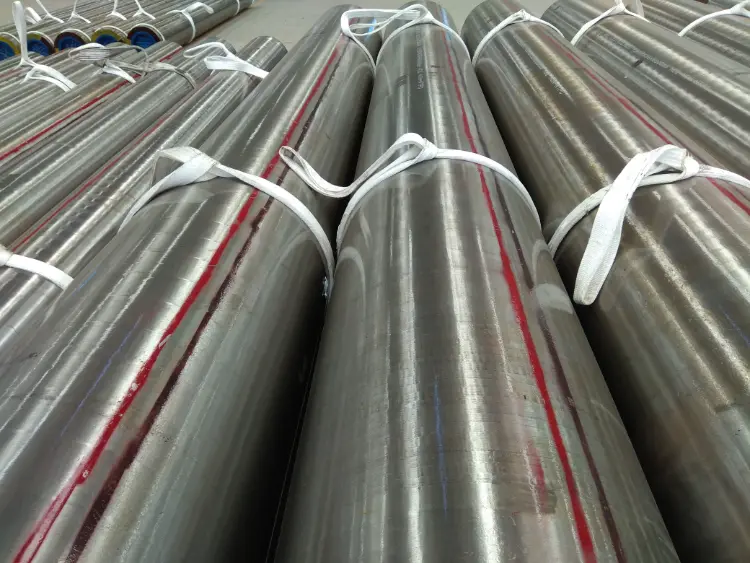
EN10219 S275MLH ERW Pipe
S275MLH ERW Pipe: Thermo-Mechanical Fine-Grain Hollow Section (EN 10219) for Low-Temperature Service
Comprehensive material data for S275MLH electric-resistance-welded hollow section according to EN 10219-1, featuring chemical limits, mechanical properties, physical and thermal characteristics, equivalent grades, and practical application guidance.
Cold forming from thermomechanical rolled strip/plate, followed by electric resistance welding (ERW). Can be subsequently machined, drilled, cut, galvanized, painted, and welded by all common methods.
- Phone : +8618037372205
- Email : [email protected]
- WhatsApp: Contact via Whtsapp
- WeChat: +8618037372205
EN10219 S275MLH ERW Pipe Introduction
S275MLH is a thermomechanical rolled weldable fine-grain structural steel grade defined in EN 10219-1 for cold-formed welded structural hollow sections. The designation indicates minimum yield strength of 275 MPa (S275), thermomechanical rolling delivery condition (M), impact test temperature of -50 °C (L), and hollow section product (H). The steel is supplied in the form of electric-resistance-welded (ERW) circular, square, or rectangular hollow sections. Its fine-grain structure, achieved by controlled thermomechanical processing with microalloying additions (e.g., Nb, V, Ti), provides an excellent combination of strength, ductility, and low-temperature toughness. Typical applications include heavy structural frameworks, bridges, offshore structures, and wind energy towers where reliable performance at subzero temperatures is required. The material offers good weldability and formability, making it suitable for complex fabricated assemblies.
EN10219 S275MLH ERW Pipe Chemical Composition
The chemical limits according to EN 10219-1 for grade S275MLH. These values are the maximum permitted unless stated otherwise. The steel is microalloyed with grain-refining elements (Al, Nb, V, Ti) to achieve the required strength and low-temperature toughness.
| Element | Standard value | Remarks |
|---|---|---|
| C | ||
| Si | ||
| Mn | Higher Mn permitted if CEV is met | |
| P | ||
| S | ||
| Altotal | Soluble aluminium or equivalent grain-refining element | |
| Nb | ||
| V | ||
| Ti | ||
| Cr | ||
| Ni | ||
| Mo | ||
| Cu | ||
| N | ||
| CEV | Carbon equivalent value based on ladle analysis, calculated as C + Mn/6 + (Cr+Mo+V)/5 + (Ni+Cu)/15 |
EN10219 S275MLH ERW Pipe Thermal and Electrical Physical Properties
These physical properties are not part of the mandatory delivery requirements but represent typical reference values for thermomechanical rolled S275MLH steel. They are suitable for design calculations such as thermal expansion, heat conduction, and structural dynamic analysis. Actual values may vary slightly depending on exact composition and processing.
| Property | Typical value | Unit | Test condition / remarks |
|---|---|---|---|
| Density ρ | 7850 | kg/m³ | at 20 °C |
| Modulus of elasticity E | 210 | GPa | at 20 °C, static/dynamic |
| Shear modulus G | 81 | GPa | at 20 °C |
| Poisson's ratio ν | 0.3 | – | at 20 °C |
| Thermal expansion coefficient α | 12.0 | 10-6 /K | between 20 °C and 100 °C |
| Thermal conductivity λ | 53 | W/(m·K) | at 20 °C |
| Specific heat capacity cp | 460 | J/(kg·K) | at 20 °C |
| Electrical resistivity ρe | 0.22 | μΩ·m | at 20 °C |
EN10219 S275MLH ERW Pipe Mechanical Properties
The mechanical properties are guaranteed for the finished hollow section. Yield strength and tensile strength values depend on product thickness. Elongation values differ for circular and square/rectangular sections. Impact energy is tested at -50 °C on longitudinal specimens. Bend test requirements apply to square and rectangular sections.
| Property | Required value | Unit | Test condition |
|---|---|---|---|
| Yield strength ReH | ≥ 275 | MPa | Nominal thickness t ≤ 16 mm |
| Yield strength ReH | ≥ 265 | MPa | 16 mm < t ≤ 40 mm |
| Yield strength ReH | ≥ 255 | MPa | 40 mm < t ≤ 63 mm |
| Yield strength ReH | ≥ 245 | MPa | 63 mm < t ≤ 80 mm |
| Yield strength ReH | ≥ 235 | MPa | 80 mm < t ≤ 100 mm |
| Tensile strength Rm | 370 – 530 | MPa | All thicknesses, longitudinal direction |
| Elongation A (circular hollow sections) | ≥ 24 | % | Lo = 5.65√So, t ≤ 40 mm |
| Elongation A (circular hollow sections) | ≥ 22 | % | Lo = 5.65√So, 40 mm < t ≤ 65 mm |
| Elongation A (square/rectangular) | ≥ 20 | % | Lo = 5.65√So, t ≤ 40 mm |
| Elongation A (square/rectangular) | ≥ 18 | % | Lo = 5.65√So, 40 mm < t ≤ 65 mm |
| Impact energy KV2 | ≥ 27 | J | -50 °C, full-size 10×10 mm test piece, longitudinal |
| Impact energy KV2 | ≥ 19 | J | -50 °C, 10×7.5 mm test piece, longitudinal (t<10 mm, proportional value) |
| Impact energy KV2 | ≥ 14 | J | -50 °C, 10×5 mm test piece, longitudinal (t<10 mm, proportional value) |
| Bend test (square/rectangular) | Crack-free through 180° bending | – | Mandrel diameter = 2t (t ≤ 16 mm), = 3t (t > 16 mm) |
EN10219 S275MLH ERW Pipe Direct Equivalent Standards and Replaceable Designations
| Country/Region | Standard | Designation | Remarks |
|---|---|---|---|
| Europe | EN 10219-1 | S275MLH | Original cold-formed hollow section grade |
| Europe | EN 10210 | S275MLH | Hot-finished hollow section; similar chemical/mechanical requirements, slightly different delivery condition and dimensional tolerances |
| Europe | EN 10025-4 | S275ML | Flat product equivalent (plate/strip) used as feedstock for hollow sections |
| International | ISO 630-3 | E275ML | Hot-rolled structural steel plate, comparable chemistry and strength, but not a hollow section standard |
EN10219 S275MLH ERW Pipe Application Introduction
S275MLH ERW hollow sections are designed for demanding structural applications where good toughness at low ambient temperatures is essential. The fine-grain microstructure and controlled chemical composition permit effective welding even under field conditions. Typical application areas and products include:
Product Applications: Multi-story building frames and trusses, Bridge piers, arches, and cantilevered elements, Offshore platform legs and bracings, Wind turbine lower and upper tower sections, Scaffolding and falsework (when certified), Roll-over protective structures (ROPS), Lighting poles and transmission masts
Processed into products: Circular and rectangular hollow section chords/braces in tubular joints, End-plate connections for beam-column assemblies, Welded node connectors and cast steel nodes, Lattice beams and space-frame members, Split-shell stiffeners and reinforcement rings, Anchor cages and support structures for heavy equipment
Application industries: Construction and civil engineering, Bridge building (road, railway, pedestrian), Offshore and marine engineering, Wind energy (turbine towers, transitional pieces), Transportation (trailers, railway components), Heavy machinery and agricultural equipment
EN10219 S275MLH ERW Pipe Similar or Alternative Material Designations
| Country/Region | Standard | Designation | Remarks |
|---|---|---|---|
| Europe | EN 10219 | S355MLH | Higher strength version (min yield 355 MPa) with same low-temperature toughness; may be substituted if higher load capacity needed |
| Europe | EN 10219 | S275NLH | Normalized rolled variant with comparable strength; impact minimum temperature -50 °C; slightly different weldability and ductility |
| Europe | EN 10219 | S275J2H | Impact at -20 °C instead of -50 °C; suitable for less severe low-temperature exposure |
| USA | ASTM A500 | Grade B | Common structural hollow section; yield strength 315 MPa (46 ksi) – higher than S275; no guaranteed impact at -50 °C; widely available |
| USA | ASTM A572 | Grade 42 | Yield strength 290 MPa (42 ksi); flat products; comparable base chemistry but no KV at -50 °C specified |
Notes:
Welding: S275MLH can be welded using all common arc processes (SMAW, GMAW, SAW, FCAW) with appropriate consumables matching the base metal strength and toughness. Preheating is generally not required for moderate thicknesses, but local guidelines should be followed based on section size and ambient conditions.
Low-temperature service: The designation 'L' guarantees impact energy of 27 J at -50 °C; for applications down to -50 °C, this grade is suitable without additional proving tests.
Corrosion protection: Hollow sections may be supplied uncoated, primed, or hot-dip galvanized according to EN ISO 1461. When galvanizing, care must be taken to avoid liquid metal assisted cracking (LMAC) in cold-formed zones, especially for thick-walled sections.
- Share



