
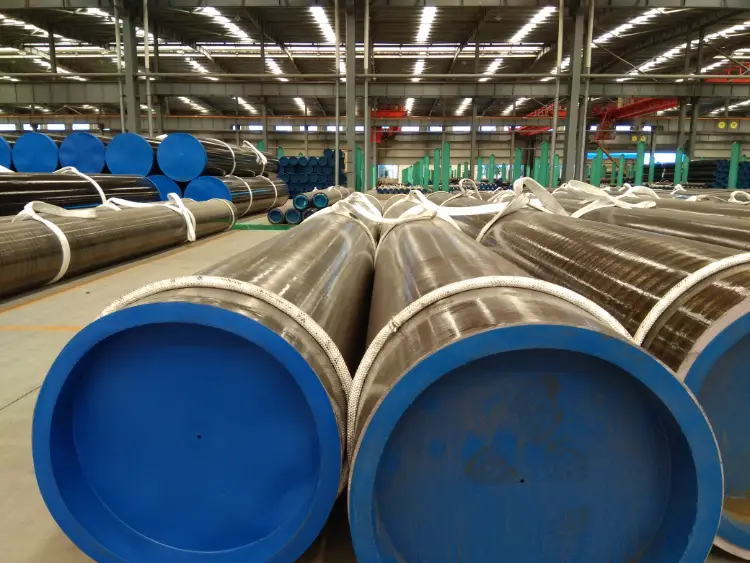
EN10219 S275J0H SSAW Pipe
EN10219 S275J0H SSAW Pipe: Structural Hollow Section Properties & Equivalents
Comprehensive technical data for EN10219 S275J0H spiral submerged arc welded (SSAW) pipe, including chemical composition, mechanical properties, thermal and electrical physical properties, international equivalents and application guidelines.
Cold forming, welding (SAW, ERW), hot-dip galvanizing, machining, drilling, cutting.
- Phone : +8618037372205
- Email : [email protected]
- WhatsApp: Contact via Whtsapp
- WeChat: +8618037372205
EN10219 S275J0H SSAW Pipe Introduction
S275J0H is a non-alloy structural steel grade specified in EN 10219 for cold-formed welded structural hollow sections. It offers a minimum yield strength of 275 MPa and guaranteed impact toughness of 27 J at 0 °C. This grade is widely supplied as spiral submerged arc welded (SSAW) pipe, combining high strength, good weldability, and moderate toughness for structural applications.
- Basic form: circular, square or rectangular hollow sections
- Characteristic: balanced strength and ductility, suitable for cold forming and welding
EN10219 S275J0H SSAW Pipe Chemical Composition
Chemical composition limits for S275J0H according to EN 10219-1. The steel is fully killed and grain refined with sufficient Al or other grain-refining elements.
- Max values unless a range is indicated
- For product thickness ≤ 40 mm
| Element | Standard Value (max, %) | Remarks |
|---|---|---|
| C | 0.20 | Carbon |
| Si | 0.55 | Silicon |
| Mn | 1.50 | Manganese |
| P | 0.035 | Phosphorus |
| S | 0.035 | Sulfur |
| N | 0.009 | Nitrogen |
| Altotal | ≥ 0.020 | Total aluminium (grain refinement); or other grain-refining elements may be used. |
| Cu | 0.40 | Copper (residual) |
| Cr | 0.30 | Chromium (residual) |
| Ni | 0.30 | Nickel (residual) |
| Mo | 0.10 | Molybdenum (residual) |
| Nb | 0.05 | Niobium (residual) |
| V | 0.05 | Vanadium (residual) |
| Ti | 0.03 | Titanium (residual) |
EN10219 S275J0H SSAW Pipe Thermal and Electrical Physical Properties
Physical properties are typical for non-alloy structural carbon steels and are not mandatory requirements of EN 10219. They serve as engineering reference.
- Room temperature values unless otherwise noted.
- Electrical resistivity may vary with composition.
| Property | Typical Value | Unit | Condition |
|---|---|---|---|
| Density (ρ) | 7850 | kg/m³ | 20 °C |
| Modulus of elasticity (E) | 210 | GPa | 20 °C |
| Shear modulus (G) | 81 | GPa | 20 °C |
| Poisson's ratio (ν) | 0.3 | – | 20 °C |
| Thermal expansion coefficient (α) | 12 × 10-6 | K-1 | 20–100 °C |
| Thermal conductivity (λ) | 50 | W/(m·K) | 20 °C |
| Specific heat capacity | 460 | J/(kg·K) | 20 °C |
| Electrical resistivity (ρe) | 0.20 | μΩ·m | 20 °C |
EN10219 S275J0H SSAW Pipe Mechanical Properties
Minimum mechanical properties for S275J0H in accordance with EN 10219-1, applicable to hollow sections.
- Yield strength and tensile strength values vary with thickness.
- Impact test: Charpy V-notch longitudinal, 0 °C, min. average 27 J.
| Property | Required Value | Unit | Test Condition |
|---|---|---|---|
| Yield strength (ReH) | 275 | MPa | Thickness ≤ 16 mm |
| Yield strength (ReH) | 265 | MPa | Thickness > 16 mm and ≤ 40 mm |
| Tensile strength (Rm) | 430 - 580 | MPa | Thickness ≤ 40 mm |
| Elongation (A) | 23 | % | Thickness ≤ 3 mm, gauge length L0 = 5.65√S0 |
| Elongation (A) | 22 | % | Thickness > 3 mm and ≤ 40 mm |
| Impact energy (KV) | 27 | J | Charpy V-notch, longitudinal, 0 °C (J0) |
| Bend test | No cracks | – | Bend angle 180°; former diameter = 3t (t = wall thickness) for t ≤ 16 mm; larger for thicker sections |
EN10219 S275J0H SSAW Pipe Identical/Equivalent Material Standards & Substitute Grades
| Country/Region | Standard | Grade | Remarks |
|---|---|---|---|
| International | ISO 10799-2 | S275J0H | Cold-formed welded structural hollow sections – identical designation |
| European Union | EN 10219-1 | S275J0H | Original standard – identical |
EN10219 S275J0H SSAW Pipe Application Introduction
S275J0H SSAW pipes are primarily used in structural engineering where good weldability, moderate toughness, and reliable strength are required. The spiral weld process enables large diameters, making them ideal for large-scale infrastructure.
Product Applications: Structural columns and beams, Large-diameter pilings, Joints and trusses for bridges, Offshore platform legs and braces, Towers for wind turbines and telecommunications, Conveyor galleries and industrial stands
Processed into products: Spiral welded pipe sections cut to length for columns and bracing members, Welded fabricated nodes and transition pieces, Pipe piles with driving shoes, Circular hollow section chords for trusses, Crane boom and mast segments, Piping for structural handrails and barriers (non-pressure)
Application industries: Construction and civil engineering, Offshore and marine structures, Bridge building, Wind energy towers, Transmission line poles, Piling and foundation engineering, Mechanical and plant construction
EN10219 S275J0H SSAW Pipe Similar/Alternative Material Recommendations
| Country/Region | Standard | Grade | Remarks |
|---|---|---|---|
| European Union | EN 10219-1 | S275J2H | Better toughness (27 J at -20 °C); otherwise comparable strength. |
| European Union | EN 10219-1 | S355J0H | Higher strength (YS 355 MPa); similar impact requirement; suitable for weight reduction. |
| European Union | EN 10210-1 | S275J0H | Hot-finished hollow sections; properties may differ slightly but same grade. |
| USA | ASTM A500 | Grade B (YS 315 MPa) or C (YS 345 MPa) | Not exact match; higher strength grades; verify impact and dimensions. |
| China | GB/T 6725 | Q275 (cold-formed) | Similar nominal yield; check toughness and full compliance with project specification. |
Notes:
- CEV (Carbon Equivalent Value) is typically limited to 0.40–0.45% to ensure good field weldability.
- SSAW pipes are often produced in diameters from 219 mm up to 3000 mm and wall thicknesses up to 25 mm, depending on mill capability.
- When hot-dip galvanizing is specified, a Si content below 0.04% or controlled (0.15–0.25%) can avoid excessive zinc thickness.
- For projects requiring improved through-thickness properties (e.g., offshore), EN 10225 or additional Z-quality testing should be considered.
- Share



