
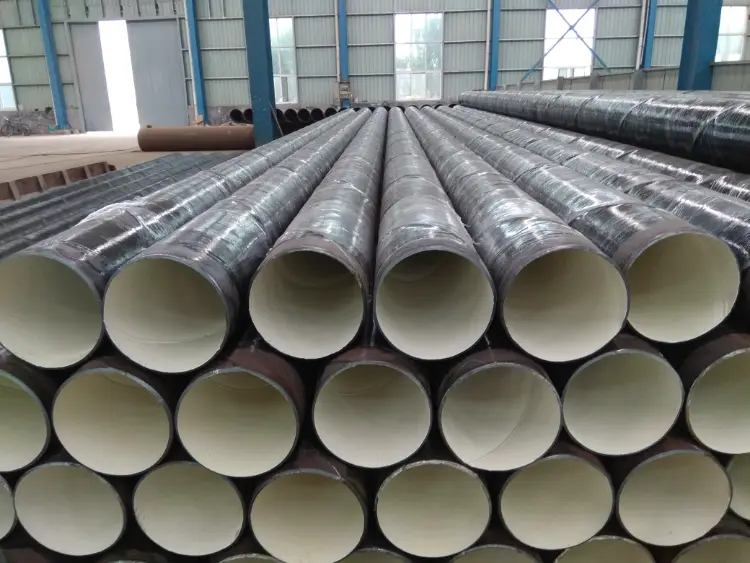
EN 10219 S275J2H SSAW Pipe
EN 10219 S275J2H SSAW Pipe: Chemical, Mechanical & Thermal Properties
Complete material data for S275J2H spiral submerged arc welded (SSAW) pipe according to EN 10219, covering chemical composition, mechanical and physical properties, international equivalent grades, and application guidance.
Cold forming followed by SAW welding; suitable for cutting, bending, welding, machining, and galvanizing
- Phone : +8618037372205
- Email : [email protected]
- WhatsApp: Contact via Whtsapp
- WeChat: +8618037372205
EN 10219 S275J2H SSAW Pipe Introduction
S275J2H is a non-alloy structural steel grade specified in EN 10219-1 for cold-formed welded structural hollow sections. The designation 'S275' indicates a minimum yield strength of 275 MPa for thicknesses up to 16 mm, while 'J2' denotes guaranteed impact energy of 27 J at -20°C. The pipe is manufactured by spiral submerged arc welding (SSAW), providing excellent dimensional accuracy and weld integrity. Key characteristics:
- Good weldability with maximum carbon equivalent CEV ≤0.40
- High strength-to-weight ratio for structural applications
- Reliable toughness at sub-zero temperatures
- Available in a wide range of sizes and wall thicknesses
This grade is widely used in construction, offshore, and mechanical engineering.
EN 10219 S275J2H SSAW Pipe Chemical Composition
The chemical composition of S275J2H complies with EN 10219-1 Table 2 for non-alloy steels. The limits are designed to provide good weldability and toughness. Carbon equivalent (CEV) is controlled to a maximum of 0.40 to ensure cold-cracking resistance. Key points:
- Low carbon content improves weldability
- Manganese contributes to strength and toughness
- Strict phosphorus and sulfur limits enhance cleanliness
- Copper content may be specified for improved atmospheric corrosion resistance
Values are maximum unless a range is indicated.
| Chemical Element | Standard Value (max. %) | Remarks |
|---|---|---|
| Carbon (C) | 0.20 | Heat analysis; product analysis may have slight deviation |
| Manganese (Mn) | 1.50 | Higher Mn may be used if CEV limits allow |
| Phosphorus (P) | 0.030 | Low P ensures toughness |
| Sulfur (S) | 0.025 | Low S improves formability and weldability |
| Nitrogen (N) | 0.012 | For ≤ 0.020% total N, Al/Ti addition may be required |
| Copper (Cu) | 0.55 | Optional; if specified for atmospheric corrosion resistance |
| Carbon Equivalent (CEV) | 0.40 | CEV = C + Mn/6 + (Cr+Mo+V)/5 + (Ni+Cu)/15, % |
EN 10219 S275J2H SSAW Pipe Thermal and Electrical Physical Properties
The following physical properties are typical for carbon steel of this type and are not mandatory requirements of EN 10219. They are useful for design calculations involving heat transfer, thermal expansion, and electrical resistance. Remarks:
- Values are representative at room temperature unless noted
- Thermal conductivity and specific heat capacity depend on temperature
- Electrical resistivity may vary with alloying elements
| Property | Typical Value | Unit | Condition |
|---|---|---|---|
| Density (ρ) | 7.85 | g/cm³ | At 20°C |
| Young's Modulus (E) | 210 | GPa | At 20°C |
| Shear Modulus (G) | 81 | GPa | Calculated from E and ν |
| Poisson's Ratio (ν) | 0.3 | - | Elastic range |
| Thermal Expansion Coefficient (α) | 12.0 × 10⁻⁶ | 1/K | Between 20°C and 100°C |
| Thermal Conductivity (λ) | 50 | W/(m·K) | At 20°C |
| Specific Heat Capacity (cp) | 460 | J/(kg·K) | At 20°C |
| Electrical Resistivity (ρe) | 0.18 | μΩ·m | Typical for low-carbon steel at 20°C |
EN 10219 S275J2H SSAW Pipe Mechanical Properties
The mechanical properties are determined on transverse test specimens (or longitudinal for sections with large dimensions) according to EN 10219-1. Yield strength decreases with increasing wall thickness. The -20°C Charpy impact requirement ensures ductile behavior at low temperatures. Important:
- Values are minimum unless a range is stated
- Elongation is measured on a gauge length L0 = 5.65√S0
- Bend test mandrel diameter depends on wall thickness
- Impact test specimens are taken from the weld area and base metal
| Property | Value | Unit | Test Condition |
|---|---|---|---|
| Yield Strength (ReH) | 275 | MPa | Wall thickness t ≤ 16 mm |
| Yield Strength (ReH) | 265 | MPa | 16 mm < t ≤ 40 mm |
| Yield Strength (ReH) | 255 | MPa | 40 mm < t ≤ 63 mm |
| Yield Strength (ReH) | 245 | MPa | 63 mm < t ≤ 80 mm |
| Yield Strength (ReH) | 235 | MPa | 80 mm < t ≤ 100 mm |
| Tensile Strength (Rm) | 410 – 560 | MPa | All thicknesses ≤ 100 mm |
| Elongation (A) | ≥ 20 | % | Longitudinal, t ≤ 40 mm; L0 = 5.65√S0 |
| Elongation (A) | ≥ 19 | % | Longitudinal, 40 mm < t ≤ 65 mm |
| Charpy Impact Energy (KV2) | ≥ 27 | J | At -20°C; average of 3 tests; min. individual 70% of avg. |
| Bend Test (Mandrel Diameter) | 3t | - | t ≤ 16 mm; 180° bend, no cracks |
| Bend Test (Mandrel Diameter) | 4t | - | 16 mm < t ≤ 25 mm |
| Bend Test (Mandrel Diameter) | 5t | - | 25 mm < t ≤ 40 mm |
| Bend Test (Mandrel Diameter) | 6t | - | 40 mm < t ≤ 63 mm |
| Bend Test (Mandrel Diameter) | 7t | - | 63 mm < t ≤ 80 mm |
| Bend Test (Mandrel Diameter) | 8t | - | 80 mm < t ≤ 100 mm |
EN 10219 S275J2H SSAW Pipe Fully Equivalent Material Standards and Recommended Substitute Grades
| Country/Region | Standard | Grade | Remarks |
|---|---|---|---|
| European Union | EN 10210-1 | S275J2H | Hot-finished structural hollow section; identical chemical and mechanical requirements |
| International | ISO 10799-2 | S275J2H | Cold-formed welded structural hollow sections; technically equivalent to EN 10219-1 |
EN 10219 S275J2H SSAW Pipe Application Introduction
S275J2H SSAW pipe combines good weldability, moderate strength, and reliable low-temperature toughness, making it a versatile choice for structural applications. It is commonly used in civil engineering, heavy machinery, and offshore structures. The SSAW production method allows economical manufacture of large-diameter pipes with thick walls, ideal for columns, piles, and tubular trusses.
Typical sectors and uses include:
Product Applications: Structural columns and beams for multi-storey buildings, Bridge piers and arch ribs, Offshore jacket structures and monopiles, Large-span roof trusses and space frames, Wind turbine tower sections, Oil and gas terminal piping supports, Conveyor gantry beams
Processed into products: Tubular base plates and end connections, Welded nodes and flanges for truss connections, Pile cut-offs and reinforcement rings, Boom sections for crawler cranes, Machine frames and bases for heavy presses, Bollards and fender systems in marine environments, Support legs for temporary works
Application industries: Building and construction (high-rise structures, stadiums, bridges), Offshore and marine (platform legs, jackets, piling), Mechanical engineering (crane booms, conveyor frames, heavy equipment chassis), Renewable energy (wind turbine towers, solar support structures), Transportation infrastructure (railway bridges, gantries)
EN 10219 S275J2H SSAW Pipe Similar or Alternative Material Recommendations
| Country/Region | Standard | Grade | Remarks |
|---|---|---|---|
| European Union | EN 10219-1 | S275J0H | Similar strength, but impact requirement at 0°C (27 J) – use where low-temperature toughness is less critical |
| European Union | EN 10219-1 | S235J2H | Lower yield strength (235 MPa) but same toughness level; suitable for less stressed components |
| European Union | EN 10219-1 | S355J2H | Higher strength (355 MPa) with same toughness; may be substituted for weight reduction or higher loads |
| USA | ASTM A500/A500M | Grade B | Yield strength 315 MPa, no specific low-temperature impact requirement; slightly different chemical limits |
| China | GB/T 6728 | Q275D | Cold-formed hollow sections; yield strength similar, -20°C impact requirement; exact equivalence must be verified |
Notes:
Additional Information:
- S275J2H pipes are available with standard mill finishes and can be supplied with optional surface treatments such as shot blasting, priming, or hot-dip galvanizing.
- Welding consumables should be compatible with the base metal (e.g., ER70S-6 for GMAW) and preheat may not be required for thicknesses below 50 mm under normal conditions.
- When ordering, specify the type of hollow section (circular, square, rectangular), dimensions, wall thickness, length, and any supplementary requirements (e.g., NDT, impact test location).
- For seismic or fatigue-sensitive designs, additional notch toughness or through-thickness properties may be required.
- Share



