
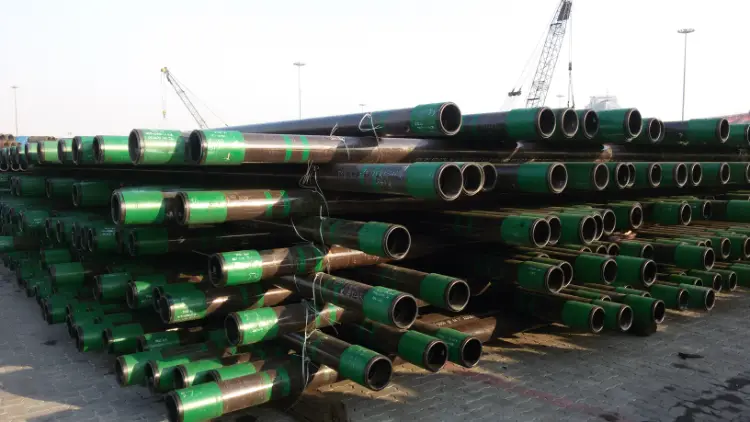
EN10216-2 X10CrMoVNb9-1 Steel Pipe Material
EN10216-2 X10CrMoVNb9-1 Steel Pipe: High-Temperature Creep-Resistant Alloy Data & Equivalents
Complete material property analysis of X10CrMoVNb9-1 seamless steel tube per EN10216-2. Includes chemical composition, room and elevated temperature mechanical properties, physical constants, and full international equivalents like ASTM A335 P91.
Hot‑finished seamless, cold‑finished seamless; subsequent heat treatment: normalizing at 1 040–1 080 °C + tempering at 750–780 °C
- Phone : +8618037372205
- Email : [email protected]
- WhatsApp: Contact via Whtsapp
- WeChat: +8618037372205
EN10216-2 X10CrMoVNb9-1 Steel Pipe Introduction
EN10216-2 X10CrMoVNb9-1 is a martensitic 9%Cr-1%Mo creep‑resistant alloy steel, micro‑alloyed with vanadium, niobium, and controlled nitrogen. It delivers
- High creep rupture strength up to 600–620 °C
- Excellent oxidation and steam corrosion resistance
- Good weldability with matching filler metals
- Long‑term microstructural stability due to fine MX carbonitride precipitates
The grade is widely used for thick‑wall boiler components in ultra‑supercritical power plants, replacing traditional P22 and P91 in modern designs.
EN10216-2 X10CrMoVNb9-1 Steel Pipe Chemical Composition per EN 10216-2
The ladle analysis limits for X10CrMoVNb9‑1 seamless tubes. All values are in weight percent. Controlled additions of V, Nb, and N create stable carbonitrides that strongly enhance high‑temperature strength and creep resistance. Residual elements are tightly restricted to maintain ductility.
| Chemical Element | Standard Value (ladle analysis) | Remarks |
|---|---|---|
| C (Carbon) | 0.08 – 0.12 | |
| Si (Silicon) | 0.20 – 0.50 | |
| Mn (Manganese) | 0.30 – 0.60 | |
| P (Phosphorus) | ≤ 0.020 | |
| S (Sulfur) | ≤ 0.005 | |
| Cr (Chromium) | 8.00 – 9.50 | |
| Mo (Molybdenum) | 0.85 – 1.05 | |
| Ni (Nickel) | ≤ 0.40 | |
| Altot (Total Aluminium) | ≤ 0.040 | |
| V (Vanadium) | 0.18 – 0.25 | |
| Nb (Niobium) | 0.06 – 0.10 | |
| N (Nitrogen) | 0.030 – 0.070 | |
| Cu (Copper) | ≤ 0.30 | |
| As* (Arsenic) | ≤ 0.010 | Optional, for critical applications |
| Sn* (Tin) | ≤ 0.010 | Optional, for critical applications |
| Sb* (Antimony) | ≤ 0.005 | Optional, for critical applications |
| Ti* (Titanium) | ≤ 0.01 | Optional; normally not added |
| Zr* (Zirconium) | ≤ 0.01 | Optional; normally not added |
EN10216-2 X10CrMoVNb9-1 Steel Pipe Thermal & Electrical Physical Properties
Physical constants measured on quenched‑and‑tempered material. These values are representative for design calculations and may vary slightly with actual heat treatment and product form. All thermal properties are quoted for the temperature range or at the temperature indicated.
| Property | Standard Reference Value | Unit | Test Condition / Temperature |
|---|---|---|---|
| Density ρ | 7.77 | g/cm³ | at 20 °C |
| Modulus of Elasticity E | 218 | GPa | at 20 °C |
| Modulus of Elasticity E | 200 | GPa | at 200 °C |
| Modulus of Elasticity E | 180 | GPa | at 400 °C |
| Modulus of Elasticity E | 155 | GPa | at 600 °C |
| Shear Modulus G | 84 | GPa | at 20 °C (from E and ν) |
| Poisson's Ratio ν | 0.30 | – | room temperature |
| Thermal Expansion Coefficient α | 10.9 | ×10⁻⁶ /K | 20 – 100 °C |
| Thermal Expansion Coefficient α | 11.7 | ×10⁻⁶ /K | 20 – 200 °C |
| Thermal Expansion Coefficient α | 12.3 | ×10⁻⁶ /K | 20 – 300 °C |
| Thermal Expansion Coefficient α | 12.8 | ×10⁻⁶ /K | 20 – 400 °C |
| Thermal Expansion Coefficient α | 13.1 | ×10⁻⁶ /K | 20 – 500 °C |
| Thermal Expansion Coefficient α | 13.4 | ×10⁻⁶ /K | 20 – 600 °C |
| Thermal Conductivity λ | 26 | W/(m·K) | at 20 °C |
| Thermal Conductivity λ | 28 | W/(m·K) | at 200 °C |
| Thermal Conductivity λ | 29 | W/(m·K) | at 400 °C |
| Thermal Conductivity λ | 30 | W/(m·K) | at 600 °C |
| Specific Heat Capacity cp | 440 | J/(kg·K) | at 20 °C |
| Specific Heat Capacity cp | 500 | J/(kg·K) | at 200 °C |
| Specific Heat Capacity cp | 580 | J/(kg·K) | at 400 °C |
| Specific Heat Capacity cp | 650 | J/(kg·K) | at 600 °C |
| Electrical Resistivity ρe | 0.60 | µΩ·m | at 20 °C |
EN10216-2 X10CrMoVNb9-1 Steel Pipe Mechanical Properties
Room‑temperature tensile and impact requirements for the +NT condition. Bending test parameters are given for wall thickness ≤ 30 mm. Values refer to the body of the tube (transverse properties apply where noted). High‑temperature proof strength Rp0.2 is added as a design‑relevant typical value, based on long‑term material data for P91.
| Property | Standard Requirement / Typical Value | Unit | Testing Condition |
|---|---|---|---|
| Tensile Strength Rm | 620 – 850 | MPa | Room temperature, longitudinal specimen |
| Upper Yield Strength ReH | ≥ 450 | MPa | Room temperature, longitudinal specimen |
| Elongation A (min.) | ≥ 19 | % | Longitudinal; gauge length L0 = 5.65√S0 |
| Elongation A (min.) | ≥ 17 | % | Transverse; gauge length L0 = 5.65√S0 |
| Impact Energy KV2 | ≥ 40 | J | +20 °C, V‑notch Charpy, longitudinal specimen |
| Hardness HBW | ≤ 250 | HBW | Typical after tempering; for information only |
| Bend Radius (mandrel dia.) | 3 × wall thickness (t) | – | Bend angle 180°, wall thickness ≤ 30 mm |
| Proof Strength Rp0.2 at 550 °C | ≈ 320 | MPa | Typical elevated‑temperature value, for design reference, not a code requirement |
EN10216-2 X10CrMoVNb9-1 Steel Pipe International Standard Equivalents – Fully Matching Grades
| Country / Region | Standard / Specification | Designation / Grade | Remarks |
|---|---|---|---|
| Europe | EN 10216‑2 | X10CrMoVNb9‑1 (1.4903) | Seamless tubes for pressure purposes – the base grade |
| United States | ASTM A335 / A335M | Grade P91 | Seamless ferritic alloy‑steel pipe for high‑temperature service |
| United States | ASTM A213 / A213M | Grade T91 | Seamless ferritic and austenitic alloy‑steel boiler, superheater and heat‑exchanger tubes |
| United States | ASTM A182 / SA‑182 | F91 | Forged or rolled alloy‑steel flanges, fittings and valves |
| Japan | JIS G3458 | STPA 28 | Alloy steel pipes for high temperature service |
| Japan | JIS G3462 | STBA 28 | Alloy steel tubes for boiler and heat exchanger |
| China | GB/T 5310 | 10Cr9Mo1VNbN (10Cr9Mo1VNb) | Seamless steel tubes and pipes for high pressure boiler |
| International | ISO 9329‑2 | X10CrMoVNb9‑1 | Seamless steel tubes for pressure purposes – technical delivery conditions |
EN10216-2 X10CrMoVNb9-1 Steel Pipe Application Introduction
X10CrMoVNb9‑1 (P91) is the backbone material for modern high‑efficiency fossil‑fuel power plants and high‑temperature refining units. Its creep strength allows thinner walls and reduced thermal stresses compared to conventional 2¼Cr‑1Mo steels. Typical applications:
Product Applications: Main steam pipe systems, Hot reheat pipes, Superheater and reheater banks (tube bundles), High‑pressure boiler tubes for evaporator panels, Process plant steam headers and manifolds
Processed into products: Seamless pipe spools and bends (induction‑bent elbows), Tee pieces, reducers and caps, Forged flanges (weld‑neck, blind, spectacle), Valve bodies and bonnets for steam service, Welded headers with forged branches, Tube‑to‑pipesheet joints in heat exchangers
Application industries: Fossil fuel power generation (ultra‑supercritical and supercritical boilers), Combined‑cycle heat recovery steam generators (HRSG), Petrochemical and refinery heater tubes, Nuclear power plants (secondary circuits, steam lines), District heating networks with high‑temperature water/steam
EN10216-2 X10CrMoVNb9-1 Steel Pipe Alternative / Similar Creep‑Resistant Alloy Recommendations
| Country / Region | Standard / Specification | Designation / Grade | Comparison Remarks |
|---|---|---|---|
| Europe | EN 10216‑2 | X10CrWMoVNb9‑2 (P92) | Contains tungsten (~1.7% W) and lower Mo. Offers higher creep strength up to 620 °C, suitable for higher design temperatures. |
| Europe | EN 10216‑2 | X11CrMoWVNb9‑1‑1 (P911) | 9%Cr alloy with W and high V/Nb; intermediate creep strength between P91 and P92; good weldability. |
| USA | ASTM A335 | P92 / T92 | Equivalent to EN X10CrWMoVNb9‑2; widely adopted for ultra‑supercritical boiler applications. |
| International | ISO 9329‑2 | X10CrWMoVNb9‑2 | ISO counterpart of P92; similar enhanced creep behaviour. |
| Japan | JIS G3458 | STPA 29 | Approximately equivalent to P92; provides higher allowable stress at very high temperatures. |
Notes:
Heat treatment: Normalizing at 1 040–1 080 °C followed by air cooling or accelerated cooling, then tempering at 750–780 °C. Welding: Preheating to 200–250 °C is mandatory; use matching ER90S‑B9 filler and E9015‑B9 electrodes. Post‑weld heat treatment (PWHT) at 740–760 °C for at least 2 hours is required to restore toughness and reduce residual stresses. Any forming or cold working beyond 5% deformation shall be followed by re‑tempering. For long‑term service above 550 °C, careful control of Al and As content is recommended to avoid steam‑side oxidation issues.
- Share



