
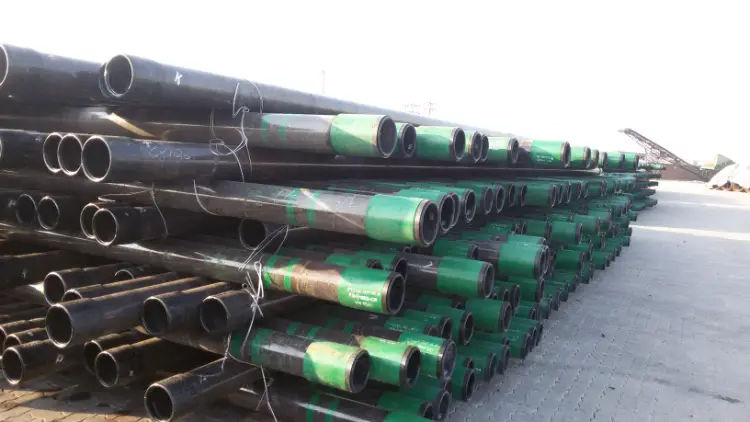
EN 10216-2 15NiCuMoNb5-6-4 Seamless Steel Tube Material
EN10216-2 15NiCuMoNb5-6-4 seamless steel tube – chemical, mechanical and physical properties
Detailed material data for EN10216-2 15NiCuMoNb5-6-4 (1.6368) seamless steel tube, including chemical composition, mechanical properties at room and elevated temperature, physical data, and equivalent grades such as ASTM A213 T36 and A335 P36.
Hot rolling, cold drawing, normalizing and tempering (+N&T), quenching and tempering (+Q&T)
- Phone : +8618037372205
- Email : [email protected]
- WhatsApp: Contact via Whtsapp
- WeChat: +8618037372205
EN 10216-2 15NiCuMoNb5-6-4 Seamless Steel Tube Introduction
EN10216-2 15NiCuMoNb5-6-4 (1.6368) is a low-alloy, nickel-copper-molybdenum-niobium steel designed for seamless tubes in pressure applications. It is widely known under the trade name WB36. The alloy offers an optimal combination of high-temperature strength, creep resistance, and corrosion resistance in water and steam environments. Its balanced composition provides a minimum yield strength of 440 MPa at room temperature and good toughness at low temperatures, making it suitable for components exposed to temperatures up to approximately 450 °C. The material is delivered in the normalized and tempered (+NT) or quenched and tempered (+QT) condition. Typical products include boiler tubes, superheater tubes, headers, and piping for power plants and petrochemical facilities.
EN 10216-2 15NiCuMoNb5-6-4 Seamless Steel Tube Chemical Composition
The ladle analysis according to EN 10216-2:2019 for grade 15NiCuMoNb5-6-4 shows a controlled addition of nickel, copper, molybdenum and niobium to achieve the required high-temperature strength. Full aluminium content must be at least 0.020 %, and the Al/N ratio shall be ≥2 to ensure grain refinement and nitrogen fixation. Residual elements are kept at low levels.
| Chemical Element | Standard Value (%) | Remarks & Notes |
|---|---|---|
| Carbon (C) | ≤0.17 | |
| Silicon (Si) | 0.25 – 0.50 | |
| Manganese (Mn) | 0.80 – 1.20 | |
| Phosphorus (P) | ≤0.025 | |
| Sulfur (S) | ≤0.020 | |
| Chromium (Cr) | ≤0.30 | Residual; not intentionally added |
| Nickel (Ni) | 1.00 – 1.30 | |
| Molybdenum (Mo) | 0.25 – 0.50 | |
| Copper (Cu) | 0.50 – 0.80 | |
| Niobium (Nb) | 0.015 – 0.045 | |
| Nitrogen (N) | ≤0.020 | |
| Aluminium (Altotal) | ≥0.020 | Al/N ≥ 2:1 |
EN 10216-2 15NiCuMoNb5-6-4 Seamless Steel Tube Thermal and Electrical Physical Properties
Physical properties are typical for low-alloyed Ni-Cu-Mo-Nb steel in the normalized and tempered condition. Values are representative for a temperature range from room temperature to about 500 °C. The thermal conductivity is relatively high for an alloy steel, and the specific heat capacity supports the use in heat exchanger applications.
| Property | Typical Value | Unit | Temperature / Condition |
|---|---|---|---|
| Density (ρ) | 7.85 | g/cm³ | 20 °C |
| Young's modulus (E) | 210 | GPa | 20 °C |
| Shear modulus (G) | 81 | GPa | 20 °C |
| Poisson's ratio (ν) | 0.3 | – | 20 °C |
| Coefficient of thermal expansion (α) | 11.1 | 10⁻⁶ / K | 20 – 100 °C |
| Coefficient of thermal expansion (α) | 12.2 | 10⁻⁶ / K | 20 – 200 °C |
| Coefficient of thermal expansion (α) | 12.9 | 10⁻⁶ / K | 20 – 300 °C |
| Coefficient of thermal expansion (α) | 13.4 | 10⁻⁶ / K | 20 – 400 °C |
| Thermal conductivity (λ) | 42 | W/(m·K) | 20 °C |
| Thermal conductivity (λ) | 44 | W/(m·K) | 200 °C |
| Thermal conductivity (λ) | 42 | W/(m·K) | 300 °C |
| Thermal conductivity (λ) | 39 | W/(m·K) | 400 °C |
| Specific heat capacity (cp) | 460 | J/(kg·K) | 20 °C |
| Electrical resistivity (ρe) | 0.25 | 10⁻⁶ Ω·m | 20 °C |
EN 10216-2 15NiCuMoNb5-6-4 Seamless Steel Tube Mechanical Properties
Room-temperature tensile properties are specified in EN 10216-2 for the +NT or +QT delivery condition. Yield strength and tensile strength depend on wall thickness. The material exhibits excellent toughness, with a required minimum impact energy of 27 J at 0 °C on longitudinal specimens (transverse testing may also be agreed upon). Elongation values are minimum requirements for gauge length 5.65√So.
| Property | Standard Required Value | Unit | Test Condition & Remarks |
|---|---|---|---|
| Upper yield strength (ReH) | ≥440 | MPa | Wall thickness t ≤ 16 mm, room temperature |
| Upper yield strength (ReH) | ≥430 | MPa | Wall thickness 16 < t ≤ 40 mm, room temperature |
| Upper yield strength (ReH) | ≥420 | MPa | Wall thickness 40 < t ≤ 60 mm, room temperature |
| Tensile strength (Rm) | 610 – 780 | MPa | Wall thickness t ≤ 60 mm, room temperature |
| Elongation after fracture (A) | ≥20 (longitudinal) | % | Room temperature, proportional test piece |
| Elongation after fracture (A) | ≥18 (transverse) | % | Room temperature, proportional test piece |
| Impact energy (KV2) | ≥27 (longitudinal) | J | At 0 °C, Charpy V-notch test piece |
| Impact energy (KV2) | ≥27 (transverse) | J | At 0 °C, Charpy V-notch test piece; optional requirement |
EN 10216-2 15NiCuMoNb5-6-4 Seamless Steel Tube Fully Equivalent Material Standards and Replaceable Grades
| Country/Region | Standard | Grade | Remarks |
|---|---|---|---|
| Europe | EN 10216-2 | 15NiCuMoNb5-6-4 (1.6368) | Original European standard for seamless tubes |
| Germany | VdTÜV 377/2 | 15NiCuMoNb5 (WB36) | German material specification, identical chemistry and properties |
| USA | ASTM A213/A213M | T36 | Seamless ferritic alloy-steel tube; identical to 1.6368 |
| USA | ASTM A335/A335M | P36 | Seamless ferritic alloy-steel pipe; identical to 1.6368 |
| USA | ASME SA-213/SA-335 | T36 / P36 | ASME Boiler & Pressure Vessel Code acceptance |
| China | GB/T 5310 | 15NiCuMoNb5 | Chinese standard for seamless steel tubes for high-pressure boiler |
EN 10216-2 15NiCuMoNb5-6-4 Seamless Steel Tube Application Introduction
15NiCuMoNb5-6-4 is specifically designed for demanding pressure-part applications in steam and water circuits. Its excellent strength-to-weight ratio, good weldability, and resistance to flow-accelerated corrosion make it a preferred choice for modern high-efficiency power plants.
Product Applications: Seamless boiler tubes and superheater tubes, Steam piping and main steam lines, Feedwater heater U-tubes, High-pressure headers and manifolds, Heat exchanger tubes for high temperature
Processed into products: Boiler furnace wall tubes, Superheater and reheater tube bundles, Economizer tubes, Crossover and connecting piping, Desuperheater lines, Welded fabrications such as collecting headers
Application industries: Fossil-fuel power plants (coal, gas, oil), Nuclear power plants (secondary circuit piping, feedwater heaters), Petrochemical and chemical processing (high-temperature heat exchangers), District heating networks, Industrial boiler manufacturing
EN 10216-2 15NiCuMoNb5-6-4 Seamless Steel Tube Close and Similar Alternative Materials
| Country/Region | Standard | Grade | Remarks |
|---|---|---|---|
| Europe | EN 10216-2 | 16Mo3 | Lower strength Mo-alloy steel; maximum service temperature ~530 °C but lower yield strength (~275 MPa). Suitable for less demanding pressure parts. |
| Europe | EN 10216-2 | 13CrMo4-5 | Cr-Mo alloy steel with good creep resistance; yield strength ~300 MPa. Used for boiler and pressure vessel components at similar temperatures. |
| Europe | EN 10216-2 | 10CrMo9-10 | Higher Cr (2.25%)-Mo steel for elevated temperature service; yield strength ~280 MPa. Typically used when better oxidation resistance is needed. |
| Europe | EN 10216-2 | 20MnNb6 | Micro-alloyed C-Mn steel with Nb; yield strength ~355 MPa. Suitable for moderate temperature applications but reduced corrosion resistance compared to 15NiCuMoNb5-6-4. |
| USA | ASTM A213 | T22 | 2.25Cr-1Mo steel comparable to 10CrMo9-10; lower strength than T36, used for superheaters and heat exchangers. |
Notes:
Welding of 15NiCuMoNb5-6-4 requires careful control of preheat (typically 150–200 °C) and post-weld heat treatment (PWHT) at 580–620 °C to avoid cold cracking and to maintain toughness. The material exhibits resistance to flow-accelerated corrosion (FAC) under proper water chemistry, reducing wall thinning in steam lines. For elevated temperature design, the 0.2% proof strength values at temperature should be taken from EN 10216-2 Annex A. The maximum recommended continuous service temperature is approximately 450 °C for strength-governed components.
- Share



