
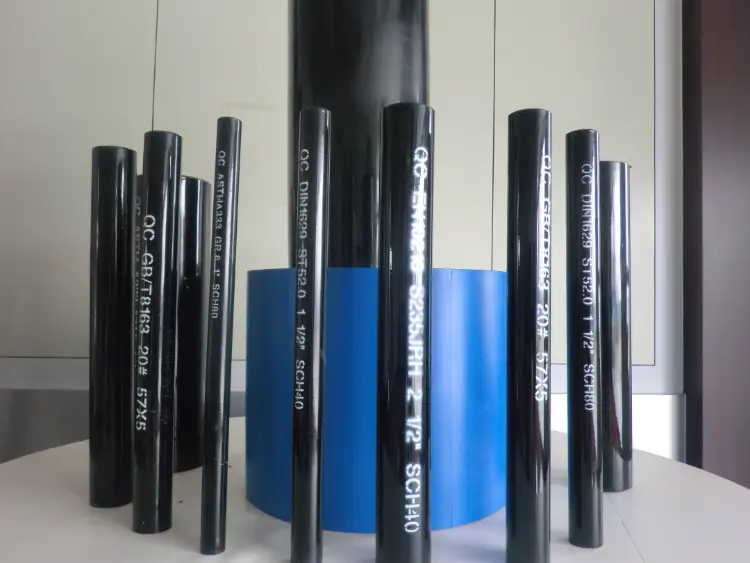
DIN 1629 ST44.0 Seamless Carbon Steel Tube Material
DIN 1629 ST44.0 Seamless Carbon Steel Tube - Properties, Equivalents & Applications
In-depth material data for DIN 1629 ST44.0 non-alloy steel seamless circular tubes: chemical composition, mechanical properties, physical properties, international equivalents, and application guidance.
Hot rolling, cold drawing
- Phone : +8618037372205
- Email : [email protected]
- WhatsApp: Contact via Whtsapp
- WeChat: +8618037372205
DIN 1629 ST44.0 Seamless Carbon Steel Tube Introduction
DIN 1629 ST44.0 is a non-alloy quality steel grade intended for the manufacture of seamless circular tubes with special quality requirements. It is characterised by a minimum yield strength of 235 MPa (wall thickness ≤16 mm) and a tensile strength range of 440–540 MPa. The steel offers good weldability, formability, and ductility, making it suitable for medium-duty structural and piping applications. The grade is typically supplied in the hot-rolled or cold-drawn condition, and supplementary testing may be requested to meet elevated quality demands. Although the DIN 1629 standard has been officially withdrawn, ST44.0 remains a widely recognised designation in European mechanical engineering and pipeline construction.
DIN 1629 ST44.0 Seamless Carbon Steel Tube Chemical Composition
The chemical composition of ST44.0, as defined in DIN 1629, guarantees a basic non-alloy steel with controlled phosphorus and sulfur contents for improved quality. No intentional additions of Cr, Ni, Mo, or other alloying elements are made. The manganese content is specified as a minimum; in practice, typical values lie between 0.40% and 1.20% to achieve the required mechanical properties.
| Element | Standard Value (%) | Remarks |
|---|---|---|
| Carbon (C) | ≤ 0.21 | Ladle analysis |
| Silicon (Si) | ≤ 0.35 | Ladle analysis |
| Manganese (Mn) | ≥ 0.40 | Typically 0.40–1.20 |
| Phosphorus (P) | ≤ 0.040 | Ladle analysis |
| Sulfur (S) | ≤ 0.040 | Ladle analysis |
DIN 1629 ST44.0 Seamless Carbon Steel Tube Physical Properties
The following physical properties are representative of carbon steels similar to ST44.0. Slight variations may occur depending on the exact chemical composition and manufacturing route. These values are suitable for engineering calculations in the temperature range indicated.
| Property | Typical Value | Unit | Test Condition |
|---|---|---|---|
| Density (ρ) | 7.85 | g/cm³ | 20 °C |
| Elastic modulus (E) | 210 | GPa | 20 °C |
| Shear modulus (G) | 81 | GPa | 20 °C |
| Poisson's ratio (ν) | 0.30 | – | 20 °C |
| Thermal expansion coefficient (α) | 11.1 | 10⁻⁶/K | 20 – 100 °C |
| Thermal expansion coefficient (α) | 12.1 | 10⁻⁶/K | 20 – 200 °C |
| Thermal expansion coefficient (α) | 12.9 | 10⁻⁶/K | 20 – 300 °C |
| Thermal expansion coefficient (α) | 13.5 | 10⁻⁶/K | 20 – 400 °C |
| Thermal conductivity (λ) | 50 | W/(m·K) | 20 °C (approximate) |
| Thermal conductivity (λ) | 51 | W/(m·K) | 100 °C (approximate) |
| Specific heat capacity (Cp) | 460 | J/(kg·K) | 20 °C |
| Electrical resistivity (ρe) | 0.15 | 10⁻⁶ Ω·m | 20 °C (approximate) |
DIN 1629 ST44.0 Seamless Carbon Steel Tube Mechanical Properties at Room Temperature
Tensile properties are determined on longitudinal or transverse test pieces taken from the finished tubes. The yield strength (ReH) decreases with increasing wall thickness, while the tensile strength remains constant across the thickness range. Minimum elongation values are specified separately for longitudinal and transverse specimens. Charpy impact testing is not mandatory by the standard but may be agreed upon for special quality requirements.
| Property | Required Value | Unit | Test Condition |
|---|---|---|---|
| Yield Strength (ReH) | ≥ 235 | MPa | Wall thickness ≤ 16 mm, room temperature |
| Yield Strength (ReH) | ≥ 225 | MPa | Wall thickness > 16 mm ≤ 40 mm, room temperature |
| Yield Strength (ReH) | ≥ 215 | MPa | Wall thickness > 40 mm ≤ 60 mm, room temperature |
| Tensile Strength (Rm) | 440 – 540 | MPa | All wall thicknesses, room temperature |
| Elongation after fracture (A) | ≥ 25 | % | Longitudinal specimen, gauge length L0 = 5.65√S0 |
| Elongation after fracture (A) | ≥ 23 | % | Transverse specimen, gauge length L0 = 5.65√S0 |
DIN 1629 ST44.0 Seamless Carbon Steel Tube Completely Equivalent Material Standards and Substitutable Grades
| Country / Region | Standard | Grade | Remarks |
|---|---|---|---|
| Germany | DIN 1629 (withdrawn) | ST44.0 | Original designation; no other standard defines identical chemistry and mechanical property ranges. |
DIN 1629 ST44.0 Seamless Carbon Steel Tube Application Introduction
ST44.0 tubes are employed wherever moderate strength, good weldability, and reliable quality are required. Typical areas of use span from general mechanical engineering to fluid transport systems. The "special quality requirements" clause means that supplementary testing (e.g., non-destructive inspection, stricter dimensional tolerances, or impact testing) can be specified to meet the needs of critical applications.
Product Applications: Fluid transport pipelines, Compressed air and steam lines, Structural hollow sections, Pressure vessels (up to specific limits), Heat exchangers and condensers (low duties), Hydraulic and pneumatic cylinders
Processed into products: Pipe fittings and flanges, Valve bodies and connectors, Roll bars and chassis parts, Axles and shafts (hollow), Boiler and heat exchanger tubes, Scaffolding and support structures
Application industries: Mechanical and plant engineering, Oil and gas (downstream and midstream), Chemical and petrochemical processing, Construction and civil engineering, Automotive and transportation, Power generation (non-critical piping)
DIN 1629 ST44.0 Seamless Carbon Steel Tube Similar or Alternative Materials
| Country / Region | Standard | Grade | Remarks |
|---|---|---|---|
| European Union | EN 10216-1 | P265TR1 | Comparable strength level (Rm 410–570 MPa, ReH ≥265 MPa). Slightly higher yield strength. Requires verification of chemical composition. |
| USA | ASTM A106/A106M | Grade B | Rm ≥415 MPa, ReH ≥240 MPa. Similar carbon-manganese steel; widely used for high-temperature service. |
| China | GB/T 8163 | 20 | Rm 410–550 MPa, ReH ≥245 MPa. Seamless steel tube for liquid service; chemical composition slightly different. |
| Japan | JIS G3454 | STPG 410 | Rm ≥410 MPa, ReH ≥245 MPa. Carbon steel pipe for pressure service; comparable in strength. |
| International | ISO 9329-1 | PH 26 | Rm 410–540 MPa, ReH ≥235 MPa. Seamless steel tubes for pressure purposes. Close match to ST44.0. |
Notes:
DIN 1629 has been formally withdrawn and replaced by the European standard EN 10216-1 for pressure purposes and EN 10297-1 for mechanical and general engineering. ST44.0 is not directly reproduced in the new standards; P235TR1 or P265TR1 are the closest modern designations, but their tensile strength ranges differ. When substituting, a thorough review of the required mechanical properties and supplementary testing is recommended. For elevated temperature services, the creep and time-dependent properties of ST44.0 must be independently verified, as they are not covered by the original standard.
- Share



