
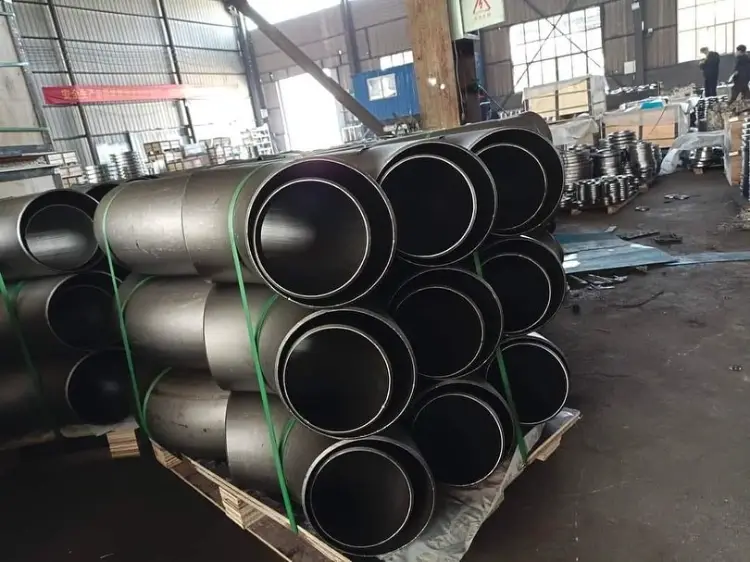
EN 10216-2 X10CrWMoVNb9-2 (1.4901) Steel Pipe Material
EN 10216-2 X10CrWMoVNb9-2 (1.4901) Steel Pipe: High-Temperature Creep-Resistant Ferritic Steel
Detailed material data for X10CrWMoVNb9-2 steel pipe conforming to EN 10216-2, including chemical composition, mechanical properties, physical properties, equivalent grades like ASTM A335 P92, and application guidance for pressure parts in power generation and petrochemical industries.
Hot rolling or cold drawing followed by normalizing and tempering (N+T). Typical normalizing at 1040–1080°C, air cooling, tempering at 730–780°C.
- Phone : +8618037372205
- Email : [email protected]
- WhatsApp: Contact via Whtsapp
- WeChat: +8618037372205
EN 10216-2 X10CrWMoVNb9-2 Steel Pipe Introduction
X10CrWMoVNb9-2 (material number 1.4901) is a 9% chromium ferritic-martensitic creep-resistant steel, designed for seamless tubes and pipes in pressure applications at elevated temperatures. It is micro-alloyed with molybdenum, tungsten, vanadium, niobium, nitrogen and boron to achieve exceptional creep rupture strength up to 620°C. The steel combines high thermal conductivity and low thermal expansion, which reduce thermal stresses and improve operational flexibility.
Main features:
- Excellent creep and oxidation resistance
- High yield strength and toughness at service temperature
- Good weldability with matching filler metals and post-weld heat treatment
- Compliant with EN 10216-2 for pressure equipment (PED 2014/68/EU)
EN 10216-2 X10CrWMoVNb9-2 Steel Pipe Chemical Composition
Chemical composition according to EN 10216-2 Table A.1 for grade X10CrWMoVNb9-2 (1.4901).
The alloy is a controlled composition 9% Cr martensitic steel, balanced with tungsten and molybdenum for creep strength, and micro-alloyed with vanadium, niobium, nitrogen and boron for precipitation hardening and grain boundary strengthening.
- All values are in weight percent (mass %).
- Unless specified otherwise, single values are maximum limits.
| Chemical Element | Standard Value | Remarks |
|---|---|---|
| Carbon (C) | 0.07 – 0.13 | – |
| Silicon (Si) | ≤ 0.50 | – |
| Manganese (Mn) | 0.30 – 0.60 | – |
| Phosphorus (P) | ≤ 0.020 | – |
| Sulfur (S) | ≤ 0.010 | – |
| Chromium (Cr) | 8.50 – 9.50 | – |
| Molybdenum (Mo) | 0.30 – 0.60 | – |
| Nickel (Ni) | ≤ 0.40 | – |
| Vanadium (V) | 0.15 – 0.25 | – |
| Niobium (Nb) | 0.04 – 0.09 | – |
| Tungsten (W) | 1.50 – 2.00 | – |
| Copper (Cu) | ≤ 0.30 | – |
| Nitrogen (N) | 0.030 – 0.070 | – |
| Boron (B) | 0.001 – 0.006 | – |
EN 10216-2 X10CrWMoVNb9-2 Steel Pipe Physical Properties
Typical physical properties for fully tempered X10CrWMoVNb9-2 (grade 92 type).
These values are not mandatory in EN 10216-2 but are representative for the material after proper heat treatment. They are compiled from published material datasheets of major tube manufacturers and can be used for engineering calculations. Slight variations may occur depending on the exact heat treatment and product form.
| Property | Typical Value | Unit | Test Condition |
|---|---|---|---|
| Density (ρ) | 7.7 | g/cm³ | At 20 °C |
| Young's Modulus (E) | 218 | GPa | At 20 °C |
| Shear Modulus (G) | 84 | GPa | At 20 °C (calculated from E and ν) |
| Poisson's Ratio (ν) | 0.30 | – | At 20 °C |
| Coefficient of Thermal Expansion (α) | 10.5 | ×10⁻⁶ /K | 20–100 °C |
| Coefficient of Thermal Expansion (α) | 11.0 | ×10⁻⁶ /K | 20–200 °C |
| Coefficient of Thermal Expansion (α) | 11.5 | ×10⁻⁶ /K | 20–300 °C |
| Coefficient of Thermal Expansion (α) | 12.0 | ×10⁻⁶ /K | 20–400 °C |
| Coefficient of Thermal Expansion (α) | 12.5 | ×10⁻⁶ /K | 20–500 °C |
| Coefficient of Thermal Expansion (α) | 13.0 | ×10⁻⁶ /K | 20–600 °C |
| Thermal Conductivity (λ) | 25.9 | W/(m·K) | At 20 °C |
| Thermal Conductivity (λ) | 26.9 | W/(m·K) | At 100 °C |
| Thermal Conductivity (λ) | 27.9 | W/(m·K) | At 200 °C |
| Thermal Conductivity (λ) | 28.5 | W/(m·K) | At 300 °C |
| Thermal Conductivity (λ) | 28.5 | W/(m·K) | At 400 °C |
| Thermal Conductivity (λ) | 28.5 | W/(m·K) | At 500 °C |
| Thermal Conductivity (λ) | 28.0 | W/(m·K) | At 600 °C |
| Specific Heat Capacity (cₚ) | 460 | J/(kg·K) | At 20 °C |
| Specific Heat Capacity (cₚ) | 540 | J/(kg·K) | At 400 °C |
| Specific Heat Capacity (cₚ) | 580 | J/(kg·K) | At 500 °C |
| Specific Heat Capacity (cₚ) | 630 | J/(kg·K) | At 600 °C |
| Electrical Resistivity (ρₑ) | 0.57 | µΩ·m | At 20 °C |
EN 10216-2 X10CrWMoVNb9-2 Steel Pipe Mechanical Properties
Mechanical properties as specified by EN 10216-2 for tubes in the normalized and tempered condition (+N).
The values are given as minimum requirements (yield strength, elongation) or range (tensile strength). The properties depend on the tube wall thickness. Two thickness ranges are normally applied: wall thickness ≤ 60 mm and 60 < t ≤ 100 mm. For the most common tube dimensions (≤ 60 mm), the following applies:
| Property | Standard Requirement Value | Unit | Test Condition |
|---|---|---|---|
| Yield Strength (ReH) | ≥ 440 | MPa | Room temperature, wall thickness ≤ 60 mm, N+T |
| Tensile Strength (Rm) | 620 – 850 | MPa | Room temperature, wall thickness ≤ 60 mm, N+T |
| Elongation (A) – longitudinal | ≥ 20 | % | L₀ = 5.65√S₀, room temperature, wall thickness ≤ 60 mm |
| Elongation (A) – transverse | ≥ 18 | % | L₀ = 5.65√S₀, room temperature, wall thickness ≤ 60 mm |
| Yield Strength (ReH) | ≥ 420 | MPa | Room temperature, wall thickness 60 < t ≤ 100 mm, N+T |
| Tensile Strength (Rm) | 610 – 850 | MPa | Room temperature, wall thickness 60 < t ≤ 100 mm, N+T |
| Elongation (A) – longitudinal | ≥ 19 | % | L₀ = 5.65√S₀, room temperature, wall thickness 60 < t ≤ 100 mm |
| Elongation (A) – transverse | ≥ 17 | % | L₀ = 5.65√S₀, room temperature, wall thickness 60 < t ≤ 100 mm |
EN 10216-2 X10CrWMoVNb9-2 Steel Pipe Exact Equivalent Material Standards & Replaceable Grades
| Country / Region | Standard | Grade | Remarks |
|---|---|---|---|
| Europe | EN 10216-2 | X10CrWMoVNb9-2 (1.4901) | Original standard grade for seamless tubes |
| USA | ASTM A335 / ASME SA-335 | P92 | Seamless ferritic alloy-steel pipe for high-temperature service |
| USA | ASTM A213 / ASME SA-213 | T92 | Seamless ferritic and austenitic alloy-steel boiler, superheater, and heat-exchanger tubes |
EN 10216-2 X10CrWMoVNb9-2 Steel Pipe Application Introduction
X10CrWMoVNb9-2 (P92) is the material of choice for high-efficiency power plants operating at steam temperatures up to 620 °C. Its excellent creep resistance allows thinner wall sections compared to traditional Cr‑Mo steels, reducing weight and thermal inertia. The steel is typically used in the following areas:
Product Applications: Seamless boiler tubes and pipes, Steam headers and manifolds, Superheater and reheater tubing, Main steam lines and hot reheat piping, Forged fittings (elbows, tees, reducers) and flanges
Processed into products: Boiler membrane wall tubes, Heat exchanger tube bundles, Header stubs and penetrations, Valve bodies for high-temperature steam control, Pipe bends and segmental elbows, Steam receivers and separators
Application industries: Fossil fuel power generation (ultra-supercritical & supercritical boilers), Combined cycle plants, Petrochemical refineries (cracking furnaces, reformers), Chemical processing (high-temperature reactors), Industrial heat recovery systems
EN 10216-2 X10CrWMoVNb9-2 Steel Pipe Similar / Alternative Creep-Resistant Martensitic Steels
| Country / Region | Standard | Grade | Remarks |
|---|---|---|---|
| Europe | EN 10216-2 | X10CrMoVNb9-1 (1.4903) – P91 | 9Cr‑1Mo‑V steel, widely used but with lower creep strength than P92; no tungsten, limited to ~600 °C |
| Europe | EN 10216-2 | X11CrMoWVNb9-1-1 (1.4905) – P911 | 9Cr‑Mo‑W‑V steel with 1 % W; intermediate creep strength between P91 and P92, suitable for ≤620 °C |
| USA | ASTM A335 | P91 (T91) | Standard 9Cr‑1Mo‑V grade; lower long‑term rupture strength, often replaced by P92 for ultra-supercritical plants |
| USA | ASTM A335 | P911 | Similar to European X11CrMoWVNb9-1-1, offering a cost‑effective upgrade from P91 |
Notes:
Welding and Post-Weld Heat Treatment (PWHT):
The steel is readily weldable by all common arc processes using matching 9CrWVNb type filler metals (e.g., AWS A5.28 ER90S-B9, E9015-B9). PWHT at 740–780 °C is mandatory to temper the martensitic heat-affected zone and restore toughness. For service temperatures above 600 °C, special attention must be paid to the risk of Type IV cracking in the intercritical heat-affected zone. Correct welding procedures and filler materials are essential to ensure full creep strength.
Availability:
Seamless tubes are supplied in the normalized and tempered condition, usually pickled or sandblasted. They are available in a wide range of sizes from major tube mills, and the grade is accepted under the European Pressure Equipment Directive (PED 2014/68/EU).
Long-term properties:
Creep rupture data are established through years of testing; the material is well characterized in NIMS, NRIM and VdTÜV data sheets. Engineers should consult the latest VdTÜV 530 or similar code cases for allowable stresses at service temperature.
- Share



