
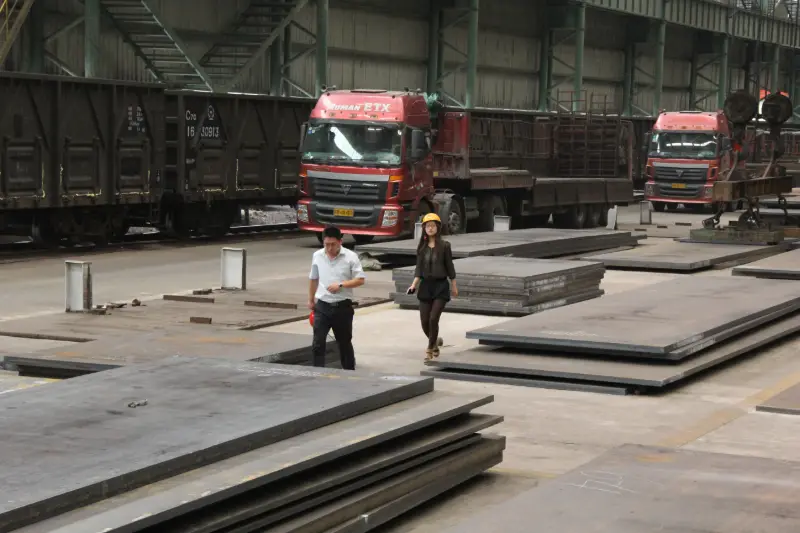
EN10025-6 S890Q Steel
EN10025-6 S890Q Steel: High-Strength Quenched & Tempered Structural Plate for Heavy Engineering
Comprehensive data sheet for EN10025-6 S890Q carbon and low-alloy high-strength steel coil, covering chemical composition, mechanical and physical properties, equivalent grades, and application guidelines. An expert resource for material selection in demanding structural applications.
Hot rolling followed by quenching and tempering; suitable for cold forming (limited), hot forming, machining, and all common welding processes (MAG, MIG, SAW, MMA) with appropriate preheating and consumables.
- Phone : +8618037372205
- Email : [email protected]
- WhatsApp: Contact via Whtsapp
- WeChat: +8618037372205
EN10025-6 S890Q Steel Introduction
S890Q is a high-yield-strength quenched and tempered structural steel grade defined in the European standard EN 10025-6. It is classified as a carbon and low-alloy steel with a minimum yield strength of 890 MPa for thicknesses up to 50 mm. This steel grade is engineered for superior strength and toughness, achieved through a specialized heat treatment process involving quenching and tempering. Key characteristics include excellent weldability for its strength class, good cold-forming properties, and high resistance to brittle fracture at low temperatures. S890Q is widely utilized in weight-critical and high-load-bearing structures, such as mobile cranes, heavy-duty machinery, and offshore components, where reducing deadweight while maximizing payload capacity is paramount. It is typically supplied in the quenched and tempered condition (Q), with an optional low-temperature toughness designation (QL1).
EN10025-6 S890Q Steel Chemical Composition
The chemical composition of S890Q steel is carefully controlled to ensure deep hardenability, high strength, and good weldability. The maximum values are specified according to the ladle analysis per EN 10025-6. Elements like manganese, chromium, molybdenum, and nickel are added to promote the formation of a martensitic structure during quenching, which is then tempered to achieve the desired balance of strength and toughness. Micro-alloying elements such as niobium, vanadium, and titanium play a crucial role in grain refinement and precipitation strengthening, while boron can be added in minute quantities to dramatically increase hardenability in thicker sections. A low carbon equivalent value (CEV/CE) is critical for ensuring weldability without cold cracking.
| Element | Standard Value (Max %) | Remarks |
|---|---|---|
| Carbon (C) | 0.20 | Max for thicknesses ≤ 50 mm; increases for thicker products. |
| Silicon (Si) | 0.80 | Deoxidizer and strength enhancer. |
| Manganese (Mn) | 1.70 | Key hardenability and strength element. |
| Phosphorus (P) | 0.020 | Max limit to ensure toughness and avoid embrittlement. |
| Sulfur (S) | 0.010 | Max limit for improved cleanliness and mechanical properties. |
| Chromium (Cr) | 1.50 | Enhances hardenability and provides high-temperature strength. |
| Nickel (Ni) | 2.0 | Improves toughness at low temperatures. |
| Molybdenum (Mo) | 0.70 | Prevents temper embrittlement and enhances high-temperature strength. |
| Copper (Cu) | 0.50 | Provides some atmospheric corrosion resistance. |
| Niobium (Nb) | 0.06 | Micro-alloying element for grain refinement. |
| Vanadium (V) | 0.12 | Micro-alloying element for precipitation strengthening. |
| Titanium (Ti) | 0.05 | Forms nitrides/carbides for grain refinement control in HAZ. |
| Boron (B) | 0.005 | Powerful hardenability agent for thick sections. |
| Zirconium (Zr) | 0.15 | Optional element for sulfide shape control. |
| Nitrogen (N) | 0.015 | Max limit to prevent aging and loss of toughness. |
| Aluminium (Al total) | ≥ 0.018 | Min is typically specified for fine-grain practice. |
EN10025-6 S890Q Steel Thermal and Electrical Physical Properties
The physical properties of S890Q steel are representative of low-alloy, high-strength steels at room temperature and are influenced by the tempered martensitic microstructure. These values are essential for engineering calculations involving thermal expansion, heat transfer, and structural dynamics. The data provided are typical, non-mandatory values for information and comparison purposes, and they may vary slightly depending on the exact chemical composition and heat treatment parameters. The modulus values are fundamental for all stiffness calculations.
| Property | Standard Requirement Value | Unit | Test Condition |
|---|---|---|---|
| Density (ρ) | 7850 | kg/m³ | At 20 °C |
| Modulus of Elasticity (E) | 205 to 210 | GPa | At 20 °C |
| Shear Modulus (G) | Approx. 80 | GPa | At 20 °C |
| Poisson's Ratio (ν) | 0.3 | - | At 20 °C |
| Thermal Expansion Coefficient (α) | 11.5 - 12.5 | 10⁻⁶/K | At 20 °C to 100 °C |
| Thermal Expansion Coefficient (α) | 12.5 - 13.5 | 10⁻⁶/K | At 20 °C to 200 °C |
| Thermal Expansion Coefficient (α) | 13.5 - 14.5 | 10⁻⁶/K | At 20 °C to 400 °C |
| Thermal Conductivity (λ) | 35 - 42 | W/(m·K) | At 20 °C |
| Thermal Conductivity (λ) | 36 - 43 | W/(m·K) | At 100 °C |
| Thermal Conductivity (λ) | 37 - 42 | W/(m·K) | At 200 °C |
| Specific Heat Capacity (c) | 460 - 480 | J/(kg·K) | At 20 °C to 100 °C |
| Electrical Resistivity (ρ_e) | 0.25 - 0.35 | Ω·mm²/m | At 20 °C |
EN10025-6 S890Q Steel Mechanical Properties
The mechanical properties of S890Q are guaranteed in the quenched and tempered condition. The values are highly dependent on the product thickness. The table below details the minimum yield strength, tensile strength, elongation, and impact toughness requirements as defined in EN 10025-6. The bending test with a specified mandrel diameter confirms the ductility and integrity of the material. Charpy V-notch impact tests are mandatory at a specified temperature to verify the designated quality level (Q or QL1), ensuring the material's resistance to brittle fracture.
| Property | Standard Requirement Value | Unit | Test Condition |
|---|---|---|---|
| Yield Strength (ReH) | ≥ 890 | MPa | Nominal thickness ≤ 50 mm |
| Yield Strength (ReH) | ≥ 830 | MPa | Nominal thickness > 50 mm ≤ 100 mm |
| Yield Strength (ReH) | ≥ 780 | MPa | Nominal thickness > 100 mm ≤ 150 mm |
| Tensile Strength (Rm) | 940 to 1180 | MPa | Nominal thickness ≤ 50 mm |
| Tensile Strength (Rm) | 880 to 1100 | MPa | Nominal thickness > 50 mm ≤ 100 mm |
| Tensile Strength (Rm) | 830 to 1050 | MPa | Nominal thickness > 100 mm ≤ 150 mm |
| Elongation (A5) | ≥ 11 | % | Gauge length L0 = 5.65√S0, nominal thickness ≤ 40 mm |
| Elongation (A) | ≥ 11 | % | Gauge length L0 = 80 mm for strips/flats > 40 mm thick |
| Bend Test (Mandrel Diameter) | No cracks | - | Bend angle 180°: Mandrel dia = 3t for t ≤ 16mm; 4t for t > 16mm ≤ 50mm (where t = specimen thickness) |
| Impact Energy (KV2) for Q grade | ≥ 30 | Joules (J) | Longitudinal specimen at -20 °C |
| Impact Energy (KV2) for QL1 grade | ≥ 40 | Joules (J) | Longitudinal specimen at -40 °C |
EN10025-6 S890Q Steel Completely Equivalent Material Standards and Substitutable Grade Recommendations
| Country/Region | Standard | Grade | Remarks |
|---|---|---|---|
| United Kingdom | BS EN 10025-6 | S890Q / S890QL1 | Identical adoption of European standard. |
| Germany | DIN EN 10025-6 | S890Q / S890QL1 | Identical adoption of European standard. |
| Italy | UNI EN 10025-6 | S890Q / S890QL1 | Identical adoption of European standard. |
| France | NF EN 10025-6 | S890Q / S890QL1 | Identical adoption of European standard. |
| International | ISO 4951-2 | S890Q | Technically identical to EN 10025-6 for this grade. |
| European Union (Superseded) | EN 10137-2 | S890Q | Predecessor standard. Material is technically equivalent. |
EN10025-6 S890Q Steel Application Introduction
S890Q steel is specifically designed for weight-sensitive, high-load applications. Its combination of ultra-high strength and good toughness allows engineers to reduce plate thickness by up to 40% compared to standard S355 steel, enabling lighter, more fuel-efficient designs with higher payload capacities. Successful application requires strict adherence to workshop processes:
- Welding: Low-hydrogen procedures (HD < 5 ml/100g) are mandatory. Precise preheating and interpass temperature control (typically 150-200°C, but calculated based on CEV and thickness) prevent cold cracking. Matching or slightly undermatching consumables are used.
- Forming: Cold bending is possible with increased force and a mandatory minimum radius (typically >4t for t≤16mm). Hot forming or flame straightening must be followed by re-tempering to restore mechanical properties.
- Cutting: Thermal cutting (plasma, oxy-fuel) is standard, but preheating is required above certain thicknesses to avoid edge cracking. High-definition plasma and laser cutting are preferred for precision parts.
Product Applications: Telescopic crane booms and jibs, Heavy-duty semi-trailer chassis, Offshore platform lifting frames and structural nodes, Reinforced earthmoving machinery buckets and blades, Hydraulic lifting platforms and scissor lifts, Pressure vessels for gas transportation, Bridge launching girders and heavy trusses
Processed into products: Longitudinally welded rectangular hollow sections, Laser or plasma cut structural brackets and gussets, Cold-formed structural profiles (with a large radius), Welded box girder web and flange plates, Turned and milled high-stress pins and bushings, Bent chassis side rails and cross-members, Reinforcement doublers and pad-eyes for lifting
Application industries: Mobile Crane Manufacturing (booms, outriggers, frames), Heavy Transport and Trailer Engineering (vehicle chassis, dump bodies), Offshore and Marine Engineering (platform structures, crane pedestals, jack-up legs), Civil Engineering and Construction (bridge beams, high-rise building columns, stadium roofs), Hydropower and Water Management (penstocks and spiral cases), Mining and Earthmoving Equipment (excavator booms, dump truck bodies, crusher jaws), Military and Security (armored plates, bridges)
EN10025-6 S890Q Steel Recommendations for Similar / Analogous Substitute Materials
| Country/Region | Standard | Grade | Remarks |
|---|---|---|---|
| USA | ASTM A514/A514M | Grade S | A direct strength equivalent (min YS 690 MPa for plates >25mm, up to 890 MPa for thin gauges). Quenched and tempered alloy plate. Chemical composition and test requirements differ structurally from EN 10025-6. |
| USA | ASTM A517/A517M | Grade S | The pressure vessel version of A514 Grade S. Similar mechanical properties but with specific supplementary requirements for pressure-containing parts. |
| Japan | JIS G 3128 | SHY 90 | High yield strength quenched and tempered steel with a minimum yield strength of 890 N/mm². Conceptually similar for Japanese domestic applications. |
| China | GB/T 16270 | Q890D | High-strength structural steel with a minimum yield strength of 890 MPa and an impact test temperature of -20°C. A close functional equivalent. |
| Sweden | SSAB (Proprietary) | Strenx® 900 | Commercial brand of 900 MPa yield strength structural steel. Offers S890Q and higher performance levels with excellent workshop properties. A common advanced substitute. |
Notes:
Precautions:
- This material is highly sensitive to hydrogen embrittlement. Avoid any contact with moisture or hydrocarbons during welding. All electrodes and fluxes must be baked according to manufacturer's instructions.
- Product thickness, width, and edge condition tolerances are governed by EN 10029, EN 10051, or the relevant dimensional standard.
- Post-weld heat treatment (PWHT) is generally not recommended as it can degrade the carefully engineered mechanical properties achieved by quenching and tempering. If PWHT is unavoidable (e.g., for legal stress-relief requirements), re-qualification of the entire procedure is mandatory, and a significant strength loss must be expected.
- This high-strength steel requires a dedicated production route and high levels of metallurgical purity to achieve its rated properties. Direct substitution for lower-strength grades without a full design review is not advised despite potential weight savings.
- Share



