
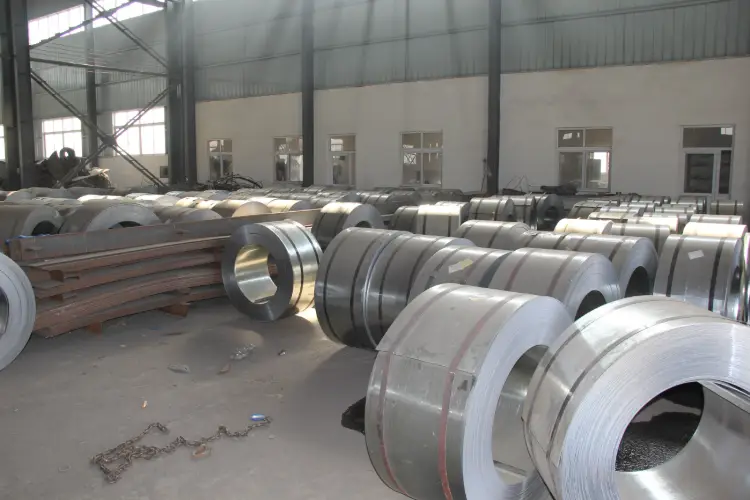
EN10025-6 S690QL1 High-Strength Quenched & Tempered Structural Steel Coil
EN10025-6 S690QL1 High-Strength Quenched & Tempered Structural Steel Coil - Premium Wear & Impact Resistance
Complete technical profile of S690QL1 steel coil under EN 10025-6: chemistry, mechanical & thermal properties, international equivalents, processing recommendations and application guide for heavy-duty structural engineering.
The material can be processed by plasma/laser/gas cutting, hot forming (with re-tempering if heated above tempering temperature), cold forming, welding (using low-hydrogen procedures and preheating as needed), and machining in the as-delivered condition.
- Phone : +8618037372205
- Email : [email protected]
- WhatsApp: Contact via Whtsapp
- WeChat: +8618037372205
EN10025-6 S690QL1 High-Strength Quenched & Tempered Structural Steel Coil Introduction
S690QL1 is a high-strength quenched and tempered structural steel defined in EN 10025-6. It belongs to the group of low-alloy special steels with a minimum yield strength of 690 MPa, tailored for superior toughness at low temperatures down to -20 °C (quality level L1). Thanks to its fine-grain microstructure and controlled alloying, it offers
- Excellent weldability with low carbon equivalent (CEV typically ≤0.52)
- High resistance to brittle fracture
- Good cold forming and bending characteristics in the quenched and tempered condition
- Outstanding strength-to-weight ratio enabling weight-optimized designs
The material is typically supplied as hot-rolled and heat-treated coils or cut-to-length sheets, with a surface condition suitable for direct use or subsequent coating.
EN10025-6 S690QL1 High-Strength Quenched & Tempered Structural Steel Coil Chemical Composition
The chemical composition of S690QL1 is controlled to ensure the required mechanical properties and weldability. Typical limits per EN 10025-6:2019 are given below. Microalloying elements such as niobium, vanadium, and titanium are often added to refine grain size. The carbon equivalent value (CEV = C + Mn/6 + (Cr+Mo+V)/5 + (Ni+Cu)/15) shall typically not exceed 0.52 for thicknesses ≤ 50 mm, unless otherwise agreed.
- All values are maxima unless a range is shown.
- Fine-grain practice is mandatory; nitrogen-binding elements are used.
| Element | Standard Value (max, %) | Remarks |
|---|---|---|
| Carbon (C) | 0.20 | Depends on thickness; can be lower for thin gauges |
| Silicon (Si) | 0.80 | Common in Q&T grades |
| Manganese (Mn) | 1.70 | Provides solid solution strengthening |
| Phosphorus (P) | 0.020 | Controlled for cleanliness |
| Sulfur (S) | 0.010 | Low sulfur for toughness |
| Chromium (Cr) | 1.50 | Hardenability element |
| Molybdenum (Mo) | 0.70 | Improves hardenability and temper resistance |
| Nickel (Ni) | 2.0 | Enhances low-temperature toughness |
| Aluminum (Al) total | 0.015 min* | Minimum 0.015% for fine-grain practice (if not other N-binding elements used) |
| Nitrogen (N) | 0.015 | Max; often lower when microalloyed |
| Vanadium (V) | 0.12 | Optional microalloy, max when added |
| Niobium (Nb) | 0.06 | Optional microalloy, max when added |
| Titanium (Ti) | 0.05 | Optional microalloy, max when added |
| Copper (Cu) | 0.50 | If specified, max 0.50 |
| Boron (B) | 0.005 | May be added for extra hardenability (not always present) |
| Carbon Equivalent (CEV) | Typ. 0.42–0.52 | Calculated value; depends on final composition |
EN10025-6 S690QL1 High-Strength Quenched & Tempered Structural Steel Coil Thermal and Electrical Physical Properties
Physical properties are not specified in EN 10025-6 but are often required for engineering calculations. The following data are typical for quenched and tempered low-alloy steels with similar composition and density. They may be used for design, but project-specific testing is recommended for critical applications.
- Values can vary slightly with actual heat treatment and alloy content.
- Density is taken as standard for steel.
| Property | Typical Value | Unit | Remarks |
|---|---|---|---|
| Density (ρ) | 7.85 | g/cm³ | At 20 °C |
| Young's modulus (E) | 205 – 210 | GPa | At room temperature, quasistatic |
| Shear modulus (G) | ≈ 80 | GPa | Calculated from E and ν |
| Poisson's ratio (ν) | 0.3 | – | Elastic region |
| Thermal expansion coefficient (α) | 11.5 | 10⁻⁶/K | Between 20°C and 100°C |
| Thermal expansion coefficient (α) | 12.5 | 10⁻⁶/K | Between 20°C and 300°C |
| Thermal conductivity (λ) | 38 – 42 | W/(m·K) | At 20 °C, depends on alloy |
| Specific heat capacity (c_p) | 460 – 480 | J/(kg·K) | At 20 °C |
| Electrical resistivity (ρ_e) | 0.25 – 0.30 | µΩ·m | At 20 °C |
EN10025-6 S690QL1 High-Strength Quenched & Tempered Structural Steel Coil Mechanical Properties
Mechanical properties are guaranteed by the manufacturer and verified on test pieces taken in the longitudinal direction (transverse values available upon agreement). The values in the table apply to thicknesses ≤ 50 mm, which is the most common coil product range. For thicker products, slight reductions in strength may apply.
- Impact test temperature: -20 °C (L1) with minimum absorbed energy of 40 J for longitudinal samples, 27 J for transverse.
- Bend test: no cracks after 180° bending around a former.
| Property | Standard Requirement (min–max) | Unit | Test Condition |
|---|---|---|---|
| Yield strength (ReH) | 690 (min) | MPa | 0.2% offset, room temperature; valid for t ≤ 50 mm |
| Tensile strength (Rm) | 770 – 940 | MPa | t ≤ 50 mm |
| Tensile strength (Rm) | See note | MPa | 50 < t ≤ 100 mm: 670–900 MPa (but coil usually ≤ 50 mm) |
| Elongation (A5) | 14 (min) | % | Longitudinal, gauge length 5.65√S0 |
| Elongation (A5), transverse | 12 (min) | % | Transverse test piece (if agreed) |
| Impact energy (KV2) | 40 (min) | J | Longitudinal, at -20 °C, Charpy V-notch |
| Impact energy (KV2), transverse | 27 (min) | J | Transverse at -20 °C (if agreed) |
| Bend test (180°) | No cracks | - | Bend former diameter: 3 × thickness (t ≤ 16 mm); 4 × thickness (16 < t ≤ 50 mm) |
EN10025-6 S690QL1 High-Strength Quenched & Tempered Structural Steel Coil Fully Equivalent Material Standards and Replaceable Grade Recommendations
The following grades are considered technically identical or direct substitutes under the respective standard. They match the EN 10025-6 S690QL1 requirements in terms of chemical composition, mechanical properties, and delivery condition.
| Country/Region | Standard | Grade | Remarks |
|---|---|---|---|
| Europe | EN 10137-2 (withdrawn) | S690QL1 | Former standard; same property limits |
| Germany | DIN EN 10025-6 | S690QL1 | Identical to EN 10025-6 |
| UK | BS EN 10025-6 | S690QL1 | British adoption of EN 10025-6 |
| France | NF EN 10025-6 | S690QL1 | French adoption |
| Italy | UNI EN 10025-6 | S690QL1 | Italian adoption |
| Spain | UNE EN 10025-6 | S690QL1 | Spanish adoption |
| Sweden | SS EN 10025-6 | S690QL1 | Swedish adoption |
| Netherlands | NEN EN 10025-6 | S690QL1 | Dutch adoption |
| Poland | PN EN 10025-6 | S690QL1 | Polish adoption |
| Finnland | SFS EN 10025-6 | S690QL1 | Finnish adoption |
EN10025-6 S690QL1 High-Strength Quenched & Tempered Structural Steel Coil Application Introduction
S690QL1 is engineered for structural components that demand maximum strength with reliable low-temperature toughness. Its excellent weldability and availability in coil form make it ideal for automated cutting and forming lines. Typical application areas are:
- Mobile crane booms and chassis
- Heavy transportation equipment
- Mining and earthmoving machinery
- Offshore structural parts
- Bridge girder stiffeners
- Pressure vessel shells under moderate temperature service
Product Applications: Mobile crane telescopic booms, Excavator booms, arms and buckets, Dump truck bodies and frames, Trailer chassis and goosenecks, Girder and box sections for bridges, Penstocks and pressure conduits, Offshore platform transition pieces, Lifting forks and spreader beams
Processed into products: Welded structural hollow sections and beams, Cut and formed brackets, gussets and stiffeners, Flame-cut sprockets and gear blanks (after tempering verification), Bolted splice plates and end plates, Cold-formed channels and angles, Bent profiles for crane jibs, Machined pin bosses and bush housings (with carbide tooling)
Application industries: Construction & Civil Engineering, Heavy Equipment Manufacturing, Shipbuilding & Offshore Engineering, Mining & Mineral Processing, Transportation & Automotive (heavy vehicles), Energy & Wind Power
EN10025-6 S690QL1 High-Strength Quenched & Tempered Structural Steel Coil Similar/Comparable Substitute Materials
These grades are close in strength level and intended use but may differ slightly in alloy content, impact test temperature, or delivery condition. They can often be substituted after an engineering assessment of chemical and mechanical limits.
| Country/Region | Standard | Grade | Remarks |
|---|---|---|---|
| Europe | EN 10025-6 | S690Q | Lower impact toughness: Q (0 °C) instead of L1 (-20 °C) |
| Europe | EN 10025-6 | S690QL | Toughness at -40 °C (L), superior to L1 |
| Europe | EN 10210 / EN 10219 | S690QH / S690QLH | Hollow sections, same strength class |
| Germany | SEW 092 / StE 690 | StE 690 | Older German designation, similar to S690Q |
| Japan | JIS G 3128 | SHY 685 / SHY 685N | High yield strength plate; check toughness level |
| USA | ASTM A514 / A517 | Grade S / Grade Q | 690 MPa min yield, quenched & tempered, some grades require higher alloying; check chemistry and CEV |
| USA | ASTM A709 | Grade HPS 690W | High performance steel for bridges, comparable strength |
| Sweden | SSAB Strenx | Strenx 700 MC / 700 E | Cold-formed or hot-rolled strip; Strenx 700 MC is thermomechanically rolled, not Q&T, but delivers similar strength; verify bendability and toughness. |
| China | GB/T 16270 | Q690D / Q690E | High strength structural steel, Q&T; Q690D (-20 °C) is a close equivalent |
Notes:
Welding recommendations: Use low-hydrogen processes (MMA, MAG, SAW) with suitable filler metals matching the steel strength. Preheat typically 100–150 °C depending on thickness; interpass temperature ≤ 200 °C. Post-weld heat treatment is generally not required but may be applied for stress relief below the original tempering temperature. Formability: S690QL1 coils can be cold bent with large radii (recommended minimum bending radius ≈ 3 × thickness for transverse direction and 4 × thickness for longitudinal direction). Severe forming may require re-tempering. Surface protection: Material is supplied as-rolled/descaled; subsequent painting, galvanizing or metallization is possible; for hot-dip galvanizing, consult the steel producer due to potential hydrogen embrittlement risk in high-strength steels. Certification: Inspection documents according to EN 10204 type 3.1 or 3.2 are standard; supplementary testing (e.g., ultrasonic, Z-grade) can be agreed at time of order.
- Share



