
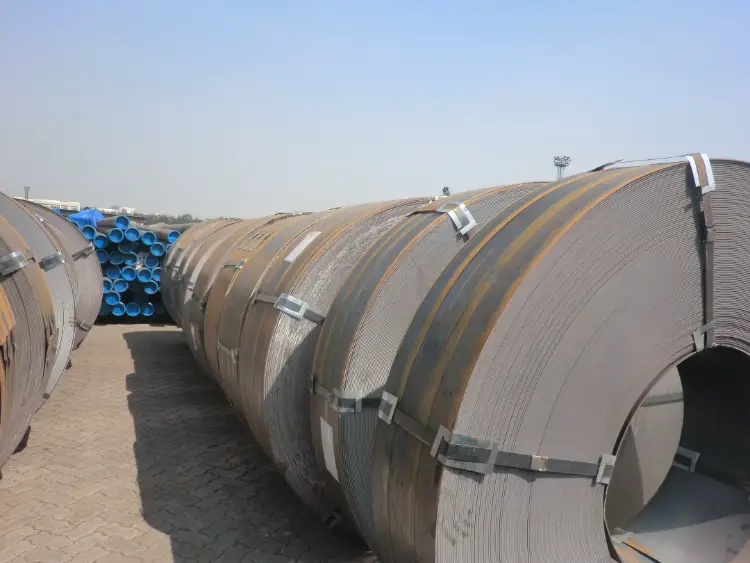
EN10025-3 S355NL High-Strength Fine Grain Structural Steel Coil
EN10025-3 S355NL Carbon and Low-alloy High-strength Steel Coil: Properties, Equivalents & Applications
Detailed analysis of EN10025-3 S355NL carbon and low-alloy high-strength steel coil including chemical composition, mechanical and thermal properties, equivalent grades, and application guidelines.
Welding, bending, cold forming (subject to strain ageing considerations), machining, cutting (thermal or mechanical)
- Phone : +8618037372205
- Email : [email protected]
- WhatsApp: Contact via Whtsapp
- WeChat: +8618037372205
EN10025-3 S355NL High-Strength Fine Grain Structural Steel Coil Introduction
S355NL is a weldable fine-grained structural steel grade specified in EN 10025-3, characterized by a minimum yield strength of 355 MPa in the normalized or normalized-rolled delivery condition. The designation 'S' stands for structural steel, '355' denotes the minimum yield strength (in MPa) for thicknesses ≤ 16 mm, 'N' indicates normalized or normalized-rolled, and 'L' specifies low-temperature impact properties at -50 °C (≥ 27 J).
This material belongs to the carbon and low-alloy high-strength steel family, offering a good balance of strength, toughness, and weldability. It is typically supplied as hot-rolled coil, plate, or sections and is widely used in heavy-duty welded structures such as bridges, offshore platforms, pressure vessels, and building frames, where reliable low-temperature toughness is essential.
EN10025-3 S355NL High-Strength Fine Grain Structural Steel Coil Chemical Composition
Chemical composition according to EN 10025-3 for grade S355NL. Values represent the maximum limits unless a range is specified.
Key microalloying elements such as niobium, vanadium, and titanium, along with a minimum aluminum content, ensure grain refinement and improved mechanical properties. The low carbon equivalent supports good weldability.
| Element | Standard Requirement (wt. %) | Notes |
|---|---|---|
| Carbon (C) | ≤ 0.18 | For product analysis, upper limit may be increased by +0.02 |
| Silicon (Si) | ≤ 0.50 | - |
| Manganese (Mn) | 0.90 – 1.65 | - |
| Phosphorus (P) | ≤ 0.025 | - |
| Sulfur (S) | ≤ 0.020 | - |
| Niobium (Nb) | ≤ 0.05 | Grain refinement; may be combined with V and/or Ti |
| Vanadium (V) | ≤ 0.12 | Optional microalloying for strength |
| Aluminum (Al total) | ≥ 0.020 | Minimum for grain refinement; dissolves in steel |
| Titanium (Ti) | ≤ 0.05 | Optional; contributes to grain size control |
| Chromium (Cr) | ≤ 0.30 | Residual element; not intentionally added |
| Nickel (Ni) | ≤ 0.50 | Residual element; may be present from scrap |
| Molybdenum (Mo) | ≤ 0.10 | Residual element |
| Copper (Cu) | ≤ 0.55 | Residual element; higher copper can be agreed for atmospheric corrosion resistance |
| Nitrogen (N) | ≤ 0.015 | Combined with Al to form nitrides |
EN10025-3 S355NL High-Strength Fine Grain Structural Steel Coil Thermal and Electrical Physical Properties
Typical physical properties for fine‑grained low‑alloy structural steel at room temperature (≈20 °C) unless otherwise stated. These values are representative for S355NL and may vary slightly depending on exact chemical composition and heat treatment condition.
| Property | Typical Value | Unit | Remark / Test Condition |
|---|---|---|---|
| Density (ρ) | ≈ 7850 | kg/m³ | At room temperature |
| Modulus of elasticity (E) | ≈ 210 | GPa | At 20 °C |
| Shear modulus (G) | ≈ 81 | GPa | Calculated from E and Poisson's ratio |
| Poisson's ratio (ν) | ≈ 0.3 | - | Elastic deformation region |
| Thermal expansion coefficient (α) | 11.5 – 12.5 | 10⁻⁶/K | 20 °C – 100 °C range |
| Thermal conductivity (λ) | 45 – 52 | W/(m·K) | At 20 °C |
| Specific heat capacity (cp) | ≈ 460 | J/(kg·K) | At room temperature |
| Electrical resistivity (ρe) | 0.22 – 0.28 | μΩ·m | At 20 °C |
EN10025-3 S355NL High-Strength Fine Grain Structural Steel Coil Mechanical Properties
Mechanical properties as specified in EN 10025-3 for S355NL in normalized (+N) condition.
Values are for longitudinal test pieces. Impact energy is Charpy V-notch (KV) at -50 °C. The bending test requires a mandrel diameter as a multiple of the specimen thickness (d = n × t) without cracking. Properties vary with product thickness; only the most common thickness categories are listed.
| Property | Standard Requirement Value | Unit | Test Condition / Thickness |
|---|---|---|---|
| Yield strength (ReH) | ≥ 355 | MPa | Thickness ≤ 16 mm, transverse optional |
| Yield strength (ReH) | ≥ 345 | MPa | Thickness 16 mm < t ≤ 40 mm |
| Yield strength (ReH) | ≥ 335 | MPa | Thickness 40 mm < t ≤ 63 mm |
| Yield strength (ReH) | ≥ 325 | MPa | Thickness 63 mm < t ≤ 80 mm |
| Yield strength (ReH) | ≥ 315 | MPa | Thickness 80 mm < t ≤ 100 mm |
| Tensile strength (Rm) | 470 – 630 | MPa | Thickness ≤ 100 mm |
| Tensile strength (Rm) | 460 – 620 | MPa | Thickness 100 mm < t ≤ 150 mm |
| Elongation after fracture (A) | ≥ 22 | % | Thickness ≤ 40 mm (L0 = 5.65√S0) |
| Elongation after fracture (A) | ≥ 21 | % | Thickness 40 mm < t ≤ 63 mm |
| Elongation after fracture (A) | ≥ 20 | % | Thickness 63 mm < t ≤ 100 mm |
| Impact energy (KV) | ≥ 27 | J | Longitudinal, -50 °C, nominal thickness ≥ 6 mm |
| Bend test (mandrel diameter) | d = 2 t | - | Bend angle 180°, thickness ≤ 16 mm |
| Bend test (mandrel diameter) | d = 3 t | - | Bend angle 180°, thickness 16 mm < t ≤ 100 mm |
EN10025-3 S355NL High-Strength Fine Grain Structural Steel Coil Exact Equivalent Standards and Substitute Grades
| Country / Region | Standard | Grade Designation | Remarks |
|---|---|---|---|
| International | ISO 630-3 | S355NL | Harmonized with EN 10025-3, identical technical requirements |
| European Union | EN 10025-3 | S355NL | Original standard; all CEN member countries adopt |
| United Kingdom | BS EN 10025-3 | S355NL | British adoption; formerly BS 4360 Grade 50EE (now obsolete) |
| Germany | DIN EN 10025-3 | S355NL | German adoption; previously St 52-3 N (but S355NL has finer grain and low‑temperature guarantee) |
| France | NF EN 10025-3 | S355NL | French adoption |
| Italy | UNI EN 10025-3 | S355NL | Italian adoption |
| Spain | UNE EN 10025-3 | S355NL | Spanish adoption |
| Sweden | SS-EN 10025-3 | S355NL | Swedish standard; sometimes designated SS 2134 (historical) |
EN10025-3 S355NL High-Strength Fine Grain Structural Steel Coil Application Introduction
S355NL is chosen when a combination of high strength, excellent weldability, and guaranteed impact toughness at -50 °C is required. The fine‑grain microstructure achieved through normalizing or normalizing rolling provides uniform mechanical properties across thick sections.
Typical industries and products:
Product Applications: Welded girders, columns, and trusses, Bridge box girders and orthotropic deck plates, Offshore jacket legs and nodes, Pressure vessel shells and heads (under PED/EN 13445 when impact -50 °C required), Wind tower tubular sections (rolled and welded from plates), Crane booms and chassis for mobile cranes, Heavy‑duty vehicle frames and tipper bodies
Processed into products: Flanges and webs of large I‑beams, Stiffeners and diaphragms for bridge box sections, Tubular joints and heavy lift lugs, Base frames and slewing rings for excavators, Manhole and nozzle reinforcements in pressure vessels, Door frames and support brackets in mining equipment, End plates and splice plates in bolted connections
Application industries: Civil engineering and construction (high‑rise buildings, sports stadiums), Bridge building (road and railway bridges in cold climates), Offshore oil and gas (platform substructures, decks, flare booms), Renewable energy (wind turbine towers, monopile foundations), Pressure vessel and storage tank manufacturing (low‑temperature service), Mining and heavy machinery (excavator booms, dump truck frames), Shipbuilding (deckhouses, crane pedestals; not for primary hull structures)
EN10025-3 S355NL High-Strength Fine Grain Structural Steel Coil Similar / Comparable Alternative Materials
| Country / Region | Standard | Grade Designation | Remarks |
|---|---|---|---|
| USA | ASTM A572 / A572M | Grade 50 [345] (when Charpy at -50 °C specified) | Yield 345 MPa, tensile ≥ 450 MPa; must be ordered with supplementary impact requirement to match -50 °C toughness |
| USA | ASTM A709 / A709M | Grade 50 (with Charpy at Zone 2 or 3) | Bridge steel; impact test temperature depends on fracture‑critical designation |
| China | GB/T 1591 | Q355NE | Yield 355 MPa, impact at -40 °C (≥ 47 J); one temperature class higher than -50 °C may require agreement; not a direct substitute for -50 °C but often used in similar applications |
| Japan | JIS G 3106 | SM490B / SM490C | SM490B: impact 0 °C; SM490C: impact -10 °C; lower toughness than S355NL; not recommended for -50 °C without additional agreement |
| Russia | GOST 19281 | 10G2S (10Г2С) with heat treatment | Yield ~345 MPa, impact at -40 °C typical; requires normalization and chemical adjustment to approach S355NL requirements |
| International | ISO 4950-2 / EN 10149-3 | S355MC (thermomechanical rolled) | Yield 355 MPa for thin gauges, impact at -20 °C; S355MC is a HSLA steel for cold forming, not a direct substitute for normalized structural application |
Notes:
Welding: S355NL has a low carbon equivalent (CEV typically ≤ 0.45) which provides good weldability. Preheating may be required for thicker sections or when using hydrogen‑prone processes. Follow EN 1011‑2 recommendations.
Corrosion protection: The steel has no inherent atmospheric corrosion resistance; surface protection (painting, galvanizing) is required for outdoor applications. Copper content up to 0.55 % can slightly improve atmospheric resistance if specified.
Forming: Cold forming is possible but care must be taken because strain ageing can occur; hot forming or stress relieving may be needed after severe deformation. Minimum bending radii are governed by the bend test requirements (d = 2 t or 3 t).
Certification: Inspection documents type 3.1 or 3.2 according to EN 10204 are normally issued, declaring the mechanical and chemical test results.
- Share



