
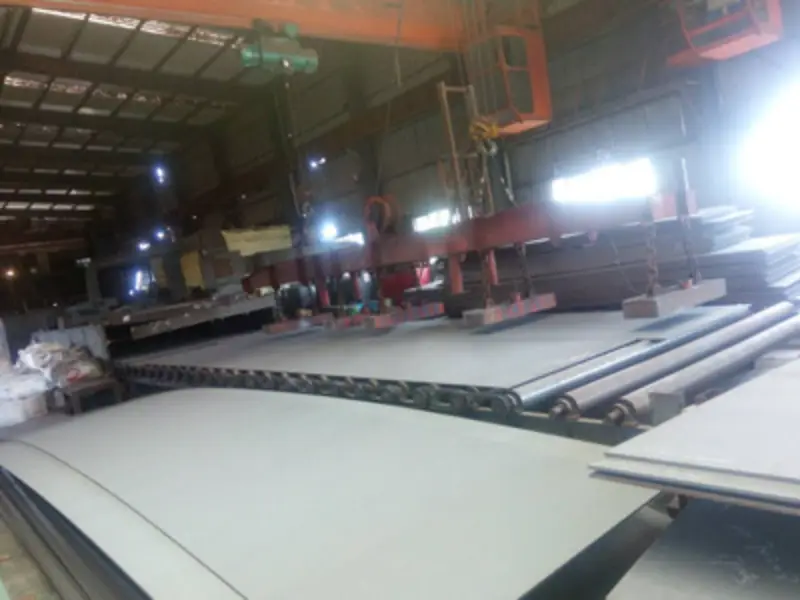
EN10025-2 S355K2 Steel
EN10025-2 S355K2 Steel: Properties, Composition and SSAW Pipe Applications
Comprehensive material data for S355K2 structural steel conforming to EN 10025-2, including chemical analysis, mechanical and physical properties. Widely utilized in spiral submerged arc welded (SSAW) pipes for oil, gas and water transmission.
Hot rolling, normalizing, cold forming, welding
- Phone : +8618037372205
- Email : [email protected]
- WhatsApp: Contact via Whtsapp
- WeChat: +8618037372205
EN10025-2 S355K2 Steel Introduction
S355K2 is a non-alloy structural steel grade defined in EN 10025-2. It is characterized by a minimum yield strength of 355 MPa and guaranteed impact toughness of 40 J at -20 °C (K2 quality). The steel offers excellent weldability and cold forming properties, making it suitable for heavy welded structures. Typical delivery conditions are as-rolled (+AR) or normalized (+N).
- High strength combined with good low-temperature toughness
- Supplied as plates, strips and wide flats, often used for spiral welded pipes
- Sulfur and phosphorus contents are tightly controlled to enhance ductility and weldability
EN10025-2 S355K2 Steel Chemical Composition
Ladle analysis limits according to EN 10025-2:2019 for grade S355K2. Values are maximum except where a range is given. Elements not listed may be controlled to achieve the required mechanical properties.
- Low carbon content ensures good weldability.
- Phosphorus and sulfur are kept low to improve ductility and impact toughness.
- Carbon equivalent (CEV) is limited for thick products to avoid hardening during welding.
| Element | Standard Value max. % | Remarks |
|---|---|---|
| C | 0.20 | For product thickness ≤ 40 mm; for t > 40 mm max. 0.22 |
| Mn | 1.60 | – |
| Si | 0.55 | – |
| P | 0.025 | For long products P max. 0.030 |
| S | 0.025 | For long products S max. 0.030 |
| N | 0.012 | Nitrogen limit; higher N is allowed if sufficient nitride-forming elements are present |
| Cu | 0.55 | Copper limit; may be adjusted for specific applications |
| CEV | 0.45 | Max. carbon equivalent value (CEV = C + Mn/6 + (Cr+Mo+V)/5 + (Ni+Cu)/15) for t ≤ 40 mm; 0.47 for 40 < t ≤ 63 mm |
EN10025-2 S355K2 Steel Physical, Thermal and Electrical Properties
Typical values for non-alloy structural steel at room temperature (20 °C) and under standard conditions. These properties are not mandatory according to EN 10025-2 but are commonly used for design calculations.
- Thermal expansion is linear up to approx. 100 °C.
- Thermal conductivity decreases with increasing temperature.
| Property | Typical Value | Unit | Notes / Test Condition |
|---|---|---|---|
| Density (ρ) | 7850 | kg/m³ | At 20 °C |
| Modulus of elasticity (E) | 200 | GPa | Tension, 20 °C |
| Shear modulus (G) | approx. 80 | GPa | Calculated from E and Poisson's ratio |
| Poisson's ratio (ν) | 0.3 | – | Elastic deformation |
| Thermal expansion coefficient (α) | 11.7 × 10⁻⁶ | K⁻¹ | 20–100 °C |
| Thermal expansion coefficient (α) | 12.5 × 10⁻⁶ | K⁻¹ | 20–200 °C |
| Thermal conductivity (λ) | 52 | W/(m·K) | At 20 °C |
| Thermal conductivity (λ) | 48 | W/(m·K) | At 200 °C |
| Specific heat capacity (Cp) | 460 | J/(kg·K) | At 20 °C |
| Electrical resistivity (ρₑ) | 0.16 | µΩ·m | At 20 °C |
EN10025-2 S355K2 Steel Mechanical Properties
Tensile and impact test values at ambient temperature as required by EN 10025-2 for grade S355K2. The impact test temperature is -20 °C, minimum average absorbed energy 40 J for full-size specimens (longitudinal direction). Bending test is performed at 180° with specified mandrel diameter.
- Yield strength decreases with increasing product thickness.
- Elongation values apply to longitudinal test pieces with gauge length L0 = 5.65 √S0.
| Property | Standard Requirement | Unit | Test Condition / Thickness |
|---|---|---|---|
| Yield strength (ReH) | ≥ 355 | MPa | t ≤ 16 mm |
| Yield strength (ReH) | ≥ 345 | MPa | 16 < t ≤ 40 mm |
| Yield strength (ReH) | ≥ 335 | MPa | 40 < t ≤ 63 mm |
| Yield strength (ReH) | ≥ 325 | MPa | 63 < t ≤ 80 mm |
| Yield strength (ReH) | ≥ 315 | MPa | 80 < t ≤ 100 mm |
| Tensile strength (Rm) | 470–630 | MPa | 3 ≤ t ≤ 100 mm |
| Tensile strength (Rm) | 510–680 | MPa | t < 3 mm |
| Elongation (A) | ≥ 22 | % | 3 ≤ t ≤ 40 mm, L₀=5.65√S₀ |
| Elongation (A) | ≥ 21 | % | 40 < t ≤ 63 mm |
| Elongation (A) | ≥ 20 | % | 63 < t ≤ 80 mm |
| Elongation (A) | ≥ 20 | % | 80 < t ≤ 100 mm |
| Elongation (A) | ≥ 19 | % | 2.5 < t < 3 mm |
| Impact energy (KV) | ≥ 40 (longitudinal) | J | -20 °C, V-notch, t ≥ 6 mm |
| Bend test (180°) | d = 2a | – | t ≤ 16 mm (mandrel diameter = 2 × sample thickness) |
| Bend test (180°) | d = 2a | – | 16 < t ≤ 40 mm |
| Bend test (180°) | d = 3a | – | 40 < t ≤ 80 mm |
EN10025-2 S355K2 Steel Completely Equivalent Material Standards and Substitutable Grades
| Country/Region | Standard | Grade | Remarks |
|---|---|---|---|
| European Union | EN 10025-2:2019 | S355K2 | Original specification; covers hot-rolled non-alloy structural steel |
| International | ISO 630-2:2021 | S355K2 | Technically identical to EN 10025-2, same chemical and mechanical requirements |
| Germany | DIN EN 10025-2 | S355K2 | Adopted European standard without modification |
| United Kingdom | BS EN 10025-2 | S355K2 | Same as EN 10025-2 |
| France | NF EN 10025-2 | S355K2 | Same as EN 10025-2 |
| Italy | UNI EN 10025-2 | S355K2 | Same as EN 10025-2 |
| China | GB/T 1591-2018 | Q355D | Chemical composition (P/S limits) and impact test (-20 °C, 40 J longitudinal) are comparable; verify full equivalence for critical applications |
EN10025-2 S355K2 Steel Application Introduction
S355K2 is specifically selected for applications requiring a combination of high strength, excellent weldability and guaranteed toughness at sub-zero temperatures (-20 °C). Its tight sulfur and phosphorus control plus the fine-grain practice ensure reliable performance in demanding structural and pressure-containing components.
- Widely used for spiral submerged arc welded (SSAW) pipes in oil & gas transmission, water mains and piling.
- Suitable for heavy welded frameworks, bridges, offshore platforms and crane booms.
- Can be delivered in normalized or as-rolled condition depending on thickness and toughness requirements.
Product Applications: Spiral submerged arc welded (SSAW) pipes, Longitudinally welded (LSAW) pipes, Welded I-beams, H-beams and box columns, Storage tank shells, Offshore platform jackets and decks, Piling pipes and foundation piles
Processed into products: Pipe body and connectors for high-pressure pipelines, Flanges, fittings and elbows in pipeline systems, Bridge main girders and cross beams, Wind turbine tower sections, Crane main chords and boom sections, Heavy-duty structural nodes and gusset plates
Application industries: Oil & gas transportation (pipeline systems), Water supply and sewage infrastructure, Structural engineering and construction, Bridge and highway construction, Offshore and marine engineering, Heavy machinery and crane manufacturing
EN10025-2 S355K2 Steel Similar / Alternative Material Recommendations
| Country/Region | Standard | Grade | Comparative Notes |
|---|---|---|---|
| EU | EN 10025-2 | S355J2 | Same strength, but impact test at +20 °C instead of -20 °C; not suitable where low-temperature toughness is required |
| EU | EN 10025-3 | S355NL | Normalized fine-grain steel with improved toughness down to -50 °C; often interchangeable with S355K2 when better notch toughness is needed |
| EU | EN 10025-4 | S355ML | Thermo-mechanically rolled, low-temperature toughness up to -50 °C; similar strength, better weldability for thick sections |
| USA | ASTM A572/A572M | Grade 50 [345] | Yield strength 345 MPa, similar chemistry; does not inherently guarantee impact toughness at -20 °C, supplementary requirement S5 can add KV test |
| USA | ASTM A709/A709M | Grade 50W [345W] | Weathering steel with 345 MPa yield; impact toughness optional; suitable for bridges where atmospheric corrosion resistance is needed |
| Japan | JIS G3106 | SM490YB | Yield strength 365 MPa (t≤16mm); weldable structural steel; impact test not mandatory unless specified; check temperature requirement |
Notes:
Welding: S355K2 exhibits excellent weldability with all common methods. Preheating may be required for thicker sections (above 40 mm) or when the carbon equivalent exceeds 0.43. Cold forming: Suitable for cold bending and flanging; a slightly larger mandrel diameter than the standard bend test is recommended for severe forming. Delivery conditions: The +AR (as-rolled) route is permissible only when the steelmaker demonstrates sufficient toughness at -20 °C; normalized (+N) condition is often preferred for thick plates and critical applications. Certification: Inspection documents according to EN 10204 type 3.1 or 3.2 are typically supplied. SSAW pipe specifics: For spiral welded pipes, the steel must satisfy both the plate/skelp requirements and the final pipe mechanicals; a hoop tensile test and weld procedure qualification are necessary.
- Share



