
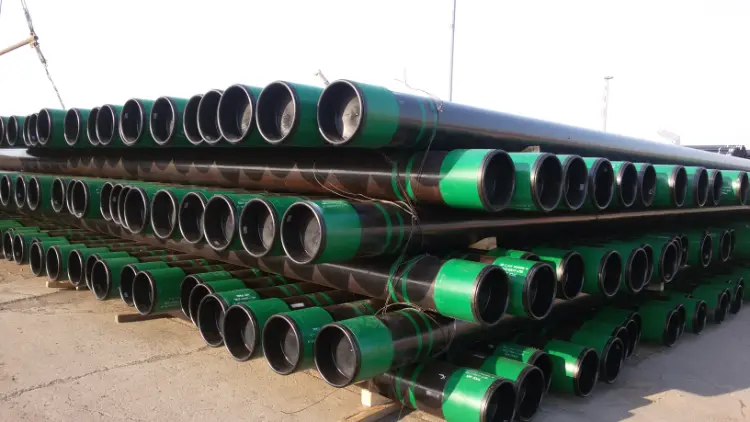
EN 10025-2 S355J2 Structural Steel for SSAW Pipe
EN 10025-2 S355J2 Structural Steel for SSAW Pipe - Chemistry, Mechanical & Thermal Data
Detailed material data for S355J2 low-alloy structural steel according to EN 10025-2, commonly used for spiral submerged arc welded (SSAW) pipes. Includes chemistry, mechanical properties at various thicknesses, thermal and electrical properties, international equivalents, and application guidance.
Welding (SAW for SSAW), cold and hot forming, machining, post-weld heat treatment (if required)
- Phone : +8618037372205
- Email : [email protected]
- WhatsApp: Contact via Whtsapp
- WeChat: +8618037372205
EN 10025-2 S355J2 Structural Steel for SSAW Pipe Introduction
S355J2 is a non-alloy structural steel grade standardized in EN 10025-2, designed for welded, bolted, and riveted structures. It offers a minimum yield strength of 355 MPa for thicknesses up to 16 mm and guarantees a Charpy V-notch impact energy of 27 J at -20°C (J2 quality). The steel is supplied in the normalized or normalizing rolled condition, exhibiting excellent weldability and cold-forming capabilities. It is widely used to manufacture spiral submerged arc welded (SSAW) pipes for oil & gas transmission, water mains, piling, and structural applications. Key advantages include:
- Controlled low carbon content (≤0.20%) for superior weldability
- Guaranteed low-temperature toughness
- Good balance of strength and ductility
- Available in a wide range of thicknesses
EN 10025-2 S355J2 Structural Steel for SSAW Pipe Chemical Composition
The table lists the maximum limits for alloying and residual elements as defined in EN 10025-2:2019 for grade S355J2. The steel is microalloyed with grain-refining elements such as Nb, V, Ti (not mandatory, but permitted to achieve mechanical properties). The carbon equivalent value (CEV) shall not exceed 0.45% for thickness ≤30 mm, and 0.47% for thickness >30 mm to ensure good weldability.
| Chemical Element | Standard Value (max %) | Remarks |
|---|---|---|
| Carbon (C) | 0.20 (t ≤16 mm); 0.22 (t >16 mm) | Low carbon ensures weldability |
| Silicon (Si) | 0.55 | Deoxidizer; improves strength |
| Manganese (Mn) | 1.60 | Main strengthening element |
| Phosphorus (P) | 0.025 | Typical for quality J2 |
| Sulfur (S) | 0.025 | Low sulfur to avoid hot shortness |
| Copper (Cu) | 0.55 | Residual, also improves atmospheric corrosion resistance |
| Nitrogen (N) | 0.012 | Residual limit |
| Others (Nb, V, Ti, etc.) | As per deoxidation practice | Optional microalloys for grain refinement; content controlled to meet mechanical properties |
EN 10025-2 S355J2 Structural Steel for SSAW Pipe Thermal & Electrical Physical Properties
The thermal and electrical properties listed below are typical for structural carbon-manganese steel and are provided for engineering design purposes. They are not mandatory requirements in EN 10025-2 and may vary slightly depending on the exact composition and microstructural condition. Values are given at room temperature unless otherwise noted.
| Physical Property | Standard Typical Value | Unit | Test Condition / Temperature |
|---|---|---|---|
| Density (ρ) | 7.80 – 7.85 | g/cm³ (1000 kg/m³) | 20°C |
| Modulus of Elasticity (E) | 205 – 210 | GPa | Ambient |
| Shear Modulus (G) | ~81 | GPa | Calculated from E and ν |
| Poisson's Ratio (ν) | 0.30 | - | Elastic range |
| Thermal Expansion Coefficient (α) | 11.5 – 12.5 | 10⁻⁶ /K | 20 – 100°C |
| Thermal Expansion Coefficient (α) | 12.5 – 13.5 | 10⁻⁶ /K | 20 – 200°C |
| Thermal Expansion Coefficient (α) | 13.0 – 14.0 | 10⁻⁶ /K | 20 – 300°C |
| Thermal Conductivity (λ) | 50 – 54 | W/(m·K) | at 20°C |
| Thermal Conductivity (λ) | 48 – 52 | W/(m·K) | at 100°C |
| Specific Heat Capacity (cₚ) | 460 – 480 | J/(kg·K) | 20 – 100°C |
| Electrical Resistivity (ρₑ) | 0.15 – 0.22 | μΩ·m | at 20°C |
EN 10025-2 S355J2 Structural Steel for SSAW Pipe Mechanical Properties
Mechanical properties are specified according to EN 10025-2 for the normalized/normalizing rolled condition. The values vary with product thickness. Tensile testing is performed in the transverse direction for plates/wideness strips and longitudinally for sections. Impact energy (KV) is the minimum average of three specimens at -20°C. The steel exhibits a pronounced yield plateau and adequate elongation for cold forming.
| Property | Standard Requirement Value | Unit | Test Condition / Thickness Range |
|---|---|---|---|
| Upper Yield Strength (ReH) | 355 | MPa | Nominal thickness ≤16 mm |
| Upper Yield Strength (ReH) | 345 | MPa | 16 mm < t ≤40 mm |
| Upper Yield Strength (ReH) | 335 | MPa | 40 mm < t ≤63 mm |
| Upper Yield Strength (ReH) | 325 | MPa | 63 mm < t ≤80 mm |
| Upper Yield Strength (ReH) | 315 | MPa | 80 mm < t ≤100 mm |
| Tensile Strength (Rm) | 510 – 680 | MPa | t <3 mm |
| Tensile Strength (Rm) | 470 – 630 | MPa | 3 mm ≤ t ≤100 mm |
| Tensile Strength (Rm) | 450 – 600 | MPa | 100 mm < t ≤150 mm |
| Elongation after Fracture (A) | 14 (min.) | % | t <3 mm, L₀ = 80 mm |
| Elongation after Fracture (A) | 20 (min.) | % | 3 mm ≤ t ≤40 mm, L₀ = 5.65√S₀ |
| Elongation after Fracture (A) | 18 (min.) | % | 40 mm < t ≤63 mm |
| Elongation after Fracture (A) | 17 (min.) | % | 63 mm < t ≤100 mm |
| Charpy V-notch Impact Energy (KV) | 27 (min. average); 19 (min. individual) | J | at -20°C; longitudinal specimens |
EN 10025-2 S355J2 Structural Steel for SSAW Pipe Completely Equivalent Material Standards & Replaceable Designations
| Country/Region | Standard | Designation | Remarks |
|---|---|---|---|
| Europe | EN 10025-2 | S355J2 | Original standard; impact 27J @ -20°C |
| International | ISO 630-2 | S355J2 | Identical to EN 10025-2 |
| Germany | DIN EN 10025-2 | S355J2 | Harmonized under EN |
| United Kingdom | BS EN 10025-2:2004 | S355J2 | BS implementation of EN |
| France | NF EN 10025-2 | S355J2 | French standard |
| Italy | UNI EN 10025-2 | S355J2 | Italian standard |
| Spain | UNE-EN 10025-2 | S355J2 | Spanish standard |
| China | GB/T 1591-2018 | Q355D | Yield 355 MPa, impact 27J @ -20°C; subtle chemistry differences possible; accepted as closest equivalent |
| Japan | JIS G 3106 | SM490A / SM490B | SM490B with supplementary requirement for 27J @ -20°C is practically equivalent; confirm with mill |
| USA | ASTM A572 / A709 | Grade 50 (345 MPa) Type 2 | A572 Gr.50 does not mandate impact testing; supplementary testing needed to match J2 requirements |
EN 10025-2 S355J2 Structural Steel for SSAW Pipe Application Introduction
S355J2 steel is a versatile structural material that, when formed into SSAW pipes, serves a wide range of industries due to its excellent weldability, strength, and guaranteed low-temperature toughness. Typical SSAW pipe diameters range from 300 mm to over 2500 mm with wall thicknesses up to 25 mm. The product conforms to standards such as EN 10219 (cold formed structural hollow sections), EN 10217 (welded tubes for pressure purposes), or API 5L (line pipe).
Product Applications: Spiral submerged arc welded (SSAW) steel pipes, Longitudinal SAW (LSAW) pipes (alternative to SSAW), Structural hollow sections (rectangular, circular), Fabricated pipe spools and fittings (elbows, tees, reducers), Piling pipes and tubular piles, Pressure vessels and storage tanks (when certified to PED)
Processed into products: Oil and gas line pipe segments, Water transmission penstocks and siphons, Monopile foundations for offshore wind turbines, Harbor fender piles and quay wall tubes, Bridge pier casings and columns, Tubular trusses for long-span roofs, Hydraulic cylinders and structural machine frames
Application industries: Oil & Gas (onshore and offshore transmission pipelines), Water supply & sewage (large-diameter mains), Civil engineering & construction (piling, bridge piers, structural supports), Mining (slurry and tailings pipelines), Renewable energy (wind turbine monopile foundations, penstocks), Dredging (dredge pipes), Fire protection and HVAC (heavy-duty piping)
EN 10025-2 S355J2 Structural Steel for SSAW Pipe Similar / Alternative Material Recommendations
| Country/Region | Standard | Designation | Remarks |
|---|---|---|---|
| Europe | EN 10025-2 | S355J0 | Similar strength but impact only guaranteed at 0°C (27J) |
| Europe | EN 10025-2 | S355K2 | Higher toughness: 40J @ -20°C; otherwise identical chemistry and strength |
| Europe | EN 10025-4 | S355M / S355ML | Thermomechanically rolled; ML grade offers 27J @ -50°C; similar strength, used for heavy sections |
| Europe | EN 10025-3 | S355N / S355NL | Normalized fine-grain steel; NL offers improved low-temp toughness |
| Europe | EN 10210 / EN 10219 | S355J2H | Hollow section variant; identical base material but certified for hot-finished/cold-formed tubes |
| International | API 5L | L290 (X42) or L360 (X52) | Line pipe grades; L360 (yield ~360 MPa) can be substituted if toughness requirements match |
| Russia/CIS | GOST 27772 | C355-2 (or 17G1S) | Similar to S355 but impact temperature may differ; verify with GOST equivalent |
Notes:
- SSAW pipes made from S355J2 normally require a post-weld heat treatment only if specified by the design code (e.g., stress relief).
- When used in sour service (H2S), additional hardness and chemistry restrictions (e.g., NACE MR0175) may apply; S355J2 is generally not pre-qualified for sour environments without special testing.
- The carbon equivalent (CEV) should be calculated and reported on the mill certificate to assist in welding procedure qualification.
- For dynamic loading conditions, additional through-thickness properties (Z quality) can be ordered according to EN 10164.
- Always verify the actual material certificate for heat-specific mechanical and chemical values, as they may differ from nominal limits.
- Share



