
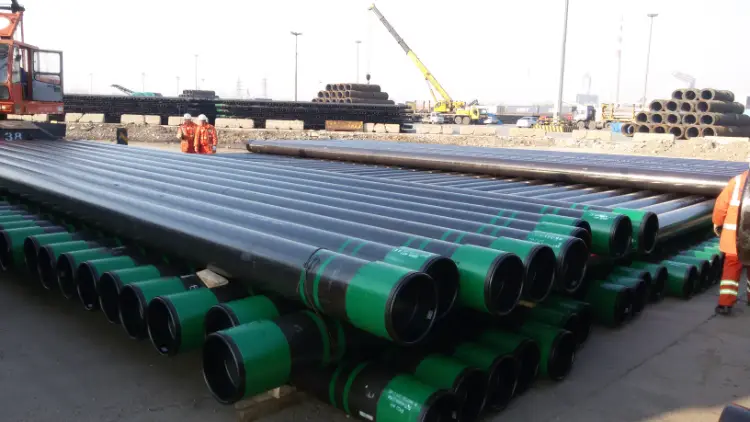
EN10025-2 S355J0 Steel for SSAW Pipe
EN10025-2 S355J0 Steel for SSAW Pipe: Chemical & Mechanical Data
Detailed material properties of EN10025-2 S355J0 steel used in spiral submerged arc welded (SSAW) pipes, including chemical composition, mechanical and thermal characteristics, equivalent grades and application guide.
Spiral forming and submerged arc welding (SSAW), suitable for cold forming, welding, machining
- Phone : +8618037372205
- Email : [email protected]
- WhatsApp: Contact via Whtsapp
- WeChat: +8618037372205
EN10025-2 S355J0 Steel for SSAW Pipe Introduction
EN10025-2 S355J0 is a hot-rolled structural steel grade with minimum yield strength of 355 MPa and Charpy impact tested at 0 °C (J0). It is widely utilized in welded structures, especially for SSAW (spiral submerged arc welded) pipes used in transmission and structural applications. The steel offers good weldability, moderate strength and toughness, and is typically supplied in as-rolled, normalized or normalized rolled condition depending on thickness and agreement. Due to its balanced combination of mechanical properties, it is suitable for structural hollow sections, piling, pipelines and general engineering. The chemical composition ensures adequate weldability and resistance to brittle fracture at low temperatures.
EN10025-2 S355J0 Steel for SSAW Pipe Chemical Composition
The chemical requirements for S355J0 according to EN 10025-2 are based on the maximum values for ladle analysis. Elements not listed may be present at trace levels but are not specified. For SSAW pipe production the same composition limits apply to the steel plate or strip.
- Carbon equivalent (CEV) is usually calculated to ensure weldability.
- If improved atmospheric corrosion resistance is required, copper may be specified up to 0.55%.
| Element | Maximum Value (%) | Remarks |
|---|---|---|
| C | ≤0.20 | Product thickness ≤ 40 mm |
| C | ≤0.22 | 40 mm < thickness ≤ 80 mm |
| Si | ≤0.55 | |
| Mn | ≤1.60 | |
| P | ≤0.035 | |
| S | ≤0.035 | |
| N | ≤0.012 | |
| Cu | ≤0.55 | If specified for improved atmospheric corrosion resistance |
| Ceq (CEV) | ≤0.45 | Typical for thickness ≤ 30 mm, depending on actual composition |
EN10025-2 S355J0 Steel for SSAW Pipe Thermal and Electrical Physical Properties
Physical properties are representative for carbon‑manganese structural steels at room temperature. Data are provided for reference and engineering design. Variations may occur depending on actual composition, heat treatment and temperature.
- Thermal expansion is important for pipeline design under temperature fluctuations.
- Thermal conductivity influences welding preheat requirements.
| Property | Typical Value | Unit | Condition / Temperature |
|---|---|---|---|
| Density (ρ) | 7.85 | g/cm³ | at 20 °C |
| Modulus of elasticity (E) | 210 | GPa | at 20 °C |
| Shear modulus (G) | 81 | GPa | at 20 °C |
| Poisson's ratio (ν) | 0.3 | – | at 20 °C |
| Thermal expansion coefficient (α) | 11.1 | ×10⁻⁶/K | 20 – 100 °C |
| Thermal expansion coefficient (α) | 12.1 | ×10⁻⁶/K | 20 – 200 °C |
| Thermal expansion coefficient (α) | 12.9 | ×10⁻⁶/K | 20 – 300 °C |
| Thermal conductivity (λ) | 53 | W/(m·K) | at 20 °C |
| Specific heat capacity | 460 | J/(kg·K) | at 20 °C |
| Electrical resistivity (ρ_e) | 0.20 | µΩ·m | at 20 °C |
EN10025-2 S355J0 Steel for SSAW Pipe Mechanical Properties
Mechanical properties of S355J0 steel depend on product thickness and test direction (longitudinal or transverse). Values below are for longitudinal test pieces unless stated otherwise. The material meets the requirements for minimum yield strength, tensile strength, elongation, and Charpy impact energy at 0 °C. For SSAW pipes made from this steel, the properties of the base metal remain valid, and the weld zone is separately qualified.
| Property | Standard Requirement | Unit | Test Condition / Thickness |
|---|---|---|---|
| Yield strength ReH | ≥355 | MPa | t ≤ 16 mm |
| Yield strength ReH | ≥345 | MPa | 16 mm < t ≤ 40 mm |
| Yield strength ReH | ≥335 | MPa | 40 mm < t ≤ 63 mm |
| Yield strength ReH | ≥325 | MPa | 63 mm < t ≤ 80 mm |
| Yield strength ReH | ≥315 | MPa | 80 mm < t ≤ 100 mm |
| Tensile strength Rm | 470 - 630 | MPa | t ≤ 100 mm |
| Tensile strength Rm | 450 - 600 | MPa | 100 mm < t ≤ 150 mm |
| Elongation A (L₀=5.65√S₀) | ≥22 | % | t ≤ 40 mm, longitudinal |
| Elongation A | ≥21 | % | 40 mm < t ≤ 63 mm, longitudinal |
| Elongation A | ≥20 | % | 63 mm < t ≤ 100 mm, longitudinal |
| Charpy impact energy KV | ≥27 | J | 0 °C, longitudinal |
| Bend test (up to 180°) | No cracks | Mandrel diameter: 2t for t≤16 mm; 3t for t>16 mm (recommended) |
EN10025-2 S355J0 Steel for SSAW Pipe Fully Equivalent Material Standards and Substitutable Grades
| Country / Region | Standard | Grade | Remarks |
|---|---|---|---|
| European Union | EN 10025-2:2019 | S355J0 | Original standard |
| International | ISO 630-2:2011 | S355J0 | Technically equivalent, identical symbol |
| Germany | DIN EN 10025-2 | S355J0 | Identical to EN 10025-2 |
| United Kingdom | BS EN 10025-2 | S355J0 | Identical to EN 10025-2 |
| France | NF EN 10025-2 | S355J0 | Identical to EN 10025-2 |
| Italy | UNI EN 10025-2 | S355J0 | Identical to EN 10025-2 |
| Spain | UNE EN 10025-2 | S355J0 | Identical to EN 10025-2 |
| Japan | JIS G 3106 | SM490A | Comparable strength, but impact test temperature differs (check delivery condition) |
| China | GB/T 1591 | Q355C | Similar yield strength, impact energy at 0 °C; limited chemical differences |
EN10025-2 S355J0 Steel for SSAW Pipe Application Introduction
S355J0 steel is ideally suited for SSAW pipes used in medium- and large-diameter application. The spiral welding process allows production of long pipes with variable diameters and wall thicknesses. The combination of strength and ductility makes it suitable for buried structures, dynamic loading conditions, and welded assemblies. Proper welding consumables and procedures must be followed to maintain the toughness of the heat‑affected zone. Preheating and post‑weld heat treatment are rarely required for thicknesses below 30 mm, but may be considered for thicker sections or when service conditions impose high restraint.
Product Applications: SSAW line pipes for hydrocarbons, Water and slurry transport pipelines, Structural hollow sections (round, square), Piling pipes for deep foundations, Casing pipes for wells, Road and bridge bearing components
Processed into products: Pipe bends, tees and reducers, Flanges (welding neck, slip-on), Anchor flanges for pipelines, Pipe supports and saddles, Structural columns and braces, Bearing stiffeners in girders, Machined couplings and connectors
Application industries: Oil and gas transmission (onshore and offshore), Water supply and sewage systems, Structural engineering and civil construction, Port and harbour works (piling), Wind energy (tower structures, foundation pipes), Mechanical engineering (general welded components)
EN10025-2 S355J0 Steel for SSAW Pipe Materials with Similar Properties
| Country / Region | Standard | Grade | Remarks |
|---|---|---|---|
| European Union | EN 10025-2 | S355JR | Same strength, impact test at +20 °C (less tough) |
| European Union | EN 10025-2 | S355J2 | Same strength, impact test at -20 °C (higher toughness) |
| European Union | EN 10025-2 | S355K2 | Same strength, impact test at -20 °C with stricter requirements |
| USA | ASTM A572/A572M | Grade 50 [345] | Minimum yield 345 MPa, comparable strength; impact requirements optional |
| USA | ASTM A709/A709M | Grade 50 | Structural steel for bridges, similar tensile properties |
| Japan | JIS G 3101 | SS400 | Lower strength (245 MPa yield), general structural use |
| China | GB/T 1591 | Q345C | Former Chinese grade with 345 MPa yield, impact at 0 °C (now Q355C) |
Notes:
- The properties given are for the steel grade S355J0 as specified in EN 10025-2. For SSAW pipe production, the steel strip or plate must conform to this standard, and the pipe manufacturer shall verify that the pipe body and weld meet the specified requirements of the relevant pipe standard (e.g., EN 10217, EN 10219, API 5L).
- When welding thick sections (> 30 mm) or in low ambient temperatures, a suitable preheating and interpass temperature control should be applied to avoid hydrogen‑induced cold cracking.
- Impact testing at 0 °C is mandatory for the base material; if higher toughness is needed, grades like S355J2 or S355K2 should be considered.
- For sour service or aggressive environments, additional testing and special chemical requirements (e.g., low sulfur) must be agreed.
- Share



