
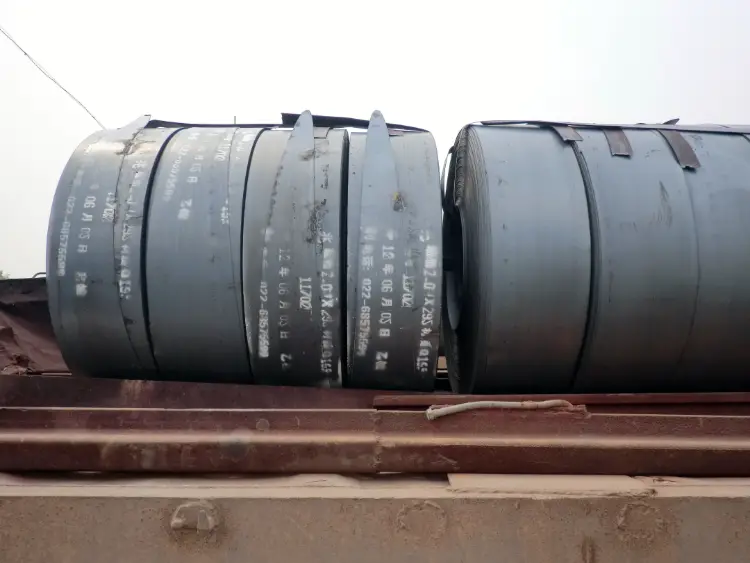
EN10025-2 S355K2 Carbon and Low-alloy High-strength Steel Coil
EN10025-2 S355K2 Carbon and Low-alloy High-strength Steel Coil - Grade Data & Properties
Complete material data for EN10025-2 S355K2 steel coil: chemical composition, mechanical properties, thermal & electrical properties, equivalent grades and application guidance for structural engineering.
Hot rolling, normalizing rolling (+N), thermomechanical rolling (+M), welding, bending, punching, cutting, machining
- Phone : +8618037372205
- Email : [email protected]
- WhatsApp: Contact via Whtsapp
- WeChat: +8618037372205
EN10025-2 S355K2 Carbon and Low-alloy High-strength Steel Coil Introduction
EN10025-2 S355K2 is a hot-rolled structural steel with minimum yield strength of 355 MPa for thicknesses ≤ 16 mm. Part of the European standard series for non-alloy and fine-grain structural steels, grade S355K2 delivers guaranteed Charpy impact energy of at least 40 J at -20°C (longitudinal), making it suitable for demanding structural applications where low-temperature toughness is critical. Typical chemical composition is carefully balanced to ensure strength, weldability and ductility, with controlled levels of carbon and alloying elements. The steel can be supplied as coils, plates or sections, and is commonly available in normalized-rolled (+N) or thermomechanically rolled (+M) delivery conditions. Its combination of high strength, excellent notch toughness and good formability enables use in bridges, buildings, offshore structures, heavy machinery and transportation equipment. Key characteristics:
- High yield strength and good tensile properties across a wide thickness range
- Outstanding low-temperature impact performance (K2 class, -20°C)
- Weldable by common methods with CEV typically below 0.45%
- Excellent workability for bending, cutting and machining
- Wide availability in coil and cut-to-length plate form
EN10025-2 S355K2 Carbon and Low-alloy High-strength Steel Coil Chemical Composition
The following table lists the maximum permitted contents according to EN 10025-2 for grade S355K2. The steel is typically fully killed and fine-grain treated. Microalloying elements such as Nb, V or Ti may be added at the discretion of the manufacturer to achieve the required mechanical properties and grain refinement. Note: If the steel is ordered with option 14 (fine-grain requirement), the sum of Nb+V+Ti or individual limits may be specified.
| Element | Maximum Value (≤, % by weight) | Remarks |
|---|---|---|
| Carbon (C) | 0.20 | For thicknesses >16 mm, max 0.22% may apply |
| Silicon (Si) | 0.55 | - |
| Manganese (Mn) | 1.60 | Higher values may be accepted if CEV is controlled |
| Phosphorus (P) | 0.025 | Max. for ladle analysis |
| Sulfur (S) | 0.025 | Max. for ladle analysis |
| Nitrogen (N) | 0.012 | If aluminium is present (Al >0.020% total) nitrogen is fixed |
| Copper (Cu) | 0.55 | Residual element; higher Cu may be permitted by agreement |
| Others (Cr, Ni, Mo, etc.) | Not specified | Residual elements from scrap; Cu+Cr+Ni+Mo+V ≤0.70% for CEV calculation |
EN10025-2 S355K2 Carbon and Low-alloy High-strength Steel Coil Thermal and Electrical Physical Properties
Physical properties are not mandated by EN 10025-2 but are commonly used values for carbon-manganese structural steels at room temperature. Thermal properties can vary slightly with temperature and exact chemical composition. Notes: All data are approximate and for general engineering calculations.
| Property | Typical Value | Unit | Remarks / Test Conditions |
|---|---|---|---|
| Density (ρ) | 7.85 | g/cm³ | Room temperature |
| Young's modulus (E) | 210 | GPa | Room temperature |
| Shear modulus (G) | 80 | GPa | Room temperature |
| Poisson's ratio (ν) | 0.3 | – | Elastic range |
| Thermal expansion coefficient (α) | 12 x 10⁻⁶ | 1/K | 20 – 100 °C |
| Thermal expansion coefficient (α) | 13 x 10⁻⁶ | 1/K | 20 – 200 °C |
| Thermal expansion coefficient (α) | 14 x 10⁻⁶ | 1/K | 20 – 300 °C |
| Thermal conductivity (λ) | 50 | W/(m·K) | Room temperature |
| Specific heat capacity | 460 | J/(kg·K) | Room temperature |
| Electrical resistivity (ρ_e) | 0.20 – 0.25 | µΩ·m | Room temperature |
EN10025-2 S355K2 Carbon and Low-alloy High-strength Steel Coil Mechanical Properties
The mechanical properties depend on product thickness. The values below are extracted from EN 10025-2 for hot-rolled, normalized-rolled (+N) or thermomechanically rolled (+M) conditions. Test direction: longitudinal for plates/wide flats; for sections, test pieces taken from the flange or web as per product standard. Impact energy applies to longitudinal Charpy-V specimens at -20°C.
| Property | Specified Value | Unit | Test Conditions / Thickness Range |
|---|---|---|---|
| Yield strength (ReH) | ≥ 355 | MPa | t ≤ 16 mm |
| Yield strength (ReH) | ≥ 345 | MPa | 16 < t ≤ 40 mm |
| Yield strength (ReH) | ≥ 335 | MPa | 40 < t ≤ 63 mm |
| Yield strength (ReH) | ≥ 325 | MPa | 63 < t ≤ 80 mm |
| Yield strength (ReH) | ≥ 315 | MPa | 80 < t ≤ 100 mm |
| Yield strength (ReH) | ≥ 295 | MPa | 100 < t ≤ 150 mm |
| Yield strength (ReH) | ≥ 285 | MPa | 150 < t ≤ 200 mm |
| Yield strength (ReH) | ≥ 275 | MPa | 200 < t ≤ 250 mm |
| Tensile strength (Rm) | 470 – 630 | MPa | t ≤ 100 mm |
| Tensile strength (Rm) | 450 – 600 | MPa | 100 < t ≤ 250 mm |
| Elongation (A) | ≥ 22 | % | t ≤ 40 mm (L0=5.65√S0) |
| Elongation (A) | ≥ 21 | % | 40 < t ≤ 63 mm |
| Elongation (A) | ≥ 20 | % | 63 < t ≤ 100 mm |
| Elongation (A) | ≥ 18 | % | 100 < t ≤ 150 mm |
| Elongation (A) | ≥ 17 | % | 150 < t ≤ 250 mm |
| Bend test (bend angle 180°) | No cracks | - | Mandrel diameter: 2a (t ≤ 16 mm), 3a (t > 16–100 mm), 4a (t > 100–150 mm) |
| Charpy impact (KV, longitudinal) | ≥ 40 | J | -20 °C; standard specimen width 10x10 mm² |
EN10025-2 S355K2 Carbon and Low-alloy High-strength Steel Coil Complete Equivalent Standards and Recommended Alternative Grades
The table lists standards and grades that are either identical or closely aligned with EN 10025-2 S355K2 in terms of chemical composition, mechanical requirements and low-temperature impact toughness.
| Country / Region | Standard | Grade | Remarks |
|---|---|---|---|
| International | ISO 630-3 | S355K2 | Identical to EN 10025-2 S355K2 |
| China | GB/T 1591 | Q355D | Very close; Min. yield 355 MPa (≤16 mm); Impact -20°C ≥27 J (transverse). Additional agreement may be needed for 40 J and longitudinal requirements. |
| USA | ASTM A572/A572M | Grade 50 [with supplemental S5 or S60 requirement for -20°C impact] | Yield strength 345 MPa; Charpy test not normally required; must be specified on order. |
| USA | ASTM A709/A709M | Grade 50T or 50F (with -20°C impact test) | Bridge steel with guaranteed toughness; Grade 50T/50F can be tailored to -20°C 40 J. |
| Japan | JIS G3106 | SM490C | SM490C offers -20°C impact (≥27 J); however YS of 325 MPa (t≤16 mm) is lower. Not a direct replacement without strength recalculation. |
| Germany (superseded) | DIN 17100 | St52-3U (no impact) / St52-3N (impact at RT) | Older standard; S355K2 provides improved toughness. Use only after careful evaluation. |
EN10025-2 S355K2 Carbon and Low-alloy High-strength Steel Coil Application Introduction
S355K2 is a workhorse grade for heavy structural applications where low-temperature toughness and high strength are both required. Its availability in coil form allows continuous production of lightweight and standardized sections. Due to its excellent weldability and good balance of strength and ductility, it is widely adopted in construction, energy and transportation sectors.
Typical uses are outlined below.
Product Applications: Welded structural hollow sections (circular, rectangular), Heavy I-beams, H-beams and sheet piles, Plates for bridge decks and stiffened panels, Offshore structural components (jacket legs, braces), Wind tower shells and flanges, Crane booms and chassis frames, Boiler and pressure vessel shells (in non-elevated temperature service)
Processed into products: Built-up plate girders and columns, Flanges and web plates for welded beams, Bearing stiffeners and base plates, Connecting gusset plates and bracing elements, Machined parts such as clevises, pins, and brackets (after annealing), Railway bogie frames and coupling components, Excavator arms and bulldozer blades
Application industries: Civil engineering and building construction, Bridge engineering (road, railway and pedestrian bridges), Offshore and marine structures (platforms, wind turbine foundations), Heavy machinery and crane manufacturing, Railway and transportation (wagons, trailers, structural frames), Pressure vessels and storage tanks (where toughness is specified), Mining equipment and materials handling
EN10025-2 S355K2 Carbon and Low-alloy High-strength Steel Coil Similar or Nearby Alternative Materials
These grades are often considered for replacement or design alternatives when exact S355K2 is unavailable. Differences in strength, toughness or weldability may exist and require engineering judgment.
| Country / Region | Standard | Grade | Remarks |
|---|---|---|---|
| Europe | EN 10025-2 | S355J2 | Lower impact toughness requirement (27 J at -20°C); otherwise similar composition and strength. |
| Europe | EN 10025-3 | S355N/NL | Normalized delivery, improved toughness; NL grade guarantees longitudinal Charpy at -50°C. |
| Europe | EN 10025-4 | S355M/ML | Thermomechanical rolled, excellent toughness; ML grade for low-temperature applications. |
| Europe | EN 10025-6 | S460Q | Higher strength grade (460 MPa min yield), quenched and tempered; suitable for weight reduction. |
| USA | ASTM A572/A572M | Grade 55 | Higher strength (380 MPa yield) but without mandatory impact requirements; often used in structural shapes. |
| Japan | JIS G3106 | SM520C | Minimum yield 365 MPa (t≤16 mm), impact -20°C 27 J; better strength but need to check ductility. |
| China | GB/T 1591 | Q355C | Impact 0°C; suitable where less stringent toughness is acceptable. |
Notes:
Weldability: The carbon equivalent (CEV) is typically kept below 0.45% to avoid cold cracking; preheating may be required for thicker sections. Cold forming: The low sulfur content promotes good bendability; hot-dip galvanizing is possible without embrittlement. Corrosion resistance: As a carbon steel, S355K2 does not possess significant atmospheric corrosion resistance; protective coating is recommended for outdoor exposure. Certification: When ordered to EN 10204, inspection certificates 3.1 or 3.2 are available. Options: Additional requirements such as improved Z-quality through-thickness properties, ultrasonic testing, or restricted chemical analysis can be agreed upon at the time of enquiry and order.
- Share



