
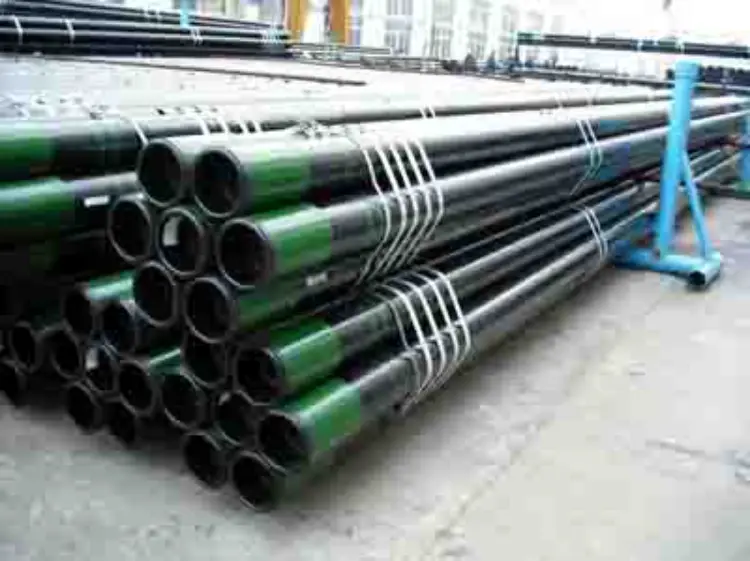
EN10025-2 S275J0 SSAW Pipe
EN10025-2 S275J0 SSAW Pipe: Non-alloy Structural Steel for Welded Tubes
Comprehensive material data for S275J0 steel according to EN 10025-2, with emphasis on its use in spiral submerged arc welded (SSAW) pipes. Includes chemical composition, mechanical properties, thermal and electrical physical properties, international equivalents, and application guidance.
Spiral submerged arc welding (SSAW), cold forming, hot forming, welding, cutting, machining
- Phone : +8618037372205
- Email : [email protected]
- WhatsApp: Contact via Whtsapp
- WeChat: +8618037372205
EN10025-2 S275J0 SSAW Pipe Introduction
S275J0 is a hot-rolled non-alloy structural steel grade specified in the European standard EN 10025-2. It is part of the S275 family, offering a minimum yield strength of 275 MPa at room temperature. The designation 'J0' indicates that the steel guarantees a minimum Charpy impact energy of 27 J at a test temperature of 0 °C. This grade is widely used in welded construction, including spiral submerged arc welded (SSAW) pipes for structural applications, piling, and low-pressure fluid transportation.
- Excellent weldability and formability
- Good toughness at zero degrees Celsius
- Balanced strength and ductility for versatile fabrication
- Available in a wide range of thicknesses and product forms
EN10025-2 S275J0 SSAW Pipe Chemical Composition
The chemical composition is based on ladle analysis according to EN 10025-2:2019, Table 5, for grade S275J0 with thicknesses ≤ 40 mm. Maximum limits are given unless a range is specified. Elements like Nb, Ti, V may be added as grain refiners; the sum of Nb+V+Ti ≤ 0.22 % is allowed but not mandatory.
- Phosphorus and sulfur are kept low to ensure good cold formability and weldability.
- Carbon equivalent (CEV) is normally below 0.40 % for thicknesses up to 30 mm.
| Element | Standard Value | Remarks |
|---|---|---|
| Carbon (C) | ≤ 0.18 % (for t ≤ 16 mm); ≤ 0.18 % (16 < t ≤ 40 mm) | For thicknesses >40 mm, refer to standard. |
| Silicon (Si) | ≤ 0.50 % | Upper limit for deoxidation. |
| Manganese (Mn) | ≤ 1.50 % (for t ≤ 16 mm); ≤ 1.50 % (16 < t ≤ 40 mm) | Higher Mn improves strength and toughness. |
| Phosphorus (P) | ≤ 0.030 % | Controlled to ensure ductility. |
| Sulfur (S) | ≤ 0.030 % | Low sulfur for good weldability. |
| Nitrogen (N) | ≤ 0.012 % | Nitrogen can be fixed by Al or other grain refiners. |
| Copper (Cu) | ≤ 0.40 % | May be present as residual element. |
| Others (Nb, V, Ti) | If added: Nb ≤ 0.05 %, V ≤ 0.05 %, Ti ≤ 0.03 %; Nb+ V+ Ti ≤ 0.22 % | Optional micro-alloying for grain refinement. |
EN10025-2 S275J0 SSAW Pipe Thermal and Electrical Physical Properties
The following thermal and electrical properties are typical for non-alloy structural steels like S275J0 at room temperature unless otherwise noted. These values are based on general engineering data for low-carbon steels and can be used for design calculations. Variations exist depending on exact chemical composition and microstructure.
- Thermal conductivity decreases and specific heat increases with temperature.
- Electrical resistivity is given for direct current at 20 °C.
| Property | Typical Value | Unit | Test Condition |
|---|---|---|---|
| Density (ρ) | 7.85 | g/cm³ | 20 °C |
| Modulus of elasticity (E) | 210 | GPa | Room temperature |
| Shear modulus (G) | Approx. 81 | GPa | Room temperature |
| Poisson's ratio (ν) | 0.3 | - | Elastic range |
| Thermal expansion coefficient (α) | 11.1 (20 – 100 °C); 12.3 (20 – 200 °C); 13.3 (20 – 400 °C) | 10⁻⁶ /K | Mean linear coefficient |
| Thermal conductivity (λ) | 53 (20 °C); 51 (100 °C); 46 (300 °C) | W/(m·K) | Typical for C-Mn steel |
| Specific heat capacity (cₚ) | 461 (20 °C); 496 (100 °C); 544 (300 °C) | J/(kg·K) | At constant pressure |
| Electrical resistivity (ρₑ) | 0.23 – 0.25 | µΩ·m | 20 °C, DC |
EN10025-2 S275J0 SSAW Pipe Mechanical Properties
Mechanical properties are specified in EN 10025-2:2019 for longitudinal or transverse test pieces depending on product form. These values apply to steel plates and wide flats intended for SSAW pipe production. For wall thicknesses up to 40 mm, the minimum yield strength is 275 MPa. Impact energy (KV) is guaranteed at 0 °C using longitudinal Charpy V-notch specimens. The requirements are valid for the base metal, not the welded joint.
- Yield strength may be slightly lower for thicknesses >16 mm.
- Elongation is measured on a gauge length of 5.65√S₀ (A5) for thicknesses ≤ 3 mm, and A for proportional test pieces otherwise.
| Property | Required Value | Unit | Test Condition |
|---|---|---|---|
| Yield Strength (ReH) | ≥ 275 (t ≤ 16 mm); ≥ 265 (16 < t ≤ 40 mm) | MPa | Ambient, as-rolled or normalized |
| Tensile Strength (Rm) | 430 – 580 (t ≤ 16 mm); 410 – 560 (16 < t ≤ 40 mm) | MPa | Ambient |
| Elongation after fracture (A) | ≥ 23 (t ≤ 3 mm, L₀=80 mm); ≥ 23 (3 < t ≤ 40 mm, L₀=5.65√S₀) | % | Longitudinal test piece |
| Charpy Impact Energy (KV) | ≥ 27 (0 °C) | J | Longitudinal, V-notch, average of 3 tests |
| Bend test (mandrel diameter) | No cracks after bending through 180°; mandrel dia: 1.5 × thickness (t ≤ 16 mm); 2.0 × thickness (16 < t ≤ 40 mm) | - | Ambient, for verification of formability |
EN10025-2 S275J0 SSAW Pipe Completely Equivalent Material Standards and Substitutable Grades
| Country/Region | Standard | Grade | Remarks |
|---|---|---|---|
| European Union | EN 10025-2:2019 | S275J0 | Direct grade, impact at 0 °C |
| International | ISO 630-2:2011 | S275J0 | Technically identical to EN version |
| Germany | DIN EN 10025-2:2019 | S275J0 | Adopted European standard |
| France | NF EN 10025-2:2019 | S275J0 | Adopted European standard |
| United Kingdom | BS EN 10025-2:2019 | S275J0 | Adopted European standard |
| Italy | UNI EN 10025-2:2019 | S275J0 | Adopted European standard |
| China | GB/T 700-2006 | Q275C | Close equivalent, yield ≥275 MPa, 0 °C impact; confirm carbon content and mechanical requirements for complete substitution |
EN10025-2 S275J0 SSAW Pipe Application Introduction
S275J0 steel is a versatile structural material suitable for welded fabrication. Its balanced strength, ductility, and guaranteed notch toughness at 0 °C make it a preferred choice for spiral-welded pipes used in moderate-temperature environments. The steel can be readily processed using standard welding techniques such as SAW, GMAW, and SMAW without preheating for limited thicknesses.
- SSAW pipes are cost-effective for large-diameter pipes.
- The material performs well in structural and piling applications where dynamic loading is not extreme.
- It may require post-weld heat treatment or normalizing depending on wall thickness and service conditions.
Product Applications: Spiral submerged arc welded (SSAW) steel pipes, Steel pipe piles, Structural hollow sections, Water mains and penstocks, Casing pipes for wells, Fabricated structural beams and columns
Processed into products: Pile pipes for docks and harbors, Foundation casings for bored piles, Truss members in industrial buildings, Bridge pier liners, Conveyor roller tubes, Low-pressure oil and gas gathering lines (subject to design code compliance), Tubular scaffolds and props
Application industries: Construction and civil engineering, Bridge building, Offshore and marine structures (limited to moderate service conditions), Piling and foundation engineering, Water and low-pressure fluid transmission, Machinery and equipment manufacturing
EN10025-2 S275J0 SSAW Pipe Similar/Comparable Alternative Materials
| Country/Region | Standard | Grade | Remarks |
|---|---|---|---|
| European Union | EN 10025-2 | S275JR | Lower toughness (room temperature impact), otherwise identical composition and strength |
| European Union | EN 10025-2 | S275J2 | Higher toughness (-20 °C impact), same strength, slight composition adjustment |
| European Union | EN 10025-2 | S235J0 | Lower yield strength (235 MPa), same impact temperature, suitable for less stressed parts |
| USA | ASTM A36/A36M-19 | A36 | Yield strength 250 MPa, no mandatory Charpy impact unless supplementary requirements; often used for structural tubes but not identical |
| China | GB/T 700 | Q235C | Yield strength 235 MPa, 0 °C impact; lower strength alternative |
| Japan | JIS G3106:2015 | SM400B | Yield strength 245 MPa, 0 °C impact; lower strength but similar weldable structural application |
Notes:
When S275J0 is used for SSAW pipes, the pipe production standard (e.g., EN 10219-1, API 5L, ASTM A252) must be consulted for additional requirements on weld seam quality, pressure testing, and dimensional tolerances.
- CEV (carbon equivalent value) is typically controlled at ≤ 0.40 % for thicknesses ≤ 30 mm to ensure good field weldability.
- Ultrasonic testing of the weld seam and hydrostatic testing are common supplementary requirements for SSAW pipes.
- For offshore or low-temperature applications, a higher toughness grade like S275J2 or S355J2 may be required.
- Surface condition and repassivation treatments are not normally required for structural use but may be specified for painting or galvanizing.
- Share



