
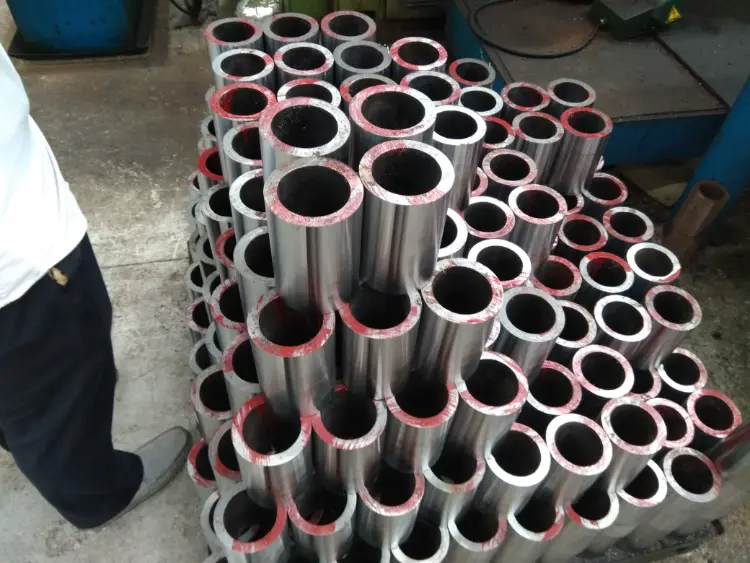
EN 10219 S355NH SSAW Pipe
EN 10219 S355NH SSAW Pipe: Superior Weldable Fine-Grain Structural Steel for Demanding Applications
Comprehensive material data for EN 10219 S355NH in spiral submerged arc welded (SSAW) pipe form, including chemical composition, mechanical and physical properties, international equivalents, and application guidance for structural engineering.
Cold forming from hot-rolled strip, spiral welding, may be supplied normalized or in normalized-rolled condition; suitable for welding, bending, flanging, and machining.
- Phone : +8618037372205
- Email : [email protected]
- WhatsApp: Contact via Whtsapp
- WeChat: +8618037372205
EN 10219 S355NH SSAW Pipe Introduction
S355NH is a fine-grain structural steel grade specified in EN 10219-1 for cold-formed welded structural hollow sections. Designed for demanding structural applications, it offers a minimum yield strength of 355 MPa in the normalized or normalized-rolled delivery condition. Its fine-grain microstructure, achieved through controlled microalloying, ensures excellent toughness, particularly at low temperatures, with guaranteed impact energy of 40 J at -20°C.
Key features:
- High strength-to-weight ratio
- Good weldability with low carbon equivalent
- Excellent ductility and cold formability
- Superior notch toughness for dynamic or low-temperature service
- Available as SSAW (Spiral Submerged Arc Welded) pipe, ideal for large-diameter structural and foundation applications
EN 10219 S355NH SSAW Pipe Chemical Composition
The chemical composition conforms to EN 10219-1, Annex A, for weldable fine-grain steels. Elements like Al, Nb, V, and Ti are added as grain refiners. The carbon equivalent (CEV) is typically controlled to ensure good weldability. Note: Single values indicate maximum contents unless a range is specified. Aluminum content is a minimum requirement for nitrogen binding.
| Chemical Element | Specified Value (wt%) | Remarks |
|---|---|---|
| Carbon (C) | ≤ 0.20 | Max. |
| Silicon (Si) | ≤ 0.50 | Max. |
| Manganese (Mn) | 0.90 - 1.65 | Range |
| Phosphorus (P) | ≤ 0.030 | Max. |
| Sulfur (S) | ≤ 0.025 | Max. |
| Nitrogen (N) | ≤ 0.015 | Max. |
| Aluminum (Al) | ≥ 0.020 | Min. total Al; grain refiner |
| Niobium (Nb) | ≤ 0.05 | Max. |
| Vanadium (V) | ≤ 0.12 | Max. |
| Titanium (Ti) | ≤ 0.05 | Max. |
| Chromium (Cr) | ≤ 0.30 | Max. |
| Nickel (Ni) | ≤ 0.80 | Max. |
| Molybdenum (Mo) | ≤ 0.10 | Max. |
| Copper (Cu) | ≤ 0.55 | Max. |
| Carbon Equivalent (CEV) | ≤ 0.43 | Typical for S355 grades; calculated per EN 10025-1 formula |
EN 10219 S355NH SSAW Pipe Thermal and Electrical Physical Properties
The following physical properties are typical for normalized fine-grain structural steel and are not part of EN 10219 mandatory requirements. They serve as design reference at ambient and elevated temperatures. Actual values may vary slightly depending on exact composition and processing.
| Property | Typical Value | Unit | Test Condition / Temperature |
|---|---|---|---|
| Density (ρ) | 7.85 | g/cm³ | Room temperature |
| Elastic Modulus (E) | 210 | GPa | Room temperature |
| Shear Modulus (G) | approx. 80 | GPa | Room temperature |
| Poisson's Ratio (ν) | 0.3 | dimensionless | Room temperature |
| Thermal Expansion Coefficient (α) | 11.7 | 10⁻⁶/K | 20 – 100 °C |
| Thermal Expansion Coefficient (α) | 12.5 | 10⁻⁶/K | 20 – 300 °C |
| Thermal Conductivity (λ) | 50 | W/(m·K) | 20 °C |
| Thermal Conductivity (λ) | 46 | W/(m·K) | 200 °C |
| Specific Heat Capacity | 460 | J/(kg·K) | 20 °C |
| Electrical Resistivity (ρe) | 0.22 | 10⁻⁶ Ω·m | Room temperature |
EN 10219 S355NH SSAW Pipe Mechanical Properties
Mechanical properties are in accordance with EN 10219-1, Table A.1, for hollow sections of fine-grain steel S355NH. Tensile testing is performed at room temperature on longitudinal test pieces. Impact testing is carried out on Charpy V-notch specimens at -20°C. Bending test (if required): For circular hollow sections, a flattening test up to 2/3 of original diameter without cracking may be specified.
| Property | Requirement | Unit | Test Condition / Note |
|---|---|---|---|
| Yield Strength (ReH) | min 355 | MPa | Wall thickness t ≤ 16 mm |
| Yield Strength (ReH) | min 345 | MPa | 16 < t ≤ 40 mm |
| Yield Strength (ReH) | min 335 | MPa | 40 < t ≤ 63 mm |
| Yield Strength (ReH) | min 325 | MPa | 63 < t ≤ 80 mm |
| Yield Strength (ReH) | min 315 | MPa | 80 < t ≤ 100 mm |
| Yield Strength (ReH) | min 295 | MPa | 100 < t ≤ 120 mm |
| Tensile Strength (Rm) | 490 – 630 | MPa | t ≤ 40 mm |
| Tensile Strength (Rm) | 470 – 610 | MPa | 40 < t ≤ 63 mm |
| Tensile Strength (Rm) | 470 – 610 | MPa | 63 < t ≤ 100 mm |
| Tensile Strength (Rm) | 450 – 590 | MPa | 100 < t ≤ 120 mm |
| Elongation (A) | min 22 | % | Gauge length L0 = 5.65√S0; t ≤ 40 mm |
| Elongation (A) | min 21 | % | 40 < t ≤ 63 mm |
| Elongation (A) | min 20 | % | 63 < t ≤ 100 mm |
| Elongation (A) | min 20 | % | 100 < t ≤ 120 mm |
| Impact Energy (KV2) | min 40 | J | Charpy V, at -20°C, longitudinal, all thicknesses |
EN 10219 S355NH SSAW Pipe Fully Equivalent Material Standards and Replaceable Grades
| Country / Region | Standard | Grade | Remarks |
|---|---|---|---|
| European Union | EN 10219-1 | S355NH | Exact standard; cold-formed welded hollow section (SSAW pipe) |
| International (ISO) | ISO 630-2 | S355N | Same normalized fine-grain concept, but for flat/long products; chemical composition and mechanical properties align for many thicknesses. |
EN 10219 S355NH SSAW Pipe Application Introduction
S355NH in SSAW pipe form is particularly suited for heavy structural applications where large diameters, high strength, and good low-temperature toughness are required. Its fine-grain structure ensures reliability under dynamic loads and in welded constructions.
Key advantages for downstream processing:
- Excellent weldability – preheating usually not necessary for moderate thicknesses at typical ambient conditions
- Can be cold bent to tight radii without cracking
- Suitable for hot-dip galvanizing
- Can be machined and drilled with standard tooling
Product Applications: SSAW large-diameter pipes and hollow sections, Structural columns and beams, Pipe piles and foundation casings, Bridge piers and pylon sections, Crane booms and lattice structures, Conveyor galleries and support frames, Offshore wind turbine monopiles, Pressure vessel shells (if certified by supplementary specification)
Processed into products: Welded pipe joints and elbows, Flanged connections for structural assemblies, Cut and beveled ends for site welding, Longitudinal stiffeners welded onto pipes, Transition cones and reducers, Bent pipe sections (induction bending), Jack-up rig legs, Lifting lugs and attachment plates
Application industries: Civil engineering and building construction, Bridge and highway infrastructure, Offshore and marine structures (platforms, jackets), Wind energy (tower sections, transition pieces), Crane and heavy lifting equipment, Mining and bulk material handling, Tubular piling and foundation engineering, Agricultural and industrial machinery
EN 10219 S355NH SSAW Pipe Similar / Comparable Substitute Materials
| Country / Region | Standard | Grade | Remarks |
|---|---|---|---|
| European Union | EN 10210-1 | S355NH | Hot-finished structural hollow section; similar strength and toughness, different processing route. |
| European Union | EN 10219-1 | S275NH / S420NH / S460NH | Same standard, different strength levels; S420NH and S460NH for higher strength needs. |
| USA | ASTM A572/A572M | Grade 50 | Comparable minimum yield strength (345 MPa), but chemical and impact requirements differ; not directly equivalent. |
| Japan | JIS G4106 | SM490A | Similar tensile strength range, but impact temperature may be 0°C or absent; requires verification. |
| Germany (superseded) | DIN 17100 | St52-3 (1.0570) | Historical grade with overlapping properties; now generally replaced by S355J2. |
Notes:
Manufacturing considerations for SSAW pipe:
- The final mechanical properties are influenced by the cold forming and welding process; the standard allows for some reduction in yield strength (Bauschinger effect) which is compensated in the guaranteed values.
- For offshore or very low-temperature environments, supplementary impact testing at -40°C or -50°C may be agreed upon.
- Hydrostatic pressure testing is not mandatory under EN 10219 but is common for pipe applications.
- Surface condition: as-rolled, optionally shot blasted and shop primed.
- All dimensions and tolerances follow EN 10219-2 for hollow sections.
- Share



