
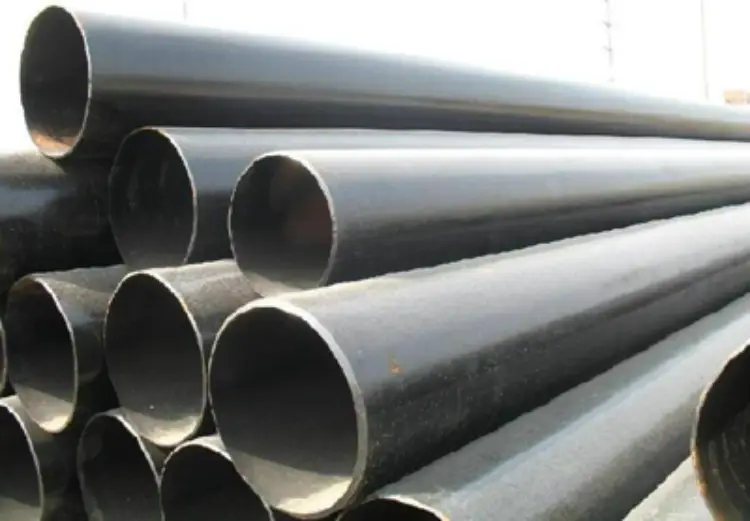
EN10219 S275NLH SSAW Pipe
EN10219 S275NLH SSAW Pipe: High-Strength Thermo-Mechanically Rolled Hollow Section for Low-Temperature Services
Detailed technical data for S275NLH spiral submerged arc welded (SSAW) pipe according to EN 10219, including chemical composition, mechanical properties, physical properties, and equivalent grades.
Cold forming, welding (SAW, SSAW), hot-dip galvanizing, machining, cutting
- Phone : +8618037372205
- Email : [email protected]
- WhatsApp: Contact via Whtsapp
- WeChat: +8618037372205
EN10219 S275NLH SSAW Pipe Introduction
S275NLH is a thermo-mechanically rolled weldable fine-grain structural steel grade for cold-formed welded structural hollow sections, specified in EN 10219. The 'N' denotes normalized or normalized rolled delivery condition, 'L' indicates suitability for low-temperature impact toughness down to -50°C, and 'H' designates hollow sections. This grade is commonly supplied as SSAW (Spiral Submerged Arc Welded) pipe, offering a balanced combination of strength, good weldability, and excellent notch toughness at sub-zero temperatures. It is widely used in heavy structural applications, offshore platforms, bridges, and construction machinery where reliable performance under cold climate is required.
EN10219 S275NLH SSAW Pipe Chemical Composition
The chemical composition according to EN 10219-1:2006 for grade S275NLH. Ladle analysis limits ensure adequate weldability and low-temperature toughness. Microalloying elements like Nb, V, Ti refine grain size and improve strength without sacrificing ductility. CEV (carbon equivalent value) is typically ≤ 0.40% for thicknesses ≤ 30 mm, enhancing weldability.
| Chemical Element | Standard Value | Remarks |
|---|---|---|
| C | ≤ 0.16 | Maximum carbon content |
| Si | ≤ 0.50 | Silicon maximum |
| Mn | 0.90 – 1.65 | Manganese range |
| P | ≤ 0.030 | Phosphorus maximum |
| S | ≤ 0.025 | Sulfur maximum |
| Nb | ≤ 0.05 | Niobium (microalloy) |
| V | ≤ 0.12 | Vanadium (microalloy) |
| Al (total) | ≥ 0.020 | Minimum total aluminium for grain refinement |
| Ti | ≤ 0.05 | Titanium maximum |
| Cr | ≤ 0.30 | Chromium maximum |
| Ni | ≤ 0.50 | Nickel maximum |
| Mo | ≤ 0.10 | Molybdenum maximum |
| Cu | ≤ 0.35 | Copper maximum |
| N | ≤ 0.015 | Nitrogen maximum |
EN10219 S275NLH SSAW Pipe Thermal and Electrical Physical Properties
Physical properties are typical for normalized fine-grain structural steels at room temperature (20°C) unless noted otherwise. Actual values may vary slightly depending on exact composition and processing route. These data support design calculations for thermal expansion, heat transfer, and electrical resistivity in structural applications.
| Property | Standard Requirement Value | Unit | Test Condition |
|---|---|---|---|
| Density (ρ) | ∼ 7850 | kg/m³ | At 20°C |
| Modulus of Elasticity (E) | ∼ 210 | GPa | At 20°C |
| Shear Modulus (G) | ∼ 81 | GPa | At 20°C |
| Poisson's Ratio (ν) | ∼ 0.3 | — | Elastic range |
| Thermal Expansion Coefficient (α) | ∼ 11.1 × 10⁻⁶ | K⁻¹ | Between 20°C and 100°C |
| Thermal Conductivity (λ) | ∼ 50 | W/(m·K) | At 20°C |
| Specific Heat Capacity | ∼ 460 | J/(kg·K) | At 20°C |
| Electrical Resistivity (ρ_e) | ∼ 0.20 – 0.25 | µΩ·m | At 20°C |
EN10219 S275NLH SSAW Pipe Mechanical Properties
Tensile and impact properties are based on EN 10219-1 for hollow sections with wall thickness ≤ 16 mm. For larger thicknesses, yield strength may be slightly reduced. Charpy V-notch impact energy at -50°C ensures ductile behavior in extreme low-temperature environments. All values are minimum required unless stated otherwise.
- Testing direction: Longitudinal (base metal, before welding).
- Applicable to SSAW pipe base material.
| Property | Standard Requirement Value | Unit | Test Condition |
|---|---|---|---|
| Yield Strength (ReH) | ≥ 275 | MPa | Wall thickness ≤ 16 mm, room temperature |
| Yield Strength (ReH) | ≥ 265 | MPa | Wall thickness 16 < t ≤ 40 mm |
| Tensile Strength (Rm) | 370 – 530 | MPa | Wall thickness ≤ 40 mm |
| Elongation (A%) | ≥ 24 | % | Longitudinal, gauge length 5.65√So |
| Elongation (A%) | ≥ 22 | % | Transverse, gauge length 5.65√So |
| Impact Energy (KV) | ≥ 27 | J | Charpy V-notch, longitudinal, -50°C |
| Bend Test | d = 2a (180°) | — | Mandrel diameter d = 2 × thickness a; no cracking for t ≤ 16 mm |
EN10219 S275NLH SSAW Pipe Completely Equivalent Material Standards and Substitutable Grades
| Country/Region | Standard | Grade | Remarks |
|---|---|---|---|
| European Union | EN 10219-1 | S275NLH | Original designation for cold-formed welded hollow sections |
| International | ISO 630-3 | Fe430D | Corresponds to S275NL with toughness class D; applicable for plates but often considered equivalent |
| Germany | DIN EN 10219-1 | S275NLH | Adopted EN standard, identical grade |
| United Kingdom | BS EN 10219-1 | S275NLH | British adoption of EN standard |
| France | NF EN 10219-1 | S275NLH | French adoption of EN standard |
| Italy | UNI EN 10219-1 | S275NLH | Italian adoption of EN standard |
EN10219 S275NLH SSAW Pipe Application Introduction
S275NLH SSAW pipe is engineered for demanding structural applications requiring reliability at low temperatures. Its fine-grain microstructure and controlled rolling ensure consistent toughness across thick sections and welded joints. Typical uses involve heavy structural frames, offshore platforms, and dynamic loading conditions. The material can be processed by cutting, welding, bending, and coating.
Product Applications: Spiral submerged arc welded (SSAW) pipes, circular hollow sections (CHS), square and rectangular hollow sections (RHS/SHS), Fabricated structural modules, bridge girders, transition pieces, Piling pipes for marine and foundation applications, Cold-formed welded beams and columns
Processed into products: Main legs and bracings of jack-up rigs and offshore platforms, Wind turbine tower shells and connecting flanges, Bridge arch ribs and truss chords, Heavy-lift crane lattice members, Earthquake-resistant building columns, Tubular supports for conveyors and material handling systems
Application industries: Offshore Oil & Gas (platform legs, jackets, caissons), Bridge Construction (truss members, piers in cold regions), Wind Energy (tower tubulars, foundation piles), Building & Infrastructure (stadiums, high-rise columns, seismic frames), Mining & Heavy Equipment (booms, chassis components), Shipbuilding (structural members, crane pedestals)
EN10219 S275NLH SSAW Pipe Similar or Alternative Material Recommendations
| Country/Region | Standard | Grade | Remarks |
|---|---|---|---|
| European Union | EN 10025-3 | S275NL | Plate equivalent; similar chemistry and mechanical properties, but not for hollow sections; impact at -50°C |
| USA | ASTM A572/A572M | Grade 50 (Type 1) | Similar yield strength; requires supplementary Charpy testing at -50°C to match toughness; not a direct hollow section standard |
| USA | ASTM A500 | Grade B/C | Structural tubing; yield strength comparable; impact toughness not specified, so not suitable for low-temperature without additional testing |
| Japan | JIS G 3106 | SM490B | Similar tensile range; impact at -10°C or -20°C typically; may be ordered with -50°C test (special requirement) |
| China | GB/T 1591-2018 | Q345D | Similar strength level; D class specifies -20°C impact; E class (Q345E) provides -40°C; not directly -50°C |
Notes:
Welding considerations: Preheating is typically not required for thicknesses up to 40 mm when using low-hydrogen processes, but interpass temperatures should be controlled. Post-weld heat treatment (PWHT) is generally not required for this material when used within design limits.
- CEV: ≤ 0.40% (typical) ensures good weldability.
- Certification: Material is supplied with EN 10204 type 3.1 or 3.2 certificates as per order.
- NDT: Ultrasonic or radiographic testing of weld seams may be specified for SSAW pipe.
- Share



