
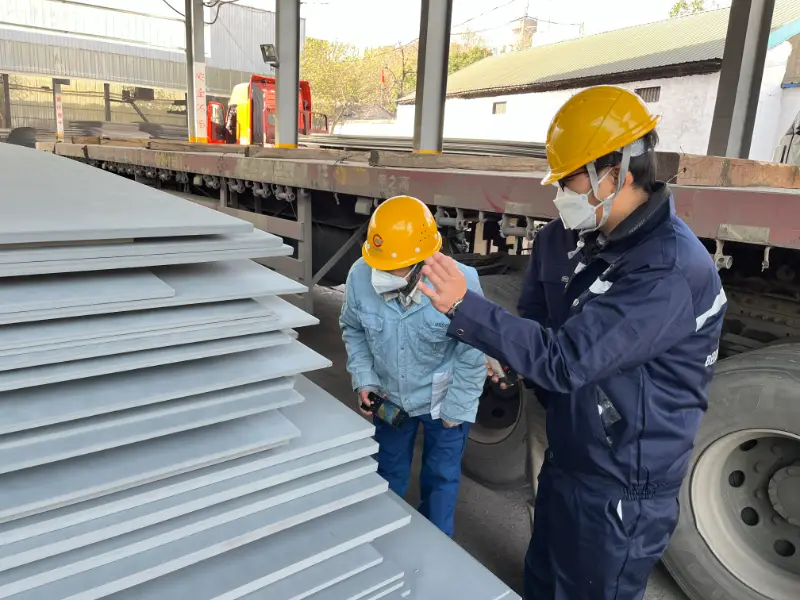
EN 10149-2 S315MC High-Strength Low-Alloy Steel
EN 10149-2 S315MC High-Strength Low-Alloy Steel for Automotive Cold Forming
S315MC is a thermomechanically rolled high-yield-strength steel for cold forming, primarily used in automotive structural components, offering minimum yield strength of 315 MPa and excellent formability.
Cold forming, bending, roll forming, stamping, welding, machining
- Phone : +8618037372205
- Email : [email protected]
- WhatsApp: Contact via Whtsapp
- WeChat: +8618037372205
EN 10149-2 S315MC High-Strength Low-Alloy Steel Introduction
EN 10149-2 S315MC is a hot-rolled, thermomechanically rolled high-yield-strength steel intended for cold forming. It belongs to the family of microalloyed steels with improved formability and weldability.
- Minimum yield strength of 315 MPa for thicknesses ≤16 mm.
- Excellent bending properties (0t bend) and good toughness down to -20°C.
- Designed for structural parts in vehicles, such as chassis and reinforcements, where weight reduction and crash performance are critical.
The thermomechanical rolling process refines the grain structure, providing a fine balance of strength and ductility.
EN 10149-2 S315MC High-Strength Low-Alloy Steel Chemical Composition
The ladle analysis limits according to EN 10149-2:2013 for grade S315MC. Elements are controlled to ensure fine grain size and precipitation hardening.
- Carbon is kept low for good weldability.
- Microalloying elements (Nb, V, Ti) contribute to grain refinement and precipitation strengthening.
- Aluminum is required for deoxidation and grain size control.
| Element | Standard Value | Remarks |
|---|---|---|
| C | ≤ 0.12 | % |
| Si | ≤ 0.50 | % |
| Mn | ≤ 1.30 | % |
| P | ≤ 0.025 | % |
| S | ≤ 0.015 | % |
| Al (total) | ≥ 0.015 | % |
| Nb | ≤ 0.09 | % |
| V | ≤ 0.20 | % |
| Ti | ≤ 0.15 | % |
| N | ≤ 0.015 | % (typical, unless agreed otherwise) |
EN 10149-2 S315MC High-Strength Low-Alloy Steel Thermal and Electrical Physical Properties
Typical physical properties for microalloyed structural steels of this category. These values are not part of the EN 10149-2 standard but are representative for design calculations.
- Density is standard for steels.
- Thermal expansion and conductivity values are average over the indicated temperature ranges.
| Property | Nominal Value | Unit | Test Condition |
|---|---|---|---|
| Density (ρ) | ~ 7850 | kg/m³ | 20 °C |
| Modulus of elasticity (E) | ~ 210 | GPa | 20 °C |
| Shear modulus (G) | ~ 80 | GPa | 20 °C |
| Poisson's ratio (ν) | ~ 0.3 | ||
| Thermal expansion coefficient (α) | ~ 11.7 × 10⁻⁶ | 1/K | 20 – 100 °C |
| Thermal conductivity (λ) | ~ 50 | W/(m·K) | 20 °C |
| Specific heat capacity (c) | ~ 490 | J/(kg·K) | 20 °C |
| Electrical resistivity (ρₑ) | ~ 0.25 | µΩ·m | 20 °C |
EN 10149-2 S315MC High-Strength Low-Alloy Steel Mechanical Properties
Mechanical properties at room temperature for thermomechanically rolled condition according to EN 10149-2. Values apply to thickness ≤16 mm unless stated otherwise. The impact test is optional and normally agreed at the time of order.
- Elongation values depend on specimen type (A80 for thickness ≤3 mm, A5 for thickness >3 mm).
- Bend test with 0t mandrel demonstrates excellent formability.
| Property | Standard Requirement | Unit | Test Condition |
|---|---|---|---|
| Yield strength (ReH) | ≥ 315 | MPa | Thickness ≤ 16 mm |
| Tensile strength (Rm) | 390 – 510 | MPa | Room temperature |
| Elongation (A80) | ≥ 20 | % | Longitudinal, thickness < 3 mm |
| Elongation (A5) | ≥ 24 | % | Longitudinal, thickness ≥ 3 mm |
| Bend test | Mandrel diameter 0t | 180°, thickness ≤ 16 mm | |
| Impact energy (KV₂) | ≥ 27 (optional) | J | -20 °C, longitudinal, min. value, thickness ≥ 6 mm |
| Impact energy (KV₂) | ≥ 40 (optional) | J | +20 °C, longitudinal, min., thickness ≥ 6 mm |
EN 10149-2 S315MC High-Strength Low-Alloy Steel Exactly Equivalent Standards and Replaceable Grades
| Country/Region | Standard | Grade | Remarks |
|---|---|---|---|
| European Union | EN 10149-2 | S315MC | Original specification |
| International | ISO 6930-2 | S315MC | Identical technical requirements |
| Germany | DIN EN 10149-2 | S315MC | Adopted EN standard |
| United Kingdom | BS EN 10149-2 | S315MC | Adopted EN standard |
| France | NF EN 10149-2 | S315MC | Adopted EN standard |
EN 10149-2 S315MC High-Strength Low-Alloy Steel Application Introduction
S315MC steel is engineered for cold-formed structural parts that require high strength, good fatigue resistance, and excellent formability. It is widely used in the automotive industry where weight reduction and energy absorption are key. The alloy design allows tight-radius bending without cracking and enables complex geometries through roll forming or stamping. Its fine grained structure also ensures consistent mechanical properties after forming.
Product Applications: Chassis longitudinal beams and cross members, Suspension control arms and mounting brackets, Door impact beams and side reinforcements, Seat frames and backrest structures, Cold-formed and welded hollow sections, Roll-formed profiles for truck frames
Processed into products: Stamped brackets and reinforcements, Welded sub-assemblies for chassis, Bent and punched parts, Laser-cut and formed plates, Structural inserts for hybrid designs
Application industries: Automotive (light commercial vehicles, passenger cars), Trailer and truck body building, Agricultural machinery, Construction and transportation, General engineering
EN 10149-2 S315MC High-Strength Low-Alloy Steel Similar/Alternative Material Recommendations
| Country/Region | Standard | Grade | Remarks |
|---|---|---|---|
| European Union | EN 10149-2 | S355MC | Higher yield strength (≥355 MPa), slightly reduced formability |
| European Union | EN 10149-2 | S260MC | Lower yield strength (≥260 MPa), more ductile |
| European Union | EN 10149-2 | S340MC | Yield ≥340 MPa, close alternative with comparable formability |
| USA | ASTM A1011/A1011M | HSLAS Grade 50 Class 1 | Yield ≥340 MPa, similar application but different chemical philosophy |
| Japan | JIS G3113 | SAPH440 | Tensile strength ≥440 MPa, for automobile structure, often replaces S315MC in thickness <6 mm |
| China | GB/T 20887.1 | HR315C | Similar thermomechanical high-strength steel for cold forming |
Notes:
Additional Information:
- EN 10149-2 specifies that S315MC is delivered in the thermomechanically rolled condition (+M) and may be supplied with a mill scale surface or descaled (pickled).
- For thicknesses above 16 mm, the minimum yield strength may be slightly reduced; consult the standard.
- Optional impact test at -20 °C (KV₂ ≥27 J) is normally agreed upon ordering for safety-critical parts.
- This grade is fully killed and fine-grained; nitrogen-binding elements (Al, Nb, Ti) ensure resistance to strain ageing.
- Welding should follow standard procedures for HSLA steels; heat input and cooling rate must be controlled to preserve mechanical properties.
- Share



