
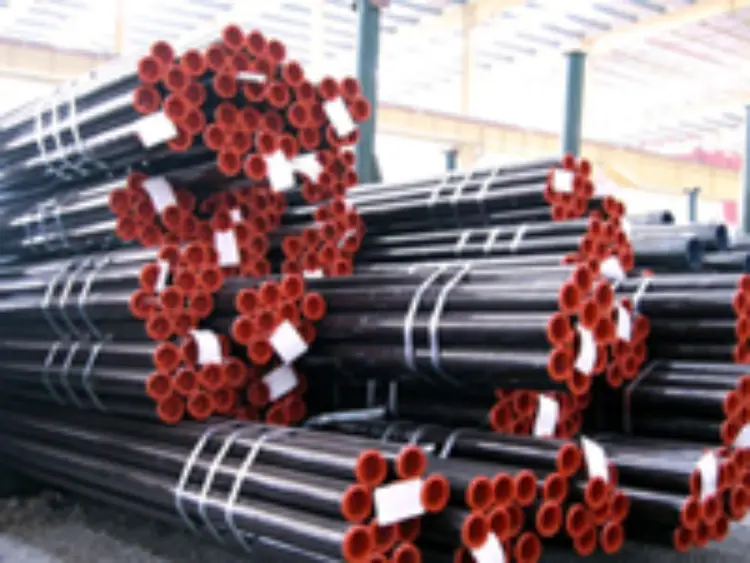
EH40 ERW Pipe Material
EH40 ERW Pipe: Marine Steel Properties, Equivalents and Welded Tube Applications
Comprehensive material data sheet for EH40 ERW pipe, a high-strength shipbuilding structural steel used for welded tubulars. Includes chemical composition, mechanical and thermal properties, international equivalents, and application guidance in offshore and marine engineering.
ERW pipe forming, hot rolling (for plates), TMCP, normalizing, welding, bending, cold forming, machining, cutting
- Phone : +8618037372205
- Email : [email protected]
- WhatsApp: Contact via Whtsapp
- WeChat: +8618037372205
EH40 ERW Pipe Introduction
EH40 ERW pipe is manufactured from EH40 grade steel, a high-strength shipbuilding structural steel primarily governed by classification society rules such as DNV, ABS, and LR. This steel is designed for welded structures in ship and offshore applications, offering a minimum yield strength of 390 MPa and guaranteed impact toughness at -40 °C. The ERW (Electric Resistance Welded) process produces longitudinal seam welded pipes suitable for structural tubing, marine piping, and various components in ship hulls and offshore platforms.
The steel is typically supplied in thermo-mechanically controlled rolled (TMCP) or normalized condition, providing a fine-grained microstructure that ensures good weldability and low-temperature toughness. EH40 ERW pipes combine high strength with excellent formability, enabling cold bending and joining by conventional welding methods. Due to rigorous impact testing requirements, these pipes are reliable in harsh, sub-zero marine environments.
EH40 ERW Pipe Chemical Composition
Chemical composition is in accordance with classification society rules for EH40 grade steel. The carbon equivalent (CEV) is typically restricted to ensure good weldability. Microalloying elements such as niobium, vanadium, and titanium may be added to achieve the required strength and toughness. Residual elements like phosphorus and sulfur are controlled at low levels to maintain ductility and impact properties.
| Element | Nominal Value (max or range) | Remarks |
|---|---|---|
| Carbon (C) | ≤0.18 % | Single element specification |
| Silicon (Si) | ≤0.50 % | Deoxidation element |
| Manganese (Mn) | 0.90 – 1.60 % | Strength and hardenability |
| Phosphorus (P) | ≤0.030 % | Controlled for toughness |
| Sulfur (S) | ≤0.030 % | Controlled for cleanliness |
| Aluminum (Als) | ≥0.015 % | Grain refining, total aluminium |
| Niobium (Nb) | ≤0.05 % | Microalloying, optional |
| Vanadium (V) | ≤0.10 % | Microalloying, optional |
| Titanium (Ti) | ≤0.02 % | Grain refinement, optional |
| Nitrogen (N) | ≤0.009 % | Maximum unless sufficient Al present |
| CEV | Typically ≤0.40 % | Carbon equivalent value (IIW formula) |
EH40 ERW Pipe Thermal and Electrical Physical Properties
The following physical properties are typical for EH40 steel in the as-supplied condition. These values are not normally part of classification requirements but are useful for design calculations. Minor variations can occur depending on the exact chemical composition and heat treatment.
| Property | Typical Value | Unit | Conditions / Remarks |
|---|---|---|---|
| Density (ρ) | 7850 | kg/m³ | At room temperature |
| Elastic Modulus (E) | 205 | GPa | At room temperature |
| Shear Modulus (G) | 80 | GPa | Calculated from E and ν |
| Poisson's Ratio (ν) | 0.3 | – | Typical for carbon-manganese steel |
| Thermal Expansion Coefficient (α) | ~12.0 × 10⁻⁶ | K⁻¹ | Between 20 °C and 100 °C |
| Thermal Conductivity (λ) | ~50 | W/(m·K) | At 20 °C |
| Specific Heat Capacity (c) | ~460 | J/(kg·K) | At 20 °C |
| Electrical Resistivity (ρ_e) | ~0.20 × 10⁻⁶ | Ω·m | At room temperature |
EH40 ERW Pipe Mechanical Properties
Mechanical properties are based on classification society requirements for EH40 steel plates and, by extension, for ERW pipe base metal. Actual properties may vary slightly depending on the final pipe dimensions and heat treatment. Bend test data refers to the plate material prior to pipe forming and may not be directly applicable to finished ERW pipes.
| Property | Specified Value | Unit | Test Condition |
|---|---|---|---|
| Yield Strength (ReH) | ≥ 390 | MPa | Thickness ≤ 50 mm, longitudinal |
| Yield Strength (ReH) | ≥ 370 | MPa | Thickness > 50 mm to 70 mm, longitudinal |
| Tensile Strength (Rm) | 510 – 650 | MPa | All thicknesses, longitudinal |
| Elongation (A5) | ≥ 20 | % | Gauge length 5.65√S0, longitudinal |
| Impact Energy (KV2) | ≥ 27 | J | At -40 °C, longitudinal, average of 3 tests |
| Impact Energy (KV2) | ≥ 20 | J | At -40 °C, longitudinal, individual test |
| Bend Test (Bend Diameter) | 3a (t ≤ 50 mm) | – | Transverse bend, a = specimen thickness; not applicable to pipe |
EH40 ERW Pipe Strict Equivalents & Fully Interchangeable Grades
| Country / Region | Standard | Grade | Remarks |
|---|---|---|---|
| International | IACS UR W11 | EH40 | Base unified requirement; adopted by all IACS members |
| Norway / Germany | DNV | EH40 | Det Norske Veritas (DNV) rules |
| USA | ABS | EH40 | American Bureau of Shipping rules |
| United Kingdom | LR | EH40 | Lloyd's Register rules |
| France | BV | EH40 | Bureau Veritas rules |
| China | CCS | EH40 | China Classification Society rules |
| Japan | NK | KE40 | Nippon Kaiji Kyokai (ClassNK) designation KE40 |
| South Korea | KR | REH40 | Korean Register designation REH40 |
| Italy | RINA | EH40 | Registro Italiano Navale rules |
| USA | ASTM A131 | Grade EH40 | Standard specification for structural steel for ships |
| Europe | EN 10225 | S355G10+M | Weldable structural steels for fixed offshore structures, TMCP condition |
EH40 ERW Pipe Application Introduction
EH40 ERW pipe is primarily utilized in marine and offshore environments where a combination of high strength, good weldability, and guaranteed low-temperature toughness is required. The pipe is produced from certified EH40 hot-rolled coil or plate, and the electric resistance welding process ensures consistent properties along the seam. These pipes find extensive use in structural and fluid service applications, especially in shipbuilding and offshore platforms operating in cold climates.
Product Applications: Hull structural members (deckhouse pillars, hull stiffeners, transverse beams), Marine piping systems (ballast, bilge, fire-fighting water, sewage), Jacket legs, conductor pipes, and pile guides, Handrails, stanchions, and grating supports, Temporary structural scaffolding in shipyard construction
Processed into products: ERW pipe sections for handrail posts and structural tubular columns, Sea chest piping and sea water intake lines, Ventilation trunks and exhaust duct supports, Piling pipes for mooring dolphins and fender systems, Pipe supports and brackets in engine room platforms, Structural bollards and fairlead foundations
Application industries: Shipbuilding (commercial and naval vessels), Offshore oil & gas exploration and production, Marine engineering and coastal infrastructure, Port and harbor construction, Renewable energy (offshore wind turbine foundations)
EH40 ERW Pipe Similar / Alternative Materials with Comparable Performance
| Country / Region | Standard | Grade | Remarks |
|---|---|---|---|
| International | IACS UR W11 | EH36 | Lower strength (min YS 355 MPa) but similar toughness (-40 °C); often a direct substitute where strength can be tolerated |
| International | IACS UR W11 | DH40 | Similar strength (min YS 390 MPa) but toughness requirement only at -20 °C; suitable for less severe cold environments |
| Europe | EN 10025-4 | S355ML | Thermo-mechanically rolled structural steel with min YS 355 MPa and -50 °C impact; close in composition and toughness but lower strength |
| USA | API 2H | Grade 50 | Offshore structural steel with min YS 345 MPa; higher toughness variant; used where EH40 ERW pipe may be substituted in platform structural tubes |
| China | CCS | EH36 | Similar to EH36 above; frequently selected for ship piping when absolute EH40 strength is not mandatory |
Notes:
ERW pipe manufacturing: EH40 ERW pipes are typically produced in accordance with classification society approvals and supplementary requirements such as DNV-OS-F101 or API 5L where applicable. The weld seam must be fully normalized or heat treated to ensure equivalent toughness to the base metal. Welding: This grade exhibits good weldability under appropriate preheat and interpass temperature control. Common welding methods include SMAW, GMAW, and SAW using low-hydrogen consumables. Corrosion: As a carbon-manganese steel, EH40 ERW pipe is not inherently corrosion resistant; protective coatings or cathodic protection are required for seawater service. Nondestructive testing: ERW pipes are usually subjected to hydrostatic testing and ultrasonic inspection of the weld, in addition to mechanical testing of the base material, per the applicable construction code.
- Share



