
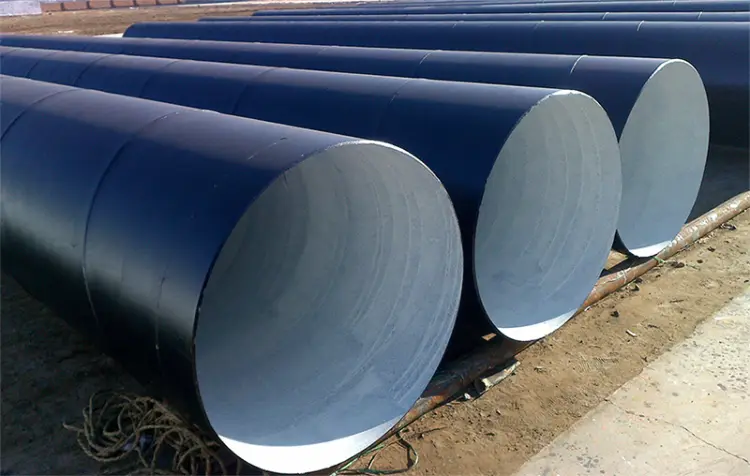
DH40 ERW Pipe Material
DH40 ERW Pipe: High-Strength Shipbuilding Steel for Welded Structural Pipes
Comprehensive material data for DH40 ERW pipe, a high-strength steel for ship and offshore structures. Covers chemical composition, mechanical properties, thermal and electrical physical properties, international equivalents, and application guide.
Steelmaking (BOF/EAF) → hot rolling or controlled rolling → normalizing (if required) → slitting into strip → ERW pipe forming and welding → testing
- Phone : +8618037372205
- Email : [email protected]
- WhatsApp: Contact via Whtsapp
- WeChat: +8618037372205
DH40 ERW Pipe Introduction
DH40 ERW pipe is manufactured from DH40 high-strength structural steel plate or strip, conforming to the rules of classification societies such as CCS, ABS, DNV, and others. The base material DH40 belongs to the high-strength hull structural steel group, with a minimum yield strength of 390 MPa and guaranteed impact toughness at -20 °C (designated by "D").
- Excellent weldability and notch toughness for cold climates.
- Suitable for electric resistance welding (ERW) to form pipes used in shipbuilding and offshore engineering.
- Delivered in hot-rolled, controlled-rolled, or normalized conditions, with subsequent ERW forming and welding.
- Compliance with GB 712-2011 and major classification society standards ensures reliability in critical structural applications.
DH40 ERW Pipe Chemical Composition
Chemical composition according to GB 712-2011 for grade DH40. Grain-refining elements (Nb, V, Ti, Al) may be added singly or in combination. All values are maximum unless a range is given.
| Element | Specified Value | Remarks |
|---|---|---|
| Carbon (C) | ≤0.18 | Ladle analysis |
| Silicon (Si) | ≤0.50 | Ladle analysis |
| Manganese (Mn) | 0.90 – 1.60 | Ladle analysis |
| Phosphorus (P) | ≤0.025 | Ladle analysis |
| Sulfur (S) | ≤0.025 | Ladle analysis |
| Copper (Cu) | ≤0.35 | Residual element |
| Chromium (Cr) | ≤0.20 | Residual element |
| Nickel (Ni) | ≤0.40 | Residual element |
| Molybdenum (Mo) | ≤0.08 | Residual element |
| Nitrogen (N) | ≤0.012 | If grain-refining elements present |
| Niobium (Nb) | 0.02 – 0.05 | Grain refiner (optional) |
| Vanadium (V) | 0.05 – 0.10 | Grain refiner (optional) |
| Titanium (Ti) | ≤0.02 | Grain refiner (optional) |
| Aluminum (Al_acid soluble) | ≥0.015 | Minimum if used as grain refiner |
DH40 ERW Pipe Thermal, Electrical and Physical Properties
Physical constants for DH40 steel at room temperature, unless otherwise noted. These values are indicative for engineering calculations and may vary slightly with heat treatment and pipe manufacturing history. Not mandatory for acceptance testing.
| Property | Typical Value | Unit | Test Condition |
|---|---|---|---|
| Density (ρ) | 7.85 | g/cm³ | 20 °C |
| Modulus of elasticity (E) | 206 | GPa | 20 °C, tensile |
| Shear modulus (G) | 80 | GPa | 20 °C, calculated from E and ν |
| Poisson's ratio (ν) | 0.3 | – | 20 °C, elastic range |
| Thermal expansion coefficient (α) | 11.7 × 10⁻⁶ | 1/K | 100 °C average |
| Thermal expansion coefficient (α) | 12.5 × 10⁻⁶ | 1/K | 300 °C average |
| Thermal conductivity (λ) | 53 | W/(m·K) | 20 °C |
| Specific heat capacity (cp) | 460 | J/(kg·K) | 20 °C |
| Electrical resistivity (ρ_e) | 0.15 | μΩ·m | 20 °C |
DH40 ERW Pipe Mechanical Properties
Tensile and impact properties per GB 712-2011 for DH40 steel plates, which also apply to the strip used for ERW pipes. Test specimens are longitudinal and taken from the base material. Impact testing is performed at -20 °C. Values may vary with pipe diameter and wall thickness; pipe body testing may be required by specific purchase specifications.
| Property | Specified Value | Unit | Test Condition |
|---|---|---|---|
| Yield Strength (ReH) | ≥390 | MPa | Thickness ≤100 mm, longitudinal |
| Tensile Strength (Rm) | 510 – 660 | MPa | Thickness ≤100 mm, longitudinal |
| Elongation after fracture (A) | ≥20 | % | Gauge length 5.65√S₀, longitudinal |
| Impact absorbed energy (KV₂) | ≥41 (average of 3 tests) | J | -20 °C, longitudinal, thickness ≤50 mm |
| Impact absorbed energy (KV₂) | ≥28 (individual value) | J | -20 °C, longitudinal, thickness ≤50 mm |
| Bend test (180°) – thickness ≤25 mm | d=3a | – | No cracks, d=bend diameter, a=specimen thickness |
| Bend test (180°) – thickness >25 mm | d=4a | – | No cracks, d=bend diameter, a=specimen thickness |
DH40 ERW Pipe Full Equivalent Material Standards and Replaceable Grades
| Country / Region | Standard / Rule | Grade | Remarks |
|---|---|---|---|
| China | GB 712-2011 | DH40 | Base standard for this material |
| International (IACS) | UR W11 | DH40 | Unified Requirement for normal and high strength hull structural steel |
| United States / International | ABS Rules | DH40 | American Bureau of Shipping |
| Norway / Germany | DNV Rules | DH40 | DNV (former GL grade DH40 identical) |
| France | BV Rules | DH40 | Bureau Veritas |
| United Kingdom | LR Rules | DH40 | Lloyd's Register |
| Japan | NK Rules | DH40 | Nippon Kaiji Kyokai (ClassNK) |
| South Korea | KR Rules | DH40 | Korean Register |
| Italy | RINA Rules | DH40 | RINA |
| Russia | RMRS Rules | DH40 or D40 | Russian Maritime Register of Shipping, equivalent high-strength grade |
DH40 ERW Pipe Application Introduction
DH40 ERW pipes combine the high strength and low-temperature toughness of DH40 steel with the cost-effectiveness of electric resistance welded tubular products. They are primarily used in ship and offshore structures where reliable mechanical properties and good weldability are essential. Typical applications include:
- Structural tubular members in ship hulls and decks
- Legs and bracing for jack-up offshore platforms
- Conductor pipes and casings for offshore wells
- High-pressure piping systems in marine environments
- Piling and mooring components
Product Applications: Ship hull stiffeners and columns, Offshore platform jacket legs and braces, Conductor pipes and risers, Deck supporting pipes and trusses, Piling pipes for jetty and quay walls
Processed into products: ERW pipe spools for ballast and bilge systems, Tubular frames for crane pedestals, Helicopter deck support pipes, Mooring bollard foundation pipes, Tension leg platform tendon pipes
Application industries: Shipbuilding, Offshore oil and gas, Marine engineering, Port and harbor construction, Renewable energy (offshore wind turbine foundations)
DH40 ERW Pipe Similar or Nearby Alternative Material Grades
These grades share the same strength level but differ in impact test temperature (toughness class) or have slightly lower strength. They can be considered for less demanding conditions or when adjustments in design are permissible.
| Country / Region | Standard / Rule | Grade | Remarks |
|---|---|---|---|
| China | GB 712-2011 | AH40 | Same strength (390 MPa), impact test at 0 °C (less stringent toughness) |
| China | GB 712-2011 | EH40 | Same strength (390 MPa), impact test at -40 °C (more stringent toughness) |
| China | GB 712-2011 | FH40 | Same strength (390 MPa), impact test at -60 °C (highest toughness class) |
| China | GB 712-2011 | DH36 | Lower yield strength (≥355 MPa), same -20 °C impact requirement |
| International | All IACS societies | AH40 / EH40 / FH40 | Equivalent toughness variants as above |
| China | GB/T 1591-2018 | Q420D | Structural steel with yield ≥420 MPa, -20 °C impact, not specifically for ship classification; requires approval |
Notes:
ERW pipe specific notes: The DH40 steel strip used for ERW pipes shall be produced from fully killed, fine-grain steel. The weld seam must be heat treated (normalized) to restore toughness if required by the specification. Non-destructive testing (e.g., ultrasonic or eddy current) is typically mandatory for classification society approval.
- The mechanical properties given in the table are for the base metal; the weld joint efficiency is assumed adequate when proper ERW procedures and post-weld heat treatment are applied.
- Hydrostatic testing may be required for pressure-containing applications.
- For offshore structural use, supplementary requirements such as through-thickness properties (Z-quality), CTOD testing, or increased inspection may be specified.
- Share



