
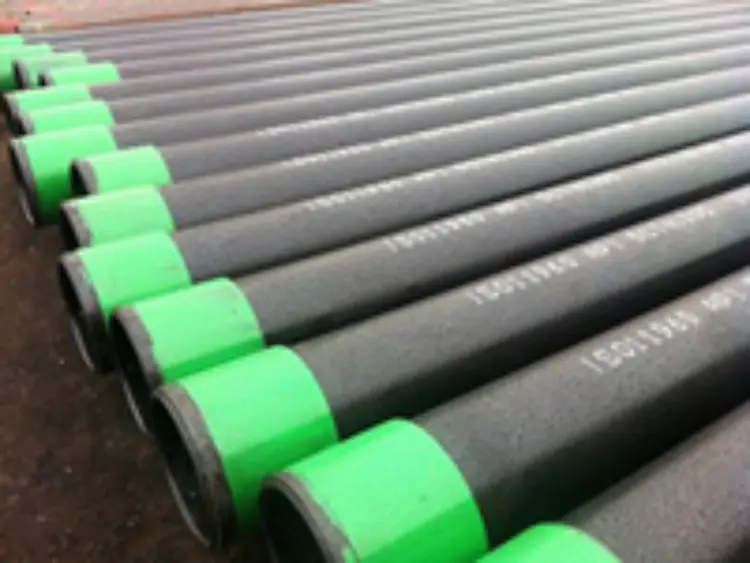
AH40 ERW Pipe Material
AH40 ERW Pipe - Shipbuilding & Offshore Structural Steel with Excellent Weldability
Detailed material data for AH40 ERW pipe: chemical composition, mechanical properties, thermal and electrical physical properties, equivalent standards worldwide, and application guidelines.
Hot rolling, controlled rolling, normalizing, TMCP; pipe forming by ERW (electric resistance welding); subsequent cold sizing, straightening, and heat treatment if required
- Phone : +8618037372205
- Email : [email protected]
- WhatsApp: Contact via Whtsapp
- WeChat: +8618037372205
AH40 ERW Pipe Introduction
AH40 is a high-strength hull structural steel grade specified in GB 712-2011 for ships and marine engineering. With a minimum yield strength of 390 MPa, it offers excellent toughness at 0°C and good weldability, making it suitable for electric-resistance-welded (ERW) pipe used in ship piping systems, offshore platforms, and structural applications. This steel is classified as a normalizing or thermo-mechanical control process (TMCP) steel, ensuring uniform mechanical properties after forming and welding. The ERW pipe form retains the base steel characteristics while providing dimensional accuracy and cost-effective production. International equivalents include ABS AH40, LR AH40, and DNV NV A40.
AH40 ERW Pipe Chemical Composition
The chemical requirements are in accordance with GB 712-2011 for grade AH40. The following elements are controlled to achieve the required strength, toughness, and weldability.
- Carbon equivalent (CEV) is typically ≤0.40% for good weldability.
- Fine grain practice with aluminum killed and microalloyed elements like Nb, V, Ti may be used but not mandatory.
| Element | Standard Value (%) | Remarks |
|---|---|---|
| C | ≤ 0.18 | Maximum content |
| Si | ≤ 0.50 | Maximum content |
| Mn | 0.90 - 1.60 | Range depending on thickness |
| P | ≤ 0.025 | Maximum content |
| S | ≤ 0.025 | Maximum content |
| Cr | ≤ 0.20 | Maximum content |
| Ni | ≤ 0.40 | Maximum content |
| Cu | ≤ 0.35 | Maximum content |
| Mo | ≤ 0.08 | Maximum content |
| Al (acid soluble) | ≥ 0.015 | Minimum for fine grain, if added |
| Nb | ≤ 0.05 | Optional microalloy; max value if used |
| V | ≤ 0.10 | Optional microalloy; max value if used |
| Ti | ≤ 0.02 | Optional microalloy; max value if used |
AH40 ERW Pipe Thermal and Electrical Physical Properties
The following values are representative for low-alloy structural steel and are applicable to AH40 grade. Actual values may vary slightly with heat treatment and exact composition.
- Density used for weight calculations.
- Thermal properties are important for welding and heat transfer applications.
- Electrical resistivity influences ERW welding efficiency.
| Property | Typical Value | Unit | Test Condition |
|---|---|---|---|
| Density (ρ) | 7.85 | g/cm³ | At 20°C |
| Modulus of Elasticity (E) | 206 | GPa | At 20°C |
| Shear Modulus (G) | 79 | GPa | Calculated from E and Poisson ratio |
| Poisson's Ratio (ν) | 0.30 | At 20°C | |
| Thermal Expansion Coefficient (α) | 12.0 | 10−⁺/K | From 20°C to 100°C |
| Thermal Conductivity (λ) | 50 | W/(m·K) | At 20°C |
| Specific Heat Capacity | 460 | J/(kg·K) | At 20°C |
| Electrical Resistivity (ρ_e) | 0.15 | Ω·mm²/m | At 20°C |
AH40 ERW Pipe Mechanical Properties
The mechanical properties apply to base material (plates/strips) used for ERW pipe production, based on GB 712-2011 for thickness ≤50 mm, in longitudinal direction. After ERW forming, the pipe body should meet equivalent values; the weld zone properties are qualified by flattening and other pipe tests.
- Impact test temperature: 0°C.
- Minimum average impact energy for full-size specimens (10x10 mm).
| Property | Specification | Unit | Test Condition |
|---|---|---|---|
| Yield Strength (ReH) | ≥ 390 | MPa | Thickness ≤ 50 mm, longitudinal |
| Tensile Strength (Rm) | 510 - 660 | MPa | Thickness ≤ 50 mm, longitudinal |
| Elongation after Fracture (A) | ≥ 20 | % | Gauge length 5.65√So; thickness ≤ 50 mm |
| Bend Test (Mandrel Diameter) | 180° no cracks, d = 3a | a = specimen thickness; if specified by purchaser | |
| Impact Energy (KV2) | ≥ 34 | J | 0°C, longitudinal, V-notch, average of 3 tests |
| Impact Energy (KV2) | ≥ 24 | J | 0°C, transverse, V-notch, average of 3 tests (if required) |
AH40 ERW Pipe Complete Equivalent Material Standards and Recommended Alternative Grades
| Country/Region | Standard | Grade | Remarks |
|---|---|---|---|
| China | GB 712-2011 | AH40 | Original standard |
| International | IACS (Unified Requirement) | UR W32/40 | AH40 corresponds to high strength hull steel with ReH ≥ 390 MPa and impact at 0°C |
| USA | ASTM A131 / ABS Rules | ABS Grade AH40 | American Bureau of Shipping equivalent |
| UK | LR Rules | LR Grade AH40 | Lloyd's Register equivalent |
| France | BV Rules | BV Grade AH40 | Bureau Veritas equivalent |
| Norway/Germany | DNV Rules | DNV NV A40 | Det Norske Veritas equivalent |
| Japan | NK Rules | NK KA40 | ClassNK equivalent |
| South Korea | KR Rules | KR RA40 | Korean Register equivalent |
| Italy | RINA Rules | RINA A40 | Registro Italiano Navale equivalent |
| Russia | RMRS Rules | PC A40 | Russian Maritime Register of Shipping equivalent |
AH40 ERW Pipe Application Introduction
AH40 ERW pipe combines the high strength and toughness of AH40 shipbuilding steel with the cost-effectiveness of electric resistance welding. It is extensively used in marine and offshore engineering where structural integrity and weight savings are essential. The pipe can be produced to various dimensional standards (e.g., API 5L, EN 10210, ISO 3183) with certification from classification societies.
- Typical applications focus on fluid transport and structural members in aggressive sea environments.
- The ERW process ensures tight tolerances and a smooth surface finish.
Product Applications: Ship hull piping (ballast, bilge, firefighting systems), Offshore platform risers and conductors, Jacket legs and bracing for offshore structures, Deck support structures and handrails, Subsea pipeline end terminals (PLETs), Structural hollow sections for buildings and bridges
Processed into products: ERW pipe sections for marine piping networks, Welded tubular nodes and joints in offshore structures, Cargo system pipelines (oil, gas, water), Heat exchanger shells (if plate/flanges added), Pile driving tubes for marine foundations, Stiffeners and columns in modular construction
Application industries: Shipbuilding and ship repair, Offshore oil & gas exploration and production, Marine engineering and port construction, Water treatment and desalination plants, Civil engineering and bridge construction, Structural steel fabrication
AH40 ERW Pipe Similar/Comparable Material Recommendations
| Country/Region | Standard | Grade | Remarks |
|---|---|---|---|
| China | GB 712-2011 | AH36 | Lower strength (ReH ≥ 355 MPa), similar temperature toughness; suitable when 390 MPa not needed |
| China | GB 712-2011 | DH40 | Same strength, better low-temperature toughness (impact at -20°C); for colder service |
| China | GB 712-2011 | EH40 | Same strength, excellent toughness (impact at -40°C); for arctic service |
| International | API 5L | X65 (L450) | Comparable yield strength (~450 MPa), but designed for line pipe with different chemistry and weldability; can be an alternative for some pipeline applications if marine certification not required |
| EU | EN 10025-4 | S420M/ML | Thermo-mechanically rolled structural steel with similar strength, used in building and offshore; not automatically certified by ship classification societies |
| USA | ASTM A572 | Grade 65 | High-strength low-alloy structural steel with min yield 450 MPa; may substitute under agreement, but not class-certified |
Notes:
For ERW (Electric Resistance Welded) pipe, the weld seam shall be normalized or heat treated to restore material properties if required by classification society rules. All pipe shall be subjected to hydrostatic testing, non-destructive testing of weld seam (e.g., ultrasonic or eddy current), and flattening tests. The maximum carbon equivalent (CEV) is typically controlled to ≤0.40% to ensure good weldability for both mill welding and on-site welding. Additional supplementary requirements such as through-thickness properties (Z-quality), ultrasonic testing of base material, or CTOD testing may be specified for critical applications. The chemical composition and mechanical properties in this data sheet refer to the base steel according to GB 712-2011; other international equivalent standards may have slight differences in allowed ranges. Verify with the specific procurement specification.
- Share



