
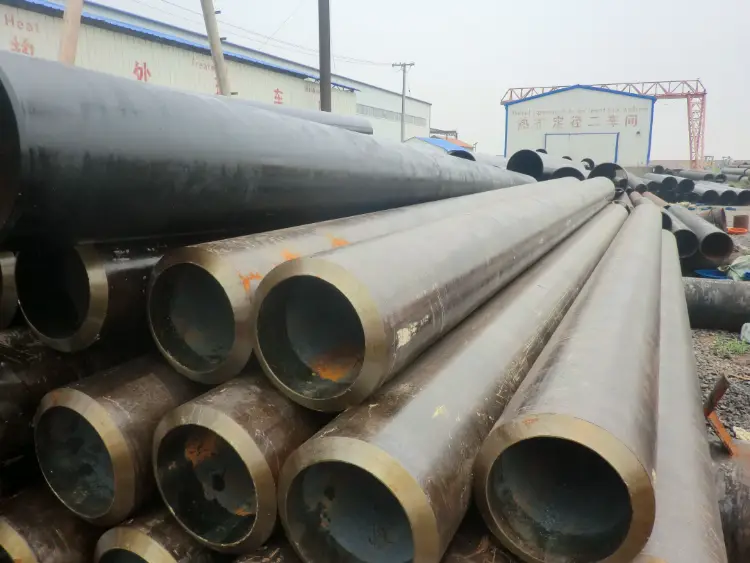
DIN 17400 1.4373 Stainless Steel Pipe
DIN 17400 1.4373 Stainless Steel Pipe | X2CrMnNiN17-7-5 Properties & Equivalents
Comprehensive technical data for DIN 17400 1.4373 (X2CrMnNiN17-7-5) stainless steel pipe, including chemical composition, mechanical and physical properties, equivalent grades, and application guidelines. Ideal for cost-effective corrosion-resistant components.
Hot forming, cold forming, machining, welding, deep drawing, bending, and solution annealing
- Phone : +8618037372205
- Email : [email protected]
- WhatsApp: Contact via Whtsapp
- WeChat: +8618037372205
DIN 17400 1.4373 Stainless Steel Pipe Introduction
DIN 17400 1.4373 stainless steel, designated X2CrMnNiN17-7-5, is a low-nickel, nitrogen-strengthened austenitic stainless steel. This grade provides an economical alternative to standard 304 stainless by partially replacing nickel with manganese and nitrogen, while maintaining good corrosion resistance and excellent formability. It is characterized by:
- Low carbon content (max 0.03%) for improved intergranular corrosion resistance after welding
- High yield strength due to nitrogen alloying, typically exceeding 350 MPa
- Good ductility and deep drawing capability in the solution-annealed condition
- Non-magnetic in the annealed condition, with potential for slight magnetism after cold working
The alloy is widely used in applications where cost efficiency, good mechanical properties, and moderate corrosion resistance are required, such as kitchen equipment, structural components, and transportation.
DIN 17400 1.4373 Stainless Steel Pipe Chemical Composition
The chemical composition of 1.4373 is carefully balanced to achieve a stable austenitic structure with reduced nickel content. The combination of manganese and nitrogen substitutes for nickel, enhancing strength while maintaining ductility. Low carbon (≤0.03%) minimizes sensitization during welding. The narrow nitrogen range ensures consistent mechanical properties.
| Chemical Element | Standard Value (wt. %) | Remarks |
|---|---|---|
| Carbon (C) | ≤ 0.03 | Low carbon for weldability |
| Silicon (Si) | ≤ 1.00 | Austenite stabilizer, deoxidizer |
| Manganese (Mn) | 6.00 – 8.00 | Key austenite former, replaces Ni |
| Phosphorus (P) | ≤ 0.045 | Impurity control |
| Sulfur (S) | ≤ 0.015 | For improved formability |
| Chromium (Cr) | 16.00 – 18.00 | Primary corrosion resistance |
| Nickel (Ni) | 3.50 – 5.50 | Stabilizes austenite |
| Nitrogen (N) | 0.15 – 0.25 | Strength and austenite stabilizer |
DIN 17400 1.4373 Stainless Steel Pipe Physical, Thermal & Electrical Properties
Physical properties are typical for the 1.4373 grade in the solution-annealed condition. They provide essential data for design and thermal calculations. Thermal expansion is similar to other Cr-Ni austenitic steels. The thermal conductivity and electrical resistivity reflect the alloying additions and influence heat transfer and electric heating applications.
| Property | Typical Value | Unit | Test Condition / Remarks |
|---|---|---|---|
| Density (ρ) | 7.8 | g/cm³ | 20°C |
| Modulus of Elasticity (E) | 200 | GPa | 20°C |
| Shear Modulus (G) | 77 | GPa | 20°C, calculated |
| Poisson Ratio (ν) | 0.3 | — | 20°C |
| Thermal Expansion Coefficient (α) | 16.0 | 10⁻⁶/K | 20–100°C |
| Thermal Expansion Coefficient (α) | 17.0 | 10⁻⁶/K | 20–200°C |
| Thermal Expansion Coefficient (α) | 17.5 | 10⁻⁶/K | 20–400°C |
| Thermal Conductivity (λ) | 15 | W/(m·K) | 20°C |
| Specific Heat Capacity (cp) | 500 | J/(kg·K) | 20°C |
| Electrical Resistivity (ρe) | 0.75 | Ω·mm²/m | 20°C |
DIN 17400 1.4373 Stainless Steel Pipe Mechanical Properties
Mechanical properties are guaranteed in the solution-annealed condition as per the original DIN 17400 specification and confirmed by EN 10088-2/3. Values refer to room temperature unless otherwise noted. Yield strength and tensile strength vary with product form and thickness; larger cross-sections may exhibit slightly lower strength. No impact test is mandated for this grade.
| Property | Standard Requirement | Unit | Test Condition |
|---|---|---|---|
| Yield Strength (Rp0.2) | ≥ 350 | MPa | Transverse, sheet/strip ≤6 mm |
| Yield Strength (Rp0.2) | ≥ 330 | MPa | Transverse, sheet/strip >6 mm |
| Yield Strength (Rp1.0) | ≥ 390 | MPa | Transverse, sheet/strip ≤6 mm |
| Tensile Strength (Rm) | 700 – 950 | MPa | All thicknesses |
| Elongation (A) | ≥ 25 | % | Longitudinal, thickness >6 mm (gauge length 5.65√S0) |
| Elongation (A80) | ≥ 20 | % | Sheet/strip ≤6 mm (80 mm gauge) |
| Bend Test (Bend Angle 180°) | D ≤ 0.5a | — | Bend diameter D, specimen thickness a ≤6 mm |
| Bend Test (Bend Angle 180°) | D ≤ 1.0a | — | Thickness >6 mm |
DIN 17400 1.4373 Stainless Steel Pipe Fully Equivalent Material Standards & Substitution Grades
| Country/Region | Standard | Designation / Grade | Remarks |
|---|---|---|---|
| Europe | EN 10088-1 | X2CrMnNiN17-7-5 (1.4373) | Identical chemical and mechanical requirements, supersedes DIN 17400 |
| International | ISO 15510 | X2CrMnNiN17-7-5 | Identical composition definition |
| Austria | ÖNORM EN 10088 | X2CrMnNiN17-7-5 (1.4373) | Same EN standard |
| China | GB/T 20878 | 12Cr17Mn7Ni5N (S35650) | Close equivalent, slightly higher C (≤0.12). Confirm exact match with manufacturer. |
DIN 17400 1.4373 Stainless Steel Pipe Application Introduction
Due to its balanced combination of cost efficiency, good formability, and moderate corrosion resistance, 1.4373 is ideally suited for mass-produced components where the high nickel content of 304 is not justified. The low carbon enables reliable welding, while nitrogen ensures high strength in thin-gauge designs. Typical application areas include:
Product Applications: Seamless and welded pipes for low-pressure fluid transport, Deep-drawn kitchen sinks and countertops, Cookware, cutlery, and catering containers, Automotive trim, exhaust system sleeves (non-hot parts), Lightweight structural hollow sections, Heat exchanger tubes (moderate temperature)
Processed into products: Pipe spools and fittings (elbows, tees), Pressed and drawn parts (sink bowls, canisters), Welded assemblies for frames and racks, Thin-walled instrument tubing, Architectural handrails and balustrades
Application industries: Household & Catering Equipment, Automotive & Transportation, Architecture & Construction, Industrial Machinery, Food Processing
DIN 17400 1.4373 Stainless Steel Pipe Similar / Analogous Alternative Materials
| Country/Region | Standard | Designation / Grade | Remarks |
|---|---|---|---|
| USA | ASTM A240 | UNS S20103 (201L) | Low-carbon 201, C≤0.03, Mn5.5-7.5, Ni3.5-5.5, N0.20-0.40. Slightly wider Mn range. |
| Japan | JIS G4304 | SUS201L | C≤0.03, Mn5.5-7.5, Ni3.5-5.5, N≤0.25. Comparable formability. |
| Europe | EN 10088-2 | 1.4372 (X12CrMnNiN17-7-5) | Higher carbon (≤0.12) version, lower welding suitability but similar strength. |
| Europe | EN 10088-2 | 1.4310 (X10CrNi18-8) | Classic 301 grade, higher Ni but no Mn alloying; used for springs. |
| Worldwide | — | Type 304 (1.4301) | Higher Ni (8-10.5%) and better corrosion resistance; not an exact substitute but frequently compared. |
Notes:
DIN 17400 has been officially withdrawn and replaced by the EN 10088 series (EN 10088-2 for plates/sheets, EN 10088-3 for bars, EN 10217-7 for welded tubes, EN 10216-5 for seamless tubes). The 1.4373 designation remains valid under EN 10088-1. When specifying pipe to 1.4373, it is recommended to reference the appropriate European pipe standard (e.g., EN 10217-7 for welded pipes). In the solution-annealed condition, the material is non-magnetic; however, cold forming can induce martensite formation and slight magnetism. Please verify the latest standard editions for mandatory chemical and mechanical requirements.
- Share



