
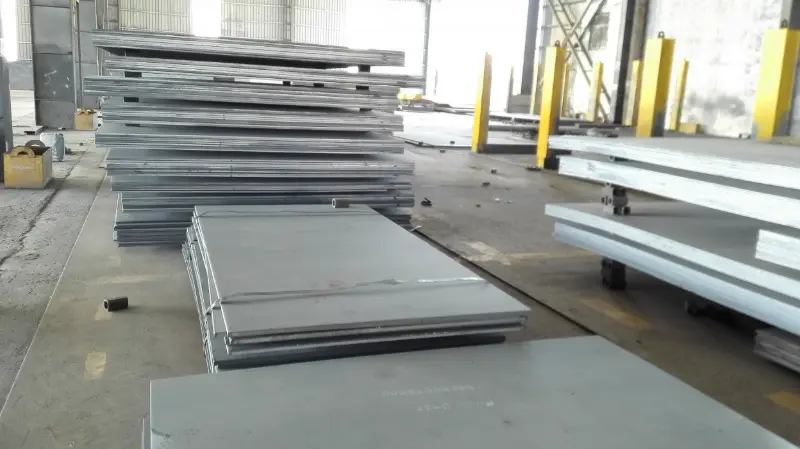
DIN 17102 TStE420 High-Strength Low-Alloy Structural Steel
DIN 17102 TStE420 High-Strength Low-Alloy Structural Steel: Properties & Equivalents
Explore DIN 17102 TStE420 carbon and low-alloy high-strength steel coil: chemical composition, mechanical properties, thermal properties, and international equivalents.
Hot rolling, Normalizing, Controlled rolling, Welding, Forming
- Phone : +8618037372205
- Email : [email protected]
- WhatsApp: Contact via Whtsapp
- WeChat: +8618037372205
DIN 17102 TStE420 High-Strength Low-Alloy Structural Steel Introduction
DIN 17102 TStE420 is a weldable fine-grain structural steel designed for high-strength applications, with a minimum yield strength of 420 MPa in the as-delivered condition (typically normalized). It belongs to the family of carbon and low-alloy high-strength (HSLA) steels and is characterized by its excellent combination of strength, toughness, and weldability. Key features: controlled chemical composition with microalloying elements (Nb, V, Ti) ensures fine grain refinement and good low-temperature notch toughness; low carbon equivalent (Ceq) permits reliable welding without excessive preheating.
- Commonly supplied in normalized condition, guaranteeing uniform mechanical properties across the thickness.
- Available as coil, plate, and strip, suitable for hot rolling, forming, and welding processes.
- Its superior low-temperature impact energy (typically ≥27 J at -20°C) makes it ideal for structural components exposed to cold climates.
This grade is widely used in bridge building, pressure vessels, offshore structures, and heavy machinery where weight savings and high structural integrity are critical.
DIN 17102 TStE420 High-Strength Low-Alloy Structural Steel Chemical Composition
The chemical composition of TStE420 conforms to DIN 17102 and is aligned with the typical analysis of EN 10025-3 S420N. The limits ensure good weldability and adequate toughness. Control philosophy: Carbon is limited to ≤0.20% to maintain weldability; Manganese (1.00–1.70%) provides solid solution strengthening without impairing ductility. Microalloying elements such as Niobium, Vanadium, and Titanium are added singly or in combination for grain refinement and precipitation hardening, while total aluminum content is specified to ensure fine-grain practice.
- Phosphorus and Sulfur are kept low (≤0.035% and ≤0.030% respectively) to enhance ductility and impact toughness.
- Residual elements (Cr, Ni, Mo, Cu) are controlled to avoid adverse effects on weldability; higher copper contents may be allowed by agreement.
- The carbon equivalent (Ceq) is typically ≤0.45, ensuring cold cracking resistance during welding.
| Element | Value (wt%) | Remarks |
|---|---|---|
| C | ≤0.20 | |
| Si | ≤0.60 | |
| Mn | 1.00 – 1.70 | |
| P | ≤0.035 | |
| S | ≤0.030 | |
| Altotal | ≥0.020 | fine-grain forming element; if Nb, V, or Ti are present, lower Al may be accepted |
| Nb | ≤0.05 | optional microalloy, typical for grain refinement |
| V | ≤0.20 | optional microalloy, typical ≤0.12 wt% |
| Ti | ≤0.05 | optional microalloy |
| Cr | ≤0.30 | residual |
| Ni | ≤0.80 | residual |
| Mo | ≤0.20 | residual |
| Cu | ≤0.55 | residual; higher if agreed |
DIN 17102 TStE420 High-Strength Low-Alloy Structural Steel Thermal and Electrical Physical Properties
The values listed below are typical for low-alloy structural steels of this class and can be used for engineering calculations. Actual properties may vary slightly depending on exact composition and heat treatment. Thermal expansion coefficient increases with temperature and is similar to that of conventional carbon steels, ensuring compatibility in composite structures. Thermal conductivity decreases as temperature rises, while specific heat capacity shows a moderate increase.
- Elastic modulus (E) decreases approximately 3–4% per 100°C rise above ambient; the value at 200°C is about 200 GPa.
- Electrical resistivity is typical of ferritic steels and is sufficient for magnetic applications but not for high-conductivity requirements.
| Property | Typical Value | Unit | Condition |
|---|---|---|---|
| Density (ρ) | 7.85 | g/cm³ | at 20°C |
| Modulus of Elasticity (E) | 210 | GPa | at 20°C |
| Shear Modulus (G) | 81 | GPa | at 20°C |
| Poisson's Ratio (ν) | 0.3 | — | |
| Thermal Expansion Coefficient (α) | 11.7 × 10&supminus;&sup6; | 1/K | 20–100°C |
| Thermal Expansion Coefficient (α) | 12.5 × 10&supminus;&sup6; | 1/K | 20–200°C |
| Thermal Expansion Coefficient (α) | 13.2 × 10&supminus;&sup6; | 1/K | 20–300°C |
| Thermal Conductivity (λ) | 42 | W/(m·K) | at 100°C |
| Thermal Conductivity (λ) | 40 | W/(m·K) | at 200°C |
| Specific Heat Capacity (c) | 460 | J/(kg·K) | at 20°C |
| Electrical Resistivity (ρe) | 0.25 × 10&supminus;&sup6; | Ω·m | at 20°C, typical for low-alloy steel |
DIN 17102 TStE420 High-Strength Low-Alloy Structural Steel Mechanical Properties
Mechanical properties are determined on transverse test pieces in accordance with DIN 17102. The steel is normally supplied in normalized condition, and the values below apply to that delivery state. Yield and tensile strength vary with product thickness, while elongation requirements slightly decrease for thicker sections. Impact energy is measured on longitudinal Charpy V-notch specimens at -20°C; the average of three tests must be ≥27 J with no single value below 70% of the average.
- Bending performance is verified by a 180° bend test with a mandrel diameter of 3 times the sample thickness (d=3a); no cracking is permitted.
- For thicknesses beyond 70 mm, properties may be agreed upon at the time of order.
- Higher impact energies or lower test temperatures (e.g., -40°C) can be supplied under other quality designations, such as the "V" suffix (TStE420V).
| Property | Required Value | Unit | Test Condition |
|---|---|---|---|
| Yield Strength (ReH) | ≥420 | MPa | thickness ≤16 mm, transverse |
| Yield Strength (ReH) | ≥400 | MPa | thickness 16–35 mm |
| Yield Strength (ReH) | ≥380 | MPa | thickness 35–50 mm |
| Yield Strength (ReH) | ≥360 | MPa | thickness 50–70 mm |
| Tensile Strength (Rm) | 500 – 650 | MPa | all thicknesses, transverse |
| Elongation (A) | ≥19 | % | L0=5.65√S0, long., thickness ≤16 mm |
| Elongation (A) | ≥18 | % | thickness 16–35 mm |
| Elongation (A) | ≥17 | % | thickness 35–50 mm |
| Elongation (A) | ≥16 | % | thickness 50–70 mm |
| Impact Energy (KV) at -20°C | ≥27 (avg.) / ≥19 (single min) | J | longitudinal, Charpy V-notch, 10×10 mm specimen |
| Bend Test, 180° | d=3a (no crack) | — | a = specimen thickness |
DIN 17102 TStE420 High-Strength Low-Alloy Structural Steel Complete Equivalent Standards and Replaceable Grades
| Country/Region | Standard | Grade | Remarks |
|---|---|---|---|
| Germany | DIN 17102 | TStE420 | Original standard; weldable fine-grain steel in normalized condition, -20°C impact |
| European Union | EN 10025-3 | S420N | Direct replacement; normalized fine-grain steel with equivalent strength and impact requirements |
| European Union | EN 10025-3 | S420NL | Low temperature variant (≥27 J at -50°C); suitable when lower design temperatures are required |
| International | ISO 4950-2 | E420 | High yield strength flat products; technical delivery conditions correspond to normalized fine-grain steel |
| USA | ASTM A572/A572M | Grade 60 [415] | Yield strength min 415 MPa; similar strength level but may require supplementary toughness requirements to match TStE420 |
| China | GB/T 1591-2018 | Q420D | High-strength low-alloy structural steel; yield strength ≥420 MPa and -20°C impact, comparable in many applications |
DIN 17102 TStE420 High-Strength Low-Alloy Structural Steel Application Introduction
TStE420 (and its modern equivalent S420N) is engineered for heavy welded structures that demand high strength, excellent toughness, and reliable service in dynamic and low-temperature environments. Design and fabrication benefits: the steel can be formed, cut, and welded using standard procedures, although appropriate preheating and interpass temperatures should be observed for thick sections.
- The fine-grain structure provides good fatigue resistance, making it suitable for bridges, cranes, and offshore structures subject to cyclic loading.
- In pressure vessel construction, it complies with many international codes when supplementary impact testing is performed.
- Its strength-to-weight ratio allows for material savings and lighter structures without sacrificing safety.
Typical processing includes hot rolling to final shape, followed by normalizing for grain refinement. Post-weld heat treatment (stress relieving) may be applied as needed.
Product Applications: Welded bridge girders and box sections, Offshore platform legs, nodes, and modules, Pressure vessels and heat exchangers, Crane booms, jibs, and outriggers, Wind turbine tower sections, Heavy-duty truck frames and railcar underframes
Processed into products: Main longitudinal beams and crossbeams in bridges, Stiffeners and diaphragms, Flanges, web plates, and splice connectors, Pin-connected tension members, Reinforcement rings and nozzles in pressure vessels, Lifting lugs and padeyes, Brackets and base plates for heavy equipment
Application industries: Construction and Civil Engineering (bridges, high-rise buildings), Offshore and Marine Engineering (platforms, shipbuilding), Pressure Vessel and Boiler Manufacturing, Heavy Machinery and Earthmoving Equipment, Renewable Energy (wind turbine towers and foundations), Transportation (railway wagons, heavy vehicle chassis)
DIN 17102 TStE420 High-Strength Low-Alloy Structural Steel Similar/Alternative Materials Recommendation
| Country/Region | Standard | Grade | Remarks |
|---|---|---|---|
| European Union | EN 10025-4 | S420M / S420ML | Thermomechanical rolled (M) grades with similar yield strength; often preferred for heavier sections due to lower carbon equivalent |
| China | GB/T 1591-2018 | Q420E | Higher toughness variant: ≥27 J at -40°C; otherwise similar strength and chemical composition to TStE420 |
| Japan | JIS G3106 | SM490B / SM490C | Weldable structural steel with nominal yield of 325–365 MPa; lower strength but widely used for general welded structures |
| USA | ASTM A709/A709M | Grade 50W [345] / HPS 70W [485] | Weathering steel grades with different strength levels; Grade 50W provides toughness but lower strength, HPS 70W higher strength |
| Russia | GOST 19281 | 09G2S | Low-alloy structural steel with nominal yield ≥345 MPa; widely used for welded structures at low temperatures, but strength lower than TStE420 |
Notes:
Welding recommendations: Use low-hydrogen processes and filler metals matching the base metal strength. Preheating to 100–150°C is advisable for thicknesses above 30 mm, with a maximum interpass temperature of 250°C. Post-weld heat treatment (PWHT) at 530–580°C may be applied to relieve residual stresses; however, prolonged holding times can affect microalloy precipitation and strength. Corrosion protection: As a non-weathering steel, TStE420 requires protective coatings (painting, galvanizing) for outdoor exposure. Availability: Supplied with inspection certificates (e.g., EN 10204 3.1), detailing chemical analysis, tensile properties, impact values, and, if required, ultrasonic testing results. Always confirm the exact property requirements with the material certificate for the specific heat/lot.
- Share



