
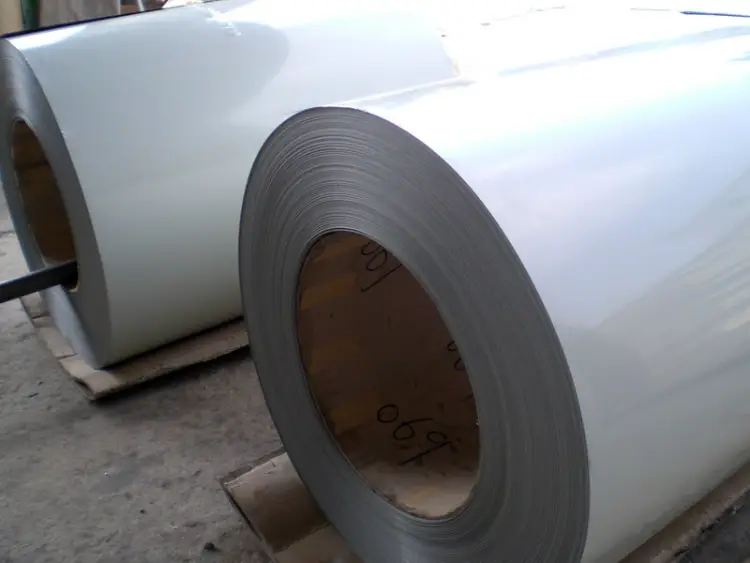
DIN 17102 EStE420 Weldable Fine-Grain Structural Steel Coil
DIN 17102 EStE420 Weldable Fine-Grain Structural Steel Coil - High Strength & Good Toughness
DIN 17102 EStE420 is a thermomechanically rolled weldable fine-grain structural steel with a minimum yield strength of 420 MPa. It offers excellent weldability, good cold-forming properties, and reliable low-temperature impact toughness, making it suitable for heavy-duty steel structures, mobile cranes, and construction machinery.
Thermomechanical rolling; suitable for cold forming, welding, machining, and hot-dip galvanizing
- Phone : +8618037372205
- Email : [email protected]
- WhatsApp: Contact via Whtsapp
- WeChat: +8618037372205
DIN 17102 EStE420 Weldable Fine-Grain Structural Steel Coil Introduction
EStE420 is a low-carbon, low-alloy, weldable fine-grain structural steel supplied as hot-rolled coils under the German standard DIN 17102. It is designed for structural applications demanding high strength, superior weldability, and consistent toughness at low temperatures. The steel is thermomechanically rolled and achieves its mechanical properties through a combination of controlled rolling and microalloying elements (Nb, V, Ti). Typical characteristics include:
- Minimum yield strength of 420 MPa for thicknesses up to 16 mm
- Tensile strength in the range of 520–680 MPa
- Minimum elongation of 19% (transverse)
- Excellent Charpy-V impact energy at -20°C (≥40 J longitudinal)
- Good cold-bendability (180° with mandrel diameter 2t)
- Outstanding weldability with all conventional welding processes
The steel is often used in mobile cranes, heavy-duty machinery, bridges, offshore structures, and pressure vessels when normalized or stress-relieved welded joints are required.
DIN 17102 EStE420 Weldable Fine-Grain Structural Steel Coil Chemical Composition
The steel is low-alloyed and microalloyed to achieve fine grain size and required mechanical properties. The ladle analysis limits comply with DIN 17102 for grade EStE420. Grain-refining elements such as Nb, V, and Ti may be used individually or in combination. The total content of these elements is restricted to avoid excessive precipitation hardening. The steel is fully killed and aluminum-treated.
| Element | Standard Value (max, unless range) | Remarks |
|---|---|---|
| Carbon (C) | ≤ 0.22 | Ladle |
| Silicon (Si) | ≤ 0.60 | Ladle |
| Manganese (Mn) | 1.00 – 1.70 | Ladle |
| Phosphorus (P) | ≤ 0.035 | Ladle |
| Sulfur (S) | ≤ 0.035 | Ladle |
| Aluminium (Al total) | ≥ 0.02 | Ladle; fully killed |
| Niobium (Nb) | ≤ 0.05 | Grain-refining microalloy |
| Vanadium (V) | ≤ 0.12 | Grain-refining microalloy |
| Titanium (Ti) | ≤ 0.05 | Grain-refining microalloy |
| Nitrogen (N) | ≤ 0.015 | Nitrogen-binding elements present |
| Others (Cr+Cu+Mo) | ≤ 0.80 | Residual elements, if not ordered |
DIN 17102 EStE420 Weldable Fine-Grain Structural Steel Coil Physical Properties
These physical properties are typical for low-alloy structural steels of this strength class. They are not part of the mandatory acceptance tests in DIN 17102 but are widely used for design and calculation purposes. Values are valid at ambient temperature unless otherwise noted.
| Property | Typical Value | Unit | Test Condition / Remarks |
|---|---|---|---|
| Density (ρ) | 7.85 | g/cm³ | At 20°C |
| Elastic modulus (E) | 210 | GPa | At 20°C |
| Shear modulus (G) | 81 | GPa | Approximate, based on v = 0.3 |
| Poisson's ratio (ν) | 0.3 | – | Room temperature, elastic range |
| Thermal expansion coefficient (α) | 12.0 | 10⁻⁶/K | Between 20°C and 100°C |
| Thermal conductivity (λ) | 50 | W/(m·K) | At 20°C |
| Specific heat capacity (cp) | 460 | J/(kg·K) | At 20°C |
| Electrical resistivity (ρe) | 0.22 | μΩ·m | At 20°C |
DIN 17102 EStE420 Weldable Fine-Grain Structural Steel Coil Mechanical Properties
The mechanical properties are guaranteed in the as-delivered condition. Values depend on product thickness. The below table gives the requirements for thickness ≤16 mm (the most common delivery range). Testing is performed on transverse specimens unless otherwise agreed. The bend test is carried out at room temperature. The impact test temperature is -20°C.
| Property | Standard Requirement | Unit | Test Condition / Remarks |
|---|---|---|---|
| Upper yield strength (ReH) | ≥ 420 | MPa | Thickness ≤ 16 mm, transverse |
| Tensile strength (Rm) | 520 – 680 | MPa | Thickness ≤ 16 mm, transverse |
| Elongation after fracture (A) | ≥ 19 | % | Gauge length L0 = 80 mm (or proportional), transverse |
| Yield-to-tensile ratio (ReH/Rm) | ≤ 0.85 | – | Typical indicative value |
| Bend test (mandrel diameter) | No cracks: 180° bend, d = 2a | – | a = specimen thickness; room temperature |
| Charpy-V impact energy (KV) | ≥ 40 | J | Longitudinal, -20°C; average of 3 specimens; min. single value 28 J |
DIN 17102 EStE420 Weldable Fine-Grain Structural Steel Coil Equivalent Standards and Substitutable Grades
| Country/Region | Standard | Grade | Remarks |
|---|---|---|---|
| European Union | EN 10149-2 | S420MC | Thermomechanically rolled, high yield strength for cold forming; nearly identical chemical concept and mechanical properties |
| European Union | EN 10025-3 | S420N | Normalized/normalized rolled weldable fine grain structural steel; toughness at -20°C; similar strength |
| International | ISO 4950-2 | E420 D | High yield strength flat products; similar strength and impact properties |
| Germany (former) | DIN 17102 | EStE420 | Original designation; fully replaceable by S420MC per EN 10149-2 |
DIN 17102 EStE420 Weldable Fine-Grain Structural Steel Coil Application Introduction
EStE420, now typically supplied as S420MC or S420N, is engineered for weight-optimized welded structures operating under dynamic loads and at low ambient temperatures. It is the material of choice when designers need to reduce thickness without sacrificing safety or fatigue life. The steel exhibits excellent weldability (CEV typically ≤0.45), enabling cost-effective fabrication with preheat-free welding up to medium plate thicknesses. Typical applications include:
- Boom and chassis components of mobile and crawler cranes
- Welded members of heavy-duty trailers and tipper bodies
- Earthmoving and mining machinery (loader arms, excavator booms)
- Welded bridge girders and structural nodes
- Offshore platform substructures and deck plating
- Pressure vessels and water turbines (when normalized welding is applied)
- Wind turbine towers and transition pieces
Product Applications: Mobile crane telescopic booms and outriggers, Excavator arms and buckets, Mining dump truck frames, Welded bridge box girders, Offshore platform decks and jacket legs, Wind tower flanges and door frames, High-pressure hydraulic tanks and penstocks, Forklift masts and carriage profiles
Processed into products: Structural hollow sections (SHS, RHS) for frames, Bent and welded sheet metal parts, Laser-cut and plasma-cut blanks, Stiffeners, brackets, and gussets, Machined welding preparation edges for butt welds, Cold-formed sections (U-channels, angles, Z-profiles), Flame-cut and drilled connecting plates
Application industries: Construction machinery (mobile cranes, bulldozers, excavators), Transportation (heavy-duty trucks, trailers, railway wagons), Bridge building and structural engineering, Offshore and marine engineering, Renewable energy (wind turbine towers), Mining and mineral processing equipment, General heavy steel fabrication
DIN 17102 EStE420 Weldable Fine-Grain Structural Steel Coil Similar / Closely Related Materials for Engineering Consideration
| Country/Region | Standard | Grade | Remarks |
|---|---|---|---|
| European Union | EN 10025-4 | S420ML | Thermomechanically rolled weldable fine grain structural steel; guaranteed impact energy at -50°C; slightly higher toughness class |
| European Union | EN 10025-6 | S420QL | Quenched and tempered structural steel; high strength with improved toughness (ML: -50°C); suitable for thicker sections |
| USA | ASTM A1011 / A1011M | Grade 60 (60 ksi) | HSLAS Grade 60, min yield 410 MPa, similar strength level, but different chemical concept |
| Japan | JIS G 3135 | SPFC590Y | Cold-rolled, high-strength steel sheet with improved formability; similar yield strength but thinner gauges |
| China | GB/T 1591 | Q420D | High strength low alloy structural steel, delivered in normalized or TMCP condition; yield 420 MPa, impact at -20°C |
Notes:
DIN 17102 has been withdrawn and replaced by European standards EN 10149-2 and EN 10025-3. The designation EStE420 remains commonly used in legacy drawings and procurement specifications. Modern orders should refer to S420MC (hot-rolled, thermomechanically rolled, suitable for cold forming) or S420N (normalized rolling). For welded structures requiring post-weld heat treatment (PWHT), normalized grades (S420N) are preferred because thermomechanically rolled grades may suffer strength loss. When specifying, state the desired delivery condition, impact test temperature, and any supplementary requirements (e.g., Z-quality for lamellar tearing resistance, stricter flatness tolerances, or through-thickness property testing per EN 10164). Thicknesses above 50 mm may require modified chemistry and special welding procedures. Always consult the latest normative documents and welding standards (EN 1011, ISO 15614) for fabrication.
- Share



