
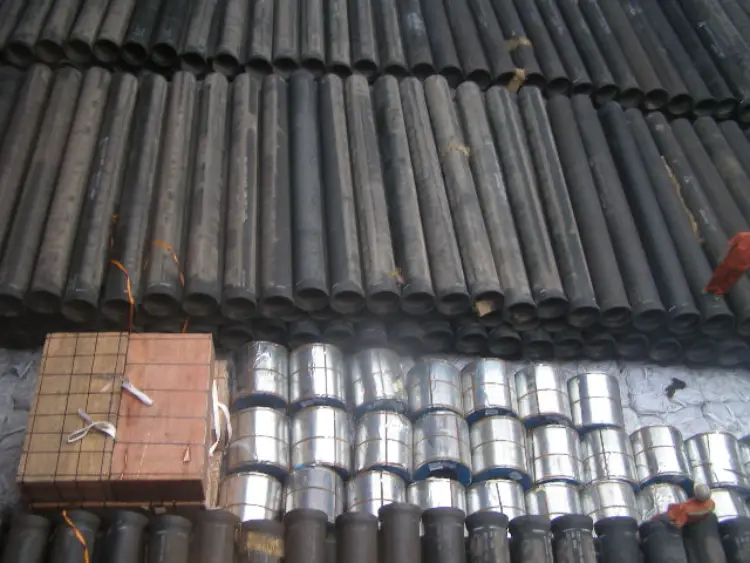
DIN 17102 TStE255 Carbon Structural Steel Coil
DIN 17102 TStE255 Carbon and Low-alloy High-strength Steel Coil Material Data Analysis
Comprehensive material data for TStE255 steel according to DIN 17102 standard, including chemical composition, mechanical and physical properties, international equivalents, and application guidance.
Normalizing (mandatory delivery condition), cold forming, bending, welding, machining.
- Phone : +8618037372205
- Email : [email protected]
- WhatsApp: Contact via Whtsapp
- WeChat: +8618037372205
DIN 17102 TStE255 Carbon Structural Steel Coil Introduction
TStE255 is a weldable fine-grain structural steel with a minimum yield strength of 255 MPa, delivered in the normalized condition. It is specified in DIN 17102 and primarily supplied as coil (also as plate and strip) for structural and pressure vessel applications. The steel exhibits good toughness at low temperatures (typically down to -20°C) and reliable weldability, suitable for service in both ambient and sub-zero environments.
Its fine-grain microstructure is achieved through controlled aluminum addition and optional microalloying (Nb, V, Ti), ensuring consistent mechanical properties across a range of thicknesses. TStE255 is widely used in fabricated steel structures, pipelines, and machinery components requiring a balance of strength and ductility.
DIN 17102 TStE255 Carbon Structural Steel Coil Chemical Composition
The typical chemical composition of TStE255 according to DIN 17102, based on ladle analysis. The steel is fully killed with aluminum to achieve fine grain size. Microalloying elements such as Nb, V, or Ti may be present to meet the required mechanical properties. Carbon equivalent (CEV) is often restricted for weldability.
- Carbon equivalent CEV [%] ≤ 0.40 for thickness ≤ 40 mm; higher values may be agreed.
- Aluminum content (total Al) ≥ 0.020% for fine grain practice.
| Element | Standard Value (%) | Remarks |
|---|---|---|
| Carbon (C) | ≤ 0.18 | Ladle analysis; typical range 0.15-0.18% |
| Silicon (Si) | ≤ 0.50 | Often 0.15-0.35% in practice |
| Manganese (Mn) | 0.50 – 1.50 | Depending on thickness; typically 1.20–1.50% |
| Phosphorus (P) | ≤ 0.030 | Strict control for toughness |
| Sulfur (S) | ≤ 0.025 | Low sulfur for formability |
| Aluminum (Al total) | ≥ 0.020 | Mandatory for fine grain treatment |
| Niobium (Nb) | ≤ 0.05 | Optional microalloying, guarantees strength |
| Vanadium (V) | ≤ 0.10 | Optional, often combined with Nb |
| Titanium (Ti) | ≤ 0.05 | Optional, grain refinement and nitrogen fixing |
| Nitrogen (N) | ≤ 0.012 | Typically bound by Al or Ti |
| Copper (Cu) | ≤ 0.30 | Residual; higher if agreed for atmospheric corrosion resistance |
| Chromium (Cr) | ≤ 0.25 | Residual element |
| Nickel (Ni) | ≤ 0.30 | Residual element |
DIN 17102 TStE255 Carbon Structural Steel Coil Thermal and Electrical Physical Properties
Physical properties of TStE255 are typical for normalized fine-grain structural carbon-manganese steel. These values are approximate and can vary slightly depending on the exact composition and microstructure. They are provided for general engineering calculations and modelling.
- Density is based on room temperature data.
- Thermal conductivity decreases with increasing temperature; values given for 20°C and 100°C.
- Electrical resistivity is representative for low-alloy steel.
| Property | Standard Value | Unit | Test Condition |
|---|---|---|---|
| Density (ρ) | 7.85 | g/cm³ | At 20°C |
| Elastic Modulus (E) | 210 | GPa | At 20°C, longitudinal |
| Shear Modulus (G) | 81 | GPa | Calculated, typical |
| Poisson's Ratio (ν) | 0.3 | – | Elastic, at 20°C |
| Thermal Expansion Coefficient (α) | 12.0 | 10⁻⁶/K | 20°C to 100°C |
| Thermal Expansion Coefficient (α) | 12.5 | 10⁻⁶/K | 20°C to 200°C |
| Thermal Expansion Coefficient (α) | 13.2 | 10⁻⁶/K | 20°C to 400°C |
| Thermal Conductivity (λ) | 50 | W/(m·K) | At 20°C |
| Thermal Conductivity (λ) | 47 | W/(m·K) | At 100°C |
| Specific Heat Capacity (c) | 460 | J/(kg·K) | At 20°C to 100°C |
| Electrical Resistivity (ρ_e) | 0.22 | μΩ·m | At 20°C (approx. 0.22 × 10⁻⁶ Ω·m) |
DIN 17102 TStE255 Carbon Structural Steel Coil Mechanical Properties
Mechanical properties at room temperature for TStE255 in normalized condition according to DIN 17102. Values depend on product thickness. Impact test temperature is -20°C for longitudinal Charpy-V specimens (transverse testing optional). The bend test is performed with a mandrel diameter as indicated.
- Yield strength (ReH) decreases with increasing thickness.
- For thicknesses above 60 mm, properties must be agreed at the time of order.
| Property | Standard Requirement | Unit | Test Condition / Thickness Range |
|---|---|---|---|
| Yield Strength (ReH) | ≥ 255 | MPa | Thickness ≤ 16 mm |
| Yield Strength (ReH) | ≥ 240 | MPa | 16 < thickness ≤ 35 mm |
| Yield Strength (ReH) | ≥ 230 | MPa | 35 < thickness ≤ 50 mm |
| Yield Strength (ReH) | ≥ 220 | MPa | 50 < thickness ≤ 60 mm |
| Tensile Strength (Rm) | 360 – 480 | MPa | Thickness ≤ 60 mm |
| Tensile Strength (Rm) | 360 – 480 | MPa | 60 < thickness ≤ 100 mm (by agreement) |
| Elongation (A), longitudinal | ≥ 24 | % | Thickness ≤ 16 mm, gauge length 5.65√So |
| Elongation (A), longitudinal | ≥ 23 | % | 16 < thickness ≤ 35 mm |
| Elongation (A), longitudinal | ≥ 22 | % | 35 < thickness ≤ 50 mm |
| Elongation (A), longitudinal | ≥ 22 | % | 50 < thickness ≤ 60 mm |
| Elongation (A), transverse | ≥ 22 | % | Thickness ≤ 16 mm (if required) |
| Charpy Impact Energy (KV), longitudinal | ≥ 27 | J | At -20°C, thickness ≤ 60 mm |
| Charpy Impact Energy (KV), transverse | ≥ 20 | J | At -20°C, thickness ≤ 60 mm, if agreed |
| Bend Test (mandrel diameter) | 0.5 t | – | Thickness ≤ 16 mm, 180° bending |
| Bend Test (mandrel diameter) | 1.0 t | – | 16 < thickness ≤ 35 mm, 180° bending |
| Bend Test (mandrel diameter) | 1.5 t | – | 35 < thickness ≤ 50 mm, 180° bending |
DIN 17102 TStE255 Carbon Structural Steel Coil Completely Equivalent Material Standards and Replaceable Grades
| Country/Region | Standard | Grade | Remarks |
|---|---|---|---|
| Europe | EN 10025-3 (2004) | S275N | Normalized fine grain structural steel, identical chemistry and mechanics; also S275NL for low temperature |
| Europe | EN 10025-3 (2004) | S275NL | Electroslag refined variant with guaranteed impact properties at -50°C; primarily for thicker sections |
| United Kingdom | BS 4360 (superseded) | 50B | Former British standard, similar grade, replaced by EN S275N |
| USA | ASTM A572/A572M | Grade 50 [345] | Slightly higher strength, but can substitute with design adjustments; note yield 345 MPa |
| USA | ASTM A709/A709M | 50 [345] | Structural steel for bridges; similar to A572 Gr 50, normalized option |
| Japan | JIS G3106 | SM490A | Welding structural steel, yield 325 MPa, close but not exact, may need adjustment |
| International | ISO 4950-2 | E275 | Normalized fine grain structural steel, essentially identical |
| Germany | DIN 17100 (superseded) | St44-3 | Older standard, lower toughness, not recommended for new designs but sometimes used as reference |
DIN 17102 TStE255 Carbon Structural Steel Coil Application Introduction
TStE255 is designed for demanding structural applications where good weldability and reliable toughness are required. Its normalized fine-grain structure ensures consistent properties and facilitates cold forming and welding. Typical uses include heavy-duty welded structures, bridges, offshore platforms, and pressure vessels operating at temperatures down to -20°C.
The steel is available in coil form, enabling efficient fabrication of spiral-welded pipes, large structural components, and machine frames.
Product Applications: Welded steel pipes (longitudinally and spiral welded), Storage tanks (fixed and floating roofs), Bridges (girder plates, box girders), Offshore wind turbine towers, Penstocks and pressure shafts, Heavy-duty machine frames and bases
Processed into products: Rolled sections for structural frameworks, Flanges and stiffeners for pressure vessels, Pipe fittings (elbows, tees, reducers) made from welded plates, Crane booms and jibs, Foundation cages and anchor plates, Automotive lift arms and chassis components (when formed from strip)
Application industries: Construction and civil engineering (bridges, high-rise buildings, stadiums), Oil and gas (offshore platforms, storage tanks, pipelines), Pressure vessel and boiler manufacturing, Crane and heavy lifting equipment, Shipbuilding and marine structures (non-qualified for ship classification societies, but similar grades used), Mining and earthmoving machinery
DIN 17102 TStE255 Carbon Structural Steel Coil Near/Similar Alternative Material Recommendations
| Country/Region | Standard | Grade | Remarks |
|---|---|---|---|
| Europe | EN 10025-3 | S355N | Higher strength (355 MPa) fine grain steel, similar weldability and toughness, heavier sections possible |
| Europe | EN 10025-2 | S275JR | Non-fine grain structural steel, lower price but reduced toughness, not for low-temperature service |
| USA | ASTM A36/A36M | A36 | Common structural steel, lower strength (~250 MPa yield), limited low-temperature performance |
| USA | ASTM A516/A516M | Grade 70 | Pressure vessel steel, 485-620 MPa tensile, not exactly equivalent but can be considered for some applications |
| Japan | JIS G3101 | SS400 | General structural rolled steel, yield ~245 MPa, not controlled for fine grain |
Notes:
- Welding: TStE255 has a CEV typically below 0.40, allowing safe welding without preheat for moderate thicknesses. Preheating may be required for thick sections (>40 mm) or when high restraint exists. Low-hydrogen welding processes are recommended.
- Cold forming: Normalized steel can be cold bent up to moderate radii without cracking; bent samples are part of the mandatory testing.
- Identification: The prefix "T" indicates specifically steel for tubes and hollow profiles, but TStE255 is also supplied as coil for general use under DIN 17102. In practice, it is often interchangeable with StE255.
- Certification: Material test certificates according to EN 10204 type 3.1 or 3.2 are standard for quality assurance.
- Surface condition: Hot-rolled and pickled or shot-blasted as agreed; coil is typically supplied un-pickled unless specified.
- Share



