
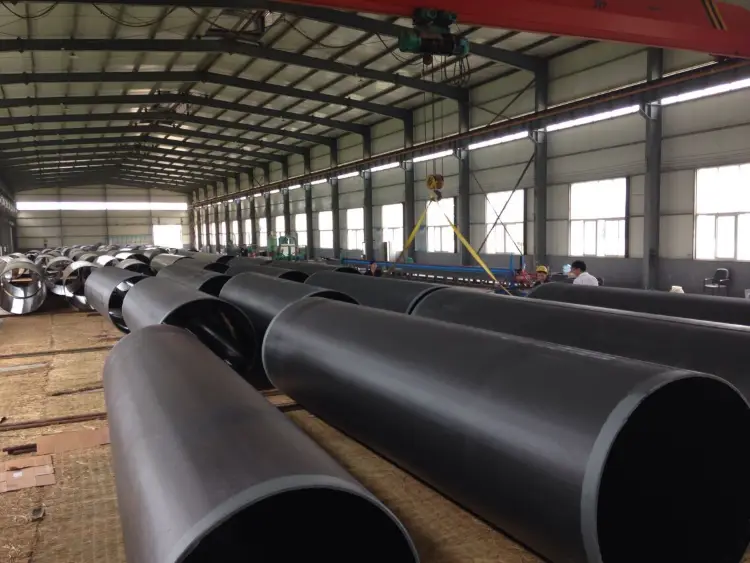
DH40 SSAW Pipe Material
DH40 SSAW Pipe: High-Strength Shipbuilding Steel Spiral Welded Pipe Properties & Equivalents
Complete material properties of DH40 SSAW pipe according to GB/T 712 standard, featuring chemical composition, mechanical and physical data, international equivalents, and application recommendations for shipbuilding and offshore structures.
Hot rolling, controlled rolling, normalizing, spiral forming and submerged arc welding
- Phone : +8618037372205
- Email : [email protected]
- WhatsApp: Contact via Whtsapp
- WeChat: +8618037372205
DH40 SSAW Pipe Introduction
DH40 SSAW pipe is a high-strength structural steel spiral submerged arc welded pipe manufactured from DH40 steel plates conforming to GB/T 712-2011 and recognized by major classification societies. It provides a minimum yield strength of 390 MPa, excellent low-temperature toughness at -20°C, and good weldability. The material is widely used in ship hulls, offshore platforms, marine engineering, and structural piling applications where high reliability and resistance to brittle fracture are essential. The spiral welded pipe form offers cost-effective production, uniform wall thickness, and adaptability to large diameters, making it ideal for deep-water pipelines, jacket legs, and foundation piles.
DH40 SSAW Pipe Chemical Composition
Chemical composition limits for DH40 steel according to GB/T 712-2011. The addition of grain-refining elements such as Al, Nb, V, and Ti ensures fine ferrite grain size and high toughness. Low sulfur and phosphorus contents are maintained for excellent weldability and resistance to lamellar tearing.
| Element | Standard Value (wt%) | Remarks |
|---|---|---|
| C | ≤ 0.20 | Carbon maximum |
| Si | ≤ 0.55 | Silicon maximum |
| Mn | 0.90 – 1.60 | Manganese range |
| P | ≤ 0.025 | Phosphorus maximum |
| S | ≤ 0.025 | Sulfur maximum |
| Cr | ≤ 0.20 | Chromium maximum |
| Ni | ≤ 0.40 | Nickel maximum |
| Cu | ≤ 0.30 | Copper maximum |
| Mo | ≤ 0.08 | Molybdenum maximum |
| Als | ≥ 0.015 | Acid soluble aluminum minimum for grain refinement |
| Nb | 0.02 – 0.05 | Niobium range (optional for fine grain) |
| V | 0.05 – 0.10 | Vanadium range |
| Ti | ≤ 0.02 | Titanium maximum |
| N | ≤ 0.012 | Nitrogen maximum |
DH40 SSAW Pipe Thermal and Electrical Physical Properties
Physical properties are provided as typical reference data for carbon-manganese structural steels similar to DH40. These values are not part of the purchase specification but are useful for design and thermal processing. Actual values may vary slightly with processing and testing conditions.
| Property | Typical Value | Unit | Test Condition |
|---|---|---|---|
| Density (ρ) | 7.85 | g/cm³ | Room temperature, 20°C |
| Elastic modulus (E) | 207 | GPa | At 20°C |
| Shear modulus (G) | 80 | GPa | At 20°C |
| Poisson's ratio (ν) | 0.30 | dimensionless | Typical for structural steel |
| Thermal expansion coeff. (α) | 12.2 × 10⁻⁶ | /K | 20 – 100°C |
| Thermal conductivity (λ) | 51.9 | W/(m·K) | At 100°C |
| Specific heat capacity (c) | 486 | J/(kg·K) | At 20°C |
| Electrical resistivity (ρ_e) | 0.20 | μΩ·m | At 20°C |
DH40 SSAW Pipe Mechanical Properties
Mechanical properties are specified in GB/T 712-2011. The values depend on product thickness. Tensile testing is performed in accordance with ISO 6892-1, impact testing with ISO 148-1 at -20°C. Yield strength and elongation vary with thickness, while impact energy requirements remain constant for D-grade (-20°C). Bending test requires 180° bending over a mandrel of diameter 3a without cracking.
| Property | Required Value | Unit | Test Condition |
|---|---|---|---|
| Yield strength (ReH) | ≥ 390 | MPa | Thickness ≤ 50 mm |
| Yield strength (ReH) | ≥ 390 | MPa | Thickness > 50 – 70 mm |
| Yield strength (ReH) | ≥ 380 | MPa | Thickness > 70 – 100 mm |
| Tensile strength (Rm) | 510 – 660 | MPa | All thicknesses |
| Elongation after fracture (A) | ≥ 20 | % | Thickness ≤ 50 mm, gauge 5.65√S₀ |
| Elongation after fracture (A) | ≥ 19 | % | Thickness > 50 – 70 mm |
| Elongation after fracture (A) | ≥ 18 | % | Thickness > 70 – 100 mm |
| Bending test (180°) | D = 3a, no cracks | a = specimen thickness; width ≥ 2a | |
| Charpy V-notch impact (KV₂) | ≥ 31 (avg), ≥ 22 (single) | J | Longitudinal, -20°C |
DH40 SSAW Pipe Fully Equivalent Material Standards and Replaceable Grades
| Country/Region | Standard | Grade | Remarks |
|---|---|---|---|
| China | GB/T 712-2011 | DH40 | Domestic shipbuilding steel |
| Norway (DNV) | DNV-OS-B101 | DNV DH40 | Identical requirements to GB/T 712 |
| USA (ABS) | ABS Rules | ABS DH40 | Yield 390 MPa, -20°C impact |
| UK (LR) | LR Rules | LR DH40 | Lloyd's Register grade |
| France (BV) | BV Rules | BV DH40 | Bureau Veritas high-strength grade |
| Japan (NK) | NK Rules | NK DH40 | Nippon Kaiji Kyokai equivalent |
| Italy (RINA) | RINA Rules | RINA DH40 | Registro Italiano Navale equivalent |
| Russia (RS) | RS Rules | RS DH40 | Russian Maritime Register of Shipping |
| Korea (KR) | KR Rules | KR DH40 | Korean Register of Shipping equivalent |
DH40 SSAW Pipe Application Introduction
DH40 SSAW pipe offers a balance of high strength, excellent weldability, and low-temperature toughness, making it suitable for demanding structural applications. The spiral welded manufacturing method allows efficient production of large-diameter pipes with consistent quality.
- Typical uses include ship hull structures, offshore platform legs, and deep-water pipelines.
- The material is often selected for Arctic and cold-water projects due to its reliable -20°C impact performance.
Product Applications: Spiral submerged arc welded (SSAW) pipes, Offshore jacket legs and braces, Piling pipes for marine terminals and bridges, Submarine oil/gas pipelines, Structural hollow sections for heavy construction, Casing pipes for offshore wells
Processed into products: Pipe bends and elbows, Tees and reducers, Flanges, Welded structural nodes, Stinger transition cones, Canal and harbour fender systems
Application industries: Shipbuilding, Offshore Oil & Gas, Marine Engineering, Structural Piling, Water & Slurry Transportation, Renewable Energy (Offshore Wind Foundations)
DH40 SSAW Pipe Similar and Alternative Material Recommendations
| Country/Region | Standard | Grade | Remarks |
|---|---|---|---|
| China | GB/T 712-2011 | EH40 | Higher notch toughness ( -40°C ), used for colder environments |
| China | GB/T 712-2011 | AH40 | 0°C impact test, suitable for ambient temperature applications |
| China | GB/T 712-2011 | DH36 | Lower yield strength ( 355 MPa ), equivalent -20°C impact |
| Europe | EN 10025-4 | S420ML | Thermomechanically rolled, yield 420 MPa, impact -50°C; not all class societies accept as DH40 substitute without additional testing |
| International | IACS UR W11 | AH/DH/EH 40 | Unified requirement covering all grades with varying impact test temperatures |
Notes:
SSAW pipes are fabricated by forming hot-rolled DH40 coil into a continuous spiral and welding with submerged arc process. Base metal certificates should confirm chemical composition, tensile properties, and Charpy V-notch impact at -20°C. For welded pipe qualification, additional tests (transverse tensile, guided bend, and weld impact) are typically required. Welding consumables should be matched to achieve equivalent strength and toughness. Post-weld heat treatment is generally not needed for wall thicknesses up to 50 mm, but hydrogen control measures are recommended.
- Share



