
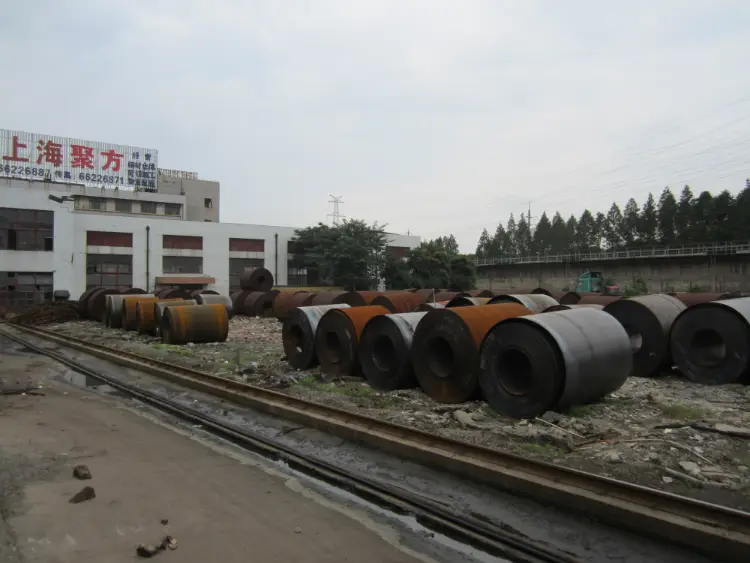
CCS DQ70 Shipbuilding Steel Coil
CCS DQ70 Shipbuilding Steel Coil - High Strength QT Offshore Grade
Comprehensive technical data for CCS DQ70 quenched and tempered extra-high strength steel coil: chemical, mechanical, physical properties, international equivalents and applications.
Cutting, Welding, Forming, Machining, Shot blasting, Primer coating
- Phone : +8618037372205
- Email : [email protected]
- WhatsApp: Contact via Whtsapp
- WeChat: +8618037372205
CCS DQ70 Shipbuilding Steel Coil Introduction
CCS DQ70 is a quenched and tempered, extra-high strength structural steel governed by the China Classification Society Rules for Materials and Welding. With a minimum yield strength of 690 MPa, it is intended for critical welded structures in shipbuilding and offshore engineering. The grade is designated "D" indicating Charpy impact testing at -20°C. The steel is supplied in the quenched and tempered (QT) condition and combines high strength with good toughness and weldability when proper procedures are followed. The coil format offers flexibility for further processing into plates, profiles and fabricated components used in high-stress areas of ships and offshore platforms, where weight savings and structural integrity are paramount.
CCS DQ70 Shipbuilding Steel Coil Chemical Composition
The chemical composition of CCS DQ70 is designed to achieve high strength, toughness and good weldability through a low carbon, micro-alloyed approach. Elements like Cr, Ni, Mo and Cu are restricted, while grain-refining additions (V, Nb, Ti, Al) improve mechanical properties. Values are as per CCS Rules, with refinements possible by manufacturer agreement.
| Chemical Element | Standard Requirement (max unless range given) | Remarks | |
|---|---|---|---|
| Carbon (C) | ≤0.20 | % | Low carbon for weldability |
| Silicon (Si) | ≤0.55 | % | Deoxidizer and strength enhancer |
| Manganese (Mn) | 0.70 ~ 1.70 | % | Contributes to hardenability |
| Phosphorus (P) | ≤0.020 | % | Residual element, limited for toughness |
| Sulfur (S) | ≤0.020 | % | Residual element, limited for toughness |
| Chromium (Cr) | ≤0.30 | % | Optional alloying element |
| Nickel (Ni) | ≤0.40 | % | Improves toughness |
| Molybdenum (Mo) | ≤0.08 | % | Increases hardenability |
| Copper (Cu) | ≤0.35 | % | Improves corrosion resistance; may be specified |
| Acid-soluble Aluminum (Als) | ≥0.015 | % | Grain refining |
| Vanadium + Niobium + Titanium (V+Nb+Ti) | ≤0.12 | % | Total micro-alloying elements |
CCS DQ70 Shipbuilding Steel Coil Thermal and Electrical Physical Properties
The following physical properties are typical for quenched and tempered high-strength low-alloy steels similar to DQ70. They are provided for design and modeling purposes and are not mandatory specification requirements. Values may vary slightly depending on the exact chemical composition and heat treatment condition.
| Property | Typical Value | Unit | Test Condition / Remarks |
|---|---|---|---|
| Density (ρ) | 7.85 | g/cm³ | Room temperature |
| Modulus of Elasticity (E) | 205 | GPa | Room temperature, longitudinal |
| Shear Modulus (G) | 80 | GPa | Room temperature |
| Poisson´s Ratio (ν) | 0.3 | – | Room temperature |
| Thermal Expansion Coefficient (α) | 11.5 × 10⁻⁶ | /K | 20°C to 100°C |
| Thermal Conductivity (λ) | 45 | W/(m·K) | Room temperature |
| Specific Heat Capacity (c) | 460 | J/(kg·K) | Room temperature |
| Electrical Resistivity (ρe) | 0.20 × 10⁻⁶ | Ω·m | Room temperature |
CCS DQ70 Shipbuilding Steel Coil Mechanical Properties
Mechanical testing is performed in accordance with CCS Rules. Specimens are taken transverse to the rolling direction unless otherwise specified. Properties vary with product thickness; values above a certain thickness may be slightly reduced. The high yield and tensile strengths are achieved through the quench and temper heat treatment. The required impact energy of 69 J at -20°C ensures good low-temperature toughness for marine applications.
| Property | Required Value | Unit | Test Condition / Remarks |
|---|---|---|---|
| Yield Strength (ReH) | ≥690 | MPa | Transverse, room temperature; applies to thickness ≤50 mm (slightly lower for thicker sections) |
| Tensile Strength (Rm) | 770 ~ 940 | MPa | Transverse, room temperature; valid for all thicknesses |
| Elongation (A) | ≥14 | % | Gauge length L0 = 5.65√S0, transverse, thickness ≤50 mm |
| Elongation (A) | ≥12 | % | Gauge length L0 = 5.65√S0, transverse, thickness >50 – 100 mm |
| Charpy Impact Energy (KV2) at -20°C | ≥69 | J | Longitudinal, standard 10x10 mm specimen; average of 3 tests, one individual min. 47 J |
| Bend Test (180°) | No cracks | – | Mandrel diameter D = 3a (a = specimen thickness), thickness ≤50 mm; transverse |
CCS DQ70 Shipbuilding Steel Coil Fully Equivalent Material Standards and Replaceable Grades
| Country/Region | Standard | Grade | Remarks |
|---|---|---|---|
| Europe | EN 10025-6 | S690QL (1.8928) | Same strength class, QT condition, -20°C impact option; widely used in offshore structures |
| USA | ASTM A514/A514M | Grade S | Quenched and tempered alloy steel plate; yield strength 690 MPa, comparable weldability |
| Japan | JIS G 3128 | SHY685 | High strength steel for welded structures; similar yield and tensile requirements, QT condition |
| USA (pressure vessels) | ASTM A517/A517M | Grade S | Same chemistry as A514 Grade S but intended for pressure vessels; equivalent mechanical properties |
CCS DQ70 Shipbuilding Steel Coil Application Introduction
CCS DQ70 steel coil, owing to its high strength-to-weight ratio and excellent low-temperature toughness, is designed for demanding marine and offshore environments. It is predominantly used in welded structures where weight reduction and high load-bearing capacity are critical. Proper welding consumables and preheating procedures should be followed to avoid hydrogen-induced cold cracking when fabricating thick sections.
Product Applications: Ship hull plates and stiffeners, Deck and bottom structures, Self-elevating platform legs and spudcans, Offshore platform topside modules, Crane booms and heavy-duty lifting frames
Processed into products: Longitudinal and transverse frames, Web frames and stringers, Bulkheads and deep stiffened panels, Hatch covers and cargo securing equipment, Transition pieces and nodes in tubular structures
Application industries: Shipbuilding (naval and commercial vessels), Offshore oil & gas platforms, Marine renewable energy foundations, Heavy lifting and transport equipment, Port and harbor infrastructure
CCS DQ70 Shipbuilding Steel Coil Similar/Comparable Alternative Materials
| Country/Region | Standard | Grade | Remarks |
|---|---|---|---|
| China | GB/T 16270 | Q690D / Q690E | High strength structural steel plate; QT condition; similar yield strength; D: -20°C, E: -40°C impact |
| Various (IACS) | IACS UR W11 | EQ70 / FQ70 | Equivalent classification society grades (e.g., DNV VL690, ABS EQ70, LR EQ70) for ship and offshore use |
| International | API 2W | Grade 60 | Steel plate for offshore structures; QT condition; yield 415-690 MPa, comparable toughness |
| Europe | EN 10025-6 | S690Q / S690QL1 | Similar base grades; Q is non-specified impact temperature, QL1 provides -40°C impact |
Notes:
Welding: Low-hydrogen processes are mandatory. Preheat and interpass temperature control is necessary, especially for thicker sections (>30 mm), typically 100–175°C depending on carbon equivalent. Post-weld stress relieving may be applied. The steel is compatible with common marine coatings and corrosion protection systems. For specific project requirements, additional testing (e.g., CTOD, through-thickness tensile) can be agreed upon between the purchaser and manufacturer. Delivery conditions normally include shot blasting and a temporary primer to prevent atmospheric corrosion during yard storage.
- Share



