
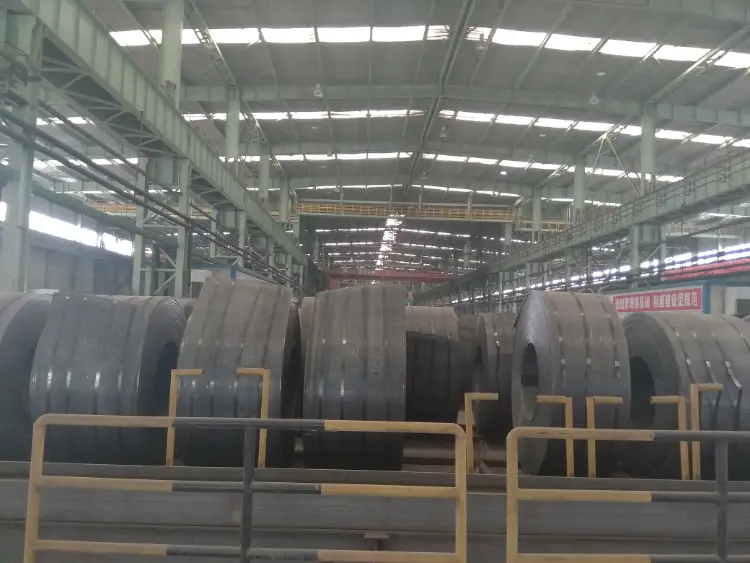
CCS AQ70 Quenched & Tempered Shipbuilding Steel Coil
CCS AQ70 Quenched & Tempered Shipbuilding Steel Coil - Ultimate Material Data Guide
Complete technical profile of CCS AQ70 high strength shipbuilding steel coil: chemical composition, mechanical properties, thermal and electrical properties, global equivalents, and application insights.
Hot rolling, quenching and tempering, cold forming, machining
- Phone : +8618037372205
- Email : [email protected]
- WhatsApp: Contact via Whtsapp
- WeChat: +8618037372205
CCS AQ70 Quenched & Tempered Shipbuilding Steel Coil Introduction
CCS AQ70 is a premium quenched and tempered high strength steel for ship and offshore structures, certified by the China Classification Society. With a minimum yield strength of 690 MPa, it combines exceptional strength, good low‑temperature toughness at 0°C, and satisfactory weldability. Typically supplied as hot‑rolled coil and subsequently heat treated, AQ70 is the material of choice for critical load‑bearing components in modern marine engineering. Key features:
- Minimum yield strength 690 MPa
- Charpy impact absorbed energy ≥47 J at 0°C
- Excellent strength‑to‑weight ratio
- Good formability and weldability under controlled procedures
CCS AQ70 Quenched & Tempered Shipbuilding Steel Coil Chemical Composition
The chemical composition of CCS AQ70 is designed to achieve a fine tempered martensitic structure with high strength and toughness. Strict limits on impurities ensure reliable weldability. All values are maximum unless a range is given. Key alloying elements:
- Cr, Ni, Mo improve hardenability
- V, Nb, Ti provide grain refinement and precipitation strengthening
- Al is added for deoxidation and grain size control
| Chemical Element | Standard Value | Remarks |
|---|---|---|
| C | ≤0.20 | |
| Si | ≤0.55 | |
| Mn | ≤1.70 | |
| P | ≤0.025 | |
| S | ≤0.025 | |
| Cu | ≤0.50 | |
| Cr | ≤1.50 | |
| Ni | ≤2.0 | |
| Mo | ≤0.70 | |
| V | ≤0.12 | |
| Nb | ≤0.06 | |
| Ti | ≤0.05 | |
| Alt (acid soluble) | ≥0.020 | Total aluminium |
| N | ≤0.020 |
CCS AQ70 Quenched & Tempered Shipbuilding Steel Coil Thermal and Electrical Physical Properties
The physical properties listed are typical for quenched and tempered low‑alloy steels at room temperature unless otherwise noted. These values are not specification requirements but are useful for engineering calculations. Variations with temperature should be considered for precise analysis.
| Property | Standard Value | Unit | Test Condition / Remarks |
|---|---|---|---|
| Density (ρ) | 7850 | kg/m³ | at 20 °C |
| Modulus of Elasticity (E) | 210 | GPa | at 20 °C |
| Shear Modulus (G) | 81 | GPa | at 20 °C |
| Poisson's Ratio (ν) | 0.3 | — | elastic range |
| Thermal Expansion Coefficient (α) | 10.8 × 10⁻⁶ | K⁻¹ | 20–100 °C |
| Thermal Conductivity (λ) | 35 | W/(m·K) | at 20 °C |
| Specific Heat Capacity | 480 | J/(kg·K) | at 20 °C |
| Electrical Resistivity (ρe) | 0.25 × 10⁻⁶ | Ω·m | at 20 °C |
CCS AQ70 Quenched & Tempered Shipbuilding Steel Coil Mechanical Properties
Mechanical tests are performed on transversely oriented specimens taken from heat‑treated material. The properties apply to thicknesses up to 50 mm, which is the usual limit for coil products. Impact testing uses Charpy V‑notch specimens at 0°C (AQ grade). Important:
- Yield strength values correspond to ReH (upper yield stress) or Rp0.2 if yield is not pronounced
- Elongation measured on a gauge length of 5.65√S0
- Impact energy is the minimum average of three specimens; one individual value may be below the average but not less than 70% of the specified minimum
| Property | Standard Requirement | Unit | Test Condition |
|---|---|---|---|
| Yield Strength (ReH) | ≥690 | MPa | t ≤ 50 mm, transverse |
| Tensile Strength (Rm) | 770 – 940 | MPa | t ≤ 50 mm, transverse |
| Elongation (A) | ≥14 | % | Gauge length 5.65√S0, transverse |
| Impact Energy (KV₂) | ≥47 (average) / ≥33 (single) | J | Charpy V‑notch, 0°C |
CCS AQ70 Quenched & Tempered Shipbuilding Steel Coil Strictly Equivalent Standards and Substitutable Grades
| Country/Region | Standard | Grade | Remarks |
|---|---|---|---|
| China | GB/T 712 | AH690 | 0 °C impact, yield ≥690 MPa |
| International (IACS) | UR W11 | A690 | Same strength and impact class |
| Europe | EN 10025‑6 | S690Q | –20 °C impact; match check required for 0 °C application |
| USA | ASTM A514/A514M | Grade Q | Yield ≥690 MPa, quenched & tempered; verify impact temperature |
CCS AQ70 Quenched & Tempered Shipbuilding Steel Coil Application Introduction
CCS AQ70 steel is engineered for highly stressed welded structures in marine and offshore environments. Its high strength enables weight reduction and increased payload. Proper preheat and welding consumables are essential to avoid hydrogen cracking. Typical fields of use:
Product Applications: Hull shell plates and stiffeners, Deck plating and hatch coamings, Transverse frames and web frames, Jack‑up rig legs and spudcans, Crane booms and pedestals, Heavy‑duty barge and pontoon structures
Processed into products: Longitudinal and transverse stiffeners, Bulkhead plates and brackets, Column and spar structures for offshore platforms, Knuckle plates and doubler plates, Load‑bearing shoe and cleat assemblies, Tubular joints and node connectors
Application industries: Shipbuilding and ship repair, Offshore oil & gas exploration and production, Marine heavy lifting equipment, Bridge and structural engineering (with approval), Wind turbine foundations and substructures
CCS AQ70 Quenched & Tempered Shipbuilding Steel Coil Similar or Alternative Material Recommendations
| Country/Region | Standard | Grade | Remarks |
|---|---|---|---|
| Europe | EN 10025‑6 | S690QL/S690QL1 | Higher toughness versions (–40/–60 °C); stronger than AQ70 for cryogenic conditions |
| USA | ASTM A514 | Grade A/B/E/F/H/P/Q | Various chemistries; all quenched & tempered with yield ≥690 MPa, use same design approach |
| Japan | JIS G 3128 | SHY685 | High yield strength steel for welded structures, similar strength level but check impact class |
| International (API) | API 2Y | Grade 60 | Offshore structural steel, yield 414–550 MPa; lower strength than AQ70, consider for less demanding areas |
Notes:
This data is based on CCS Rules for Materials and Welding (latest revision). Thickness‑dependent properties should be confirmed against the actual certificate. Welding must follow approved procedures (AWS D1.1, EN 1011, or equivalent) with low‑hydrogen electrodes and appropriate preheating. For cold forming, a minimum bend radius of 3t is recommended, and stress relief may be required after severe deformation.
- Share



