
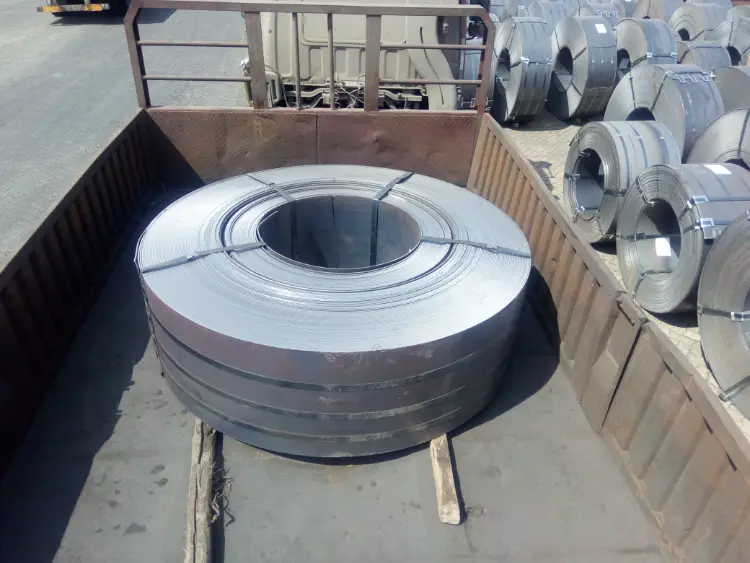
BV DH40 Shipbuilding Steel Coil
BV DH40 Shipbuilding Steel Coil - High Strength Marine Grade Plate
BV DH40 is a high-strength shipbuilding steel grade certified by Bureau Veritas (BV) under IACS UR W11. This steel coil offers minimum yield strength of 390 MPa, excellent low-temperature toughness, and good weldability for marine and offshore structures.
Normalizing (N), Thermo-mechanical controlled processing (TMCP), quenching and tempering (Q&T) upon agreement
- Phone : +8618037372205
- Email : [email protected]
- WhatsApp: Contact via Whtsapp
- WeChat: +8618037372205
BV DH40 Shipbuilding Steel Coil Introduction
BV DH40 shipbuilding steel coil is a high-strength structural steel grade specifically designed for marine and offshore engineering applications. It is certified by Bureau Veritas (BV) according to the rules for classification of steel ships, meeting the requirements of IACS UR W11. With a minimum yield strength of 390 MPa and tensile strength in the range of 510–650 MPa, DH40 provides an optimal balance of strength, ductility, and weldability. The designation "D" indicates the steel is intended for service down to -20 °C with guaranteed impact toughness (Charpy V-notch ≥31 J longitudinal). DH40 is typically supplied in normalizing (N) or thermo-mechanical controlled processing (TMCP) condition, ensuring uniform mechanical properties across a wide range of thicknesses. It is widely used in the construction of ship hulls, decks, bulkheads, and offshore platforms, where high load-bearing capacity and resistance to brittle fracture at low temperatures are essential. Its chemical composition is tightly controlled, with micro-alloying elements such as niobium, vanadium, and titanium to refine grain size and improve strength without compromising toughness. The steel is easily cut, formed, and welded using standard shipyard practices, making it a cost-effective choice for modern shipbuilding projects.
BV DH40 Shipbuilding Steel Coil Chemical Composition
Chemical composition of BV DH40 is specified according to IACS UR W11. Values are in weight percent. The steel is micro-alloyed with Nb, V, and Ti for grain refinement. Note: Maximum limits are indicated by ≤; range is shown for Mn.
- Ceq (Carbon Equivalent) formula: Ceq = C + Mn/6 + (Cr+Mo+V)/5 + (Ni+Cu)/15
| Element | Standard Value (max or range) | Remarks |
|---|---|---|
| C | ≤0.18% | Max |
| Si | ≤0.50% | Max |
| Mn | 0.90–1.60% | Range |
| P | ≤0.035% | Max |
| S | ≤0.035% | Max |
| Al (acid soluble) | ≥0.015% | Min, for grain refining |
| Nb | ≤0.05% | Max |
| V | ≤0.10% | Max |
| Ti | ≤0.02% | Max |
| Cu | ≤0.35% | Max |
| Cr | ≤0.20% | Max |
| Ni | ≤0.40% | Max |
| Mo | ≤0.08% | Max |
| N | ≤0.009% (if agreed) | If applicable |
| Ceq | Typically ≤0.43% | Carbon equivalent for weldability |
BV DH40 Shipbuilding Steel Coil Physical Properties
Physical properties are typical for carbon-manganese structural steel and can vary with processing conditions. Data provided for general design calculations.
- Density is assumed as for steel (7.85 g/cm³).
- Elastic moduli and Poisson's ratio are at room temperature unless otherwise noted.
- Thermal expansion and conductivity are approximate over the stated temperature ranges.
| Property | Typical Value | Unit | Test Conditions / Remarks |
|---|---|---|---|
| Density (ρ) | 7.85 | g/cm³ | At 20 °C |
| Elastic Modulus (E) | 205–210 | GPa | At 20 °C |
| Shear Modulus (G) | ≈80 | GPa | At 20 °C |
| Poisson's Ratio (ν) | 0.29–0.30 | – | At 20 °C |
| Thermal Expansion Coefficient (α) | 11.5–12.5 | 10⁻⁶/K | Between 20 and 100 °C |
| Thermal Conductivity (λ) | 50–54 | W/(m·K) | At 20 °C |
| Specific Heat Capacity (cp) | 0.46–0.50 | J/(g·K) | At 20 °C |
| Electrical Resistivity (ρₑ) | 0.20–0.22 | μΩ·m | At 20 °C |
BV DH40 Shipbuilding Steel Coil Mechanical Properties
Mechanical properties are tested on transverse or longitudinal test pieces according to BV rules and IACS UR W11. Thickness range: typical for plates/coils up to 50 mm. For thicker products, values may be adjusted.
- Yield strength (ReH) and tensile strength (Rm) apply to both TMCP and normalized conditions.
- Impact test temperature is -20 °C (D grade).
- Bend test is required for weldability verification (180° bend over mandrel diameter specified).
| Property | Required Value | Unit | Test Conditions |
|---|---|---|---|
| Yield Strength (ReH) | ≥390 | MPa | Thickness ≤50 mm, transverse |
| Tensile Strength (Rm) | 510–650 | MPa | Thickness ≤50 mm, transverse |
| Elongation (A) | ≥20 | % | Gauge length 5.65√S₀, thickness ≤50 mm |
| Charpy V-notch Impact Energy (KV₂) | ≥31 (longitudinal) | J | At -20 °C, average of 3 tests; ≥22 J for single value |
| Charpy V-notch Impact Energy (KV₂) | ≥22 (transverse) | J | At -20 °C, average of 3 tests; ≥16 J for single value |
| Bend Test (180°) | No cracks or defects | – | Mandrel diameter: 3a (a = specimen thickness, for Rm 510–570 MPa), 4a (Rm >570–650 MPa) |
BV DH40 Shipbuilding Steel Coil Identical International Equivalents to BV DH40
| Country / Classification Society | Standard / Rule | Grade | Remarks |
|---|---|---|---|
| American Bureau of Shipping (ABS) | ABS Rules | ABS DH40 | Identical requirements |
| DNV (Norway/Germany) | DNV Rules | DNV DH40 | Identical requirements |
| Lloyd's Register (UK) | LR Rules | LR DH40 | Identical requirements |
| China Classification Society (CCS) | CCS Rules | CCS DH40 | Identical requirements |
| ClassNK (Japan) | NK Rules | NK DH40 | Identical requirements |
| Korean Register (KR) | KR Rules | KR DH40 | Identical requirements |
| RINA (Italy) | RINA Rules | RINA DH40 | Identical requirements |
| Russian Maritime Register (RS) | RS Rules | RS DH40 | Identical requirements |
BV DH40 Shipbuilding Steel Coil Application Introduction
BV DH40 is specifically designed for demanding marine and offshore applications where high strength, good low-temperature toughness, and excellent weldability are required. It is suitable for both structural and critical safety components. Typical applications:
- Shipbuilding: main and longitudinal hull structures, decks, bottom plates, stiffeners
- Offshore: platform legs, braces, columns, module support frames
- Marine equipment: cranes, winch foundations, heavy-duty mooring components
Product Applications: Bulk carriers, tankers, container ships, Offshore platforms (jackups, semisubmersibles, FPSOs), Icebreakers and ice-class vessels, Floating docks and barges, Crane booms and marine lifting equipment
Processed into products: Hull shell plates and keel plates, Deck plating and stringers, Bulkhead panels and transverse frames, Stiffeners, brackets, and girders, Ballast and cargo tank boundaries, Offshore structural nodes and tubular joints, Foundation pads and equipment supports, Blast walls and fire protection barriers
Application industries: Shipbuilding (commercial and naval vessels), Offshore oil and gas exploration and production, Renewable marine energy (wind turbine foundations), Port and harbor infrastructure, Heavy marine engineering
BV DH40 Shipbuilding Steel Coil Similar and Alternative Materials to BV DH40
| Country / Standard | Designation | Grade / Type | Remarks |
|---|---|---|---|
| IACS UR W11 (all societies) | DH36 | Minimum yield 355 MPa | Slightly lower strength, same toughness class (-20 °C); can be substituted where lower strength is acceptable |
| IACS UR W11 (all societies) | EH36 | Minimum yield 355 MPa, -40 °C toughness | Higher toughness grade; may replace DH40 in lower-load applications with better notch toughness |
| IACS UR W11 (all societies) | AH40 | Minimum yield 390 MPa, 0 °C toughness | Higher-temperature toughness; can replace DH40 if operating temperature above 0 °C |
| IACS UR W11 (all societies) | EH40 | Minimum yield 390 MPa, -40 °C toughness | Enhanced low-temperature toughness; superior alternative for extreme cold environments |
| ISO 15574 / API 2H | BS 7191 355EMZ / API 2H Grade 50 | 355–390 MPa yield classes | For offshore structural applications; may require additional certification |
| EN 10025-4 | S355M/ML, S420M/ML, S460M/ML | Thermomechanical rolled steels | Comparable strength grades with Charpy at -20 °C or -40 °C; used in civil constructions, but not certified for marine use without specific agreement |
Notes:
Additional information:
- Welding: BV DH40 exhibits excellent weldability with low carbon equivalent (Ceq typically ≤0.43). Preheating is generally not required for thicknesses below 50 mm, but specific welding procedures must be qualified according to BV rules.
- Forming: The steel can be cold-formed and hot-formed within appropriate temperature ranges. Normalized or TMCP condition maintains ductility.
- Heat treatment: Post-weld heat treatment (PWHT) is not typically required, but if applied, stress relieving at 550–620 °C may be performed; mechanical properties must be verified.
- Z-grade options: For enhanced through-thickness properties (Z15, Z25, Z35), the steel can be ordered to reduce lamellar tearing; these supplementary requirements are available upon agreement.
- Ordering: When ordering BV DH40 coil, specify thickness, width, delivery condition, and any additional testing requirements (e.g., ultrasonic testing, drop-weight tear test).
- DNV GL, ABS, and other class societies have identical requirements; a multi-certification (e.g., BV/DNV/ABS DH40) can be arranged to comply with multiple classification societies.
- Share



