
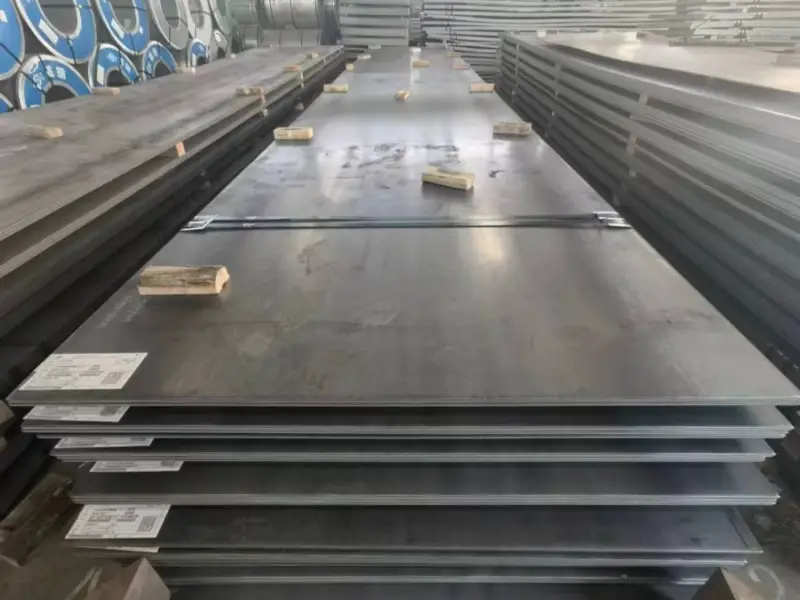
BP600 Ballistic Protection Steel Plate Material
BP600 Ballistic Protection Steel Plate - High Hardness Armor Steel for Security Applications
BP600 is a high-hardness quenched and tempered armor steel plate offering excellent ballistic resistance and good weldability. Typical hardness 570-640 HBW, designed for use in armored vehicles, security enclosures, and protective structures.
Cutting, Welding, Bending, Machining (with appropriate tooling)
- Phone : +8618037372205
- Email : [email protected]
- WhatsApp: Contact via Whtsapp
- WeChat: +8618037372205
BP600 Ballistic Protection Steel Plate Introduction
BP600 is a ballistic protection steel supplied as quenched and tempered plate. It combines high hardness (570-640 HBW) with sufficient toughness to withstand multiple ballistic impacts.
- High resistance to penetration and spalling
- Good flatness and surface quality
- Suitable for welding with low-hydrogen procedures
- Produced under strict quality control to meet international ballistic standards
BP600 Ballistic Protection Steel Plate Chemical Composition
Typical ladle analysis of BP600 according to the manufacturer's specification. The steel is microalloyed for high hardenability and clean inclusion control, ensuring consistent ballistic performance.
| Chemical Element | Typical Value | Remarks |
|---|---|---|
| Carbon (C) | 0.30 | Max 0.32 |
| Silicon (Si) | 0.25 | Max 0.35 |
| Manganese (Mn) | 0.70 | Max 0.90 |
| Phosphorus (P) | 0.015 | Max 0.020 |
| Sulfur (S) | 0.005 | Max 0.010 |
| Chromium (Cr) | 0.80 | Max 1.00 |
| Nickel (Ni) | 1.50 | Max 1.80 |
| Molybdenum (Mo) | 0.50 | Max 0.55 |
| Boron (B) | 0.002 | 0.001-0.003 |
| Iron (Fe) | Balance |
BP600 Ballistic Protection Steel Plate Thermal and Electrical Physical Properties
Physical properties are typical for low-alloy quenched and tempered steels. These values are not guaranteed but provide engineering estimates.
- Density is standard for steel
- Thermal conductivity and expansion are essential for welding simulation
- Electrical resistivity useful for grounding calculations
| Property | Typical Value | Unit | Test Condition |
|---|---|---|---|
| Density (ρ) | 7850 | kg/m³ | 20°C |
| Elastic Modulus (E) | 210 | GPa | Room temperature |
| Shear Modulus (G) | 81 | GPa | Room temperature |
| Poisson's Ratio (ν) | 0.3 | - | Room temperature |
| Thermal Expansion Coefficient (α) | 12.5 × 10⁻⁶ | 1/°C | 20 - 100°C |
| Thermal Conductivity (λ) | 35 | W/(m·K) | 100°C |
| Specific Heat Capacity | 460 | J/(kg·K) | 20°C |
| Electrical Resistivity (ρ_e) | 0.25 | µΩ·m | 20°C |
BP600 Ballistic Protection Steel Plate Mechanical Properties
Mechanical properties of BP600 after quenching and tempering. Ballistic resistance is typically correlated with hardness.
- Hardness range: 570-640 HBW
- Tensile testing according to ASTM A370 or ISO 6892-1
- Impact toughness assessed at low temperatures for critical applications
| Property | Typical Value | Unit | Test Condition |
|---|---|---|---|
| Hardness | 570 - 640 | HBW | As delivered plate surface |
| Yield Strength (ReH) | 1400 | MPa | 0.2% offset, longitudinal |
| Tensile Strength (Rm) | 1750 | MPa | Longitudinal |
| Elongation (A50) | 10 | % | Gauge length 50 mm |
| Charpy V-notch Impact (KV) | 20 - 30 | J | -40°C, longitudinal |
BP600 Ballistic Protection Steel Plate Fully Equivalent Material Standards and Replaceable Grades
| Country/Region | Standard | Grade | Remarks |
|---|---|---|---|
| Sweden | SSAB Hardox/Armox | Armox 600T | Equivalent hardness range, similar ballistic performance |
| France | Industeel Creusabro | PROTAC 600 | Comparable high-hardness armor steel |
| Germany | ThyssenKrupp | MARS 600 | Also meets MIL-DTL-46100 requirements |
| United Kingdom | BSI | BS 6562-600 | Armor plate grade with similar properties |
| USA | MIL-SPEC | MIL-DTL-46100 Grade 600 | Specifies hardness 570-640 HBW, similar chemistry |
| Australia | Bisalloy | BP600 | Benchmark grade under Bisalloy specification |
BP600 Ballistic Protection Steel Plate Application Introduction
BP600 is specifically engineered for ballistic protection. Its high hardness disrupts projectile penetration, while adequate toughness prevents brittle failure.
- Cutting: Plasma, laser, abrasive water-jet or shearing (thickness dependent)
- Welding: Use low-hydrogen electrodes and preheat to 150-200°C; post-weld heat treatment may be required to avoid cracking
- Forming: Cold bending limited; hot forming or incremental bending recommended
Product Applications: Armored personnel carriers (APC), Infantry fighting vehicles (IFV), Ballistic shields for police, Secure doors and vaults, Mobile checkpoints, Protected executive vehicles
Processed into products: Hull plates (glacis, side, rear), Turret armor, Spall liners (backing required), Welded assemblies, Bolted modules, Add-on armor packs
Application industries: Defense & Military, Security & Law Enforcement, Cash-in-Transit (CIT), Oil & Gas (blast shields), Nuclear (fragmentation barriers)
BP600 Ballistic Protection Steel Plate Similar/Alternative Material Recommendations
| Country/Region | Standard | Grade | Remarks |
|---|---|---|---|
| Sweden | SSAB Hardox | Hardox 600 | Wear plate with similar hardness, but not optimized for ballistic resistance |
| Finland | Ruukki | Rautaruukki RAEX 600 | High-strength structural steel, comparable hardness, different toughness profile |
| Japan | JFE | JFE-HITEN 780 | High-tensile steel, lower hardness but good weldability, may serve non-ballistic protective applications |
| USA | ASTM | A514 Grade Q | Quenched and tempered alloy steel plate, similar strength but much lower hardness, not intended for ballistic use |
Notes:
Ballistic testing: Plates are usually certified by V50 ballistic limit tests according to MIL-STD-662F or STANAG 2920 against specified threats (e.g., 7.62mm AP, 12.7mm). Corrosion protection: bare steel must be painted or coated; stainless or clad options not standard. Thickness tolerance: Follows standard plate mill certification. Processing: Drilling requires carbide tooling; stress-relieving after severe cold forming is recommended. Always refer to latest manufacturer data sheet for exact specifications.
- Share



