
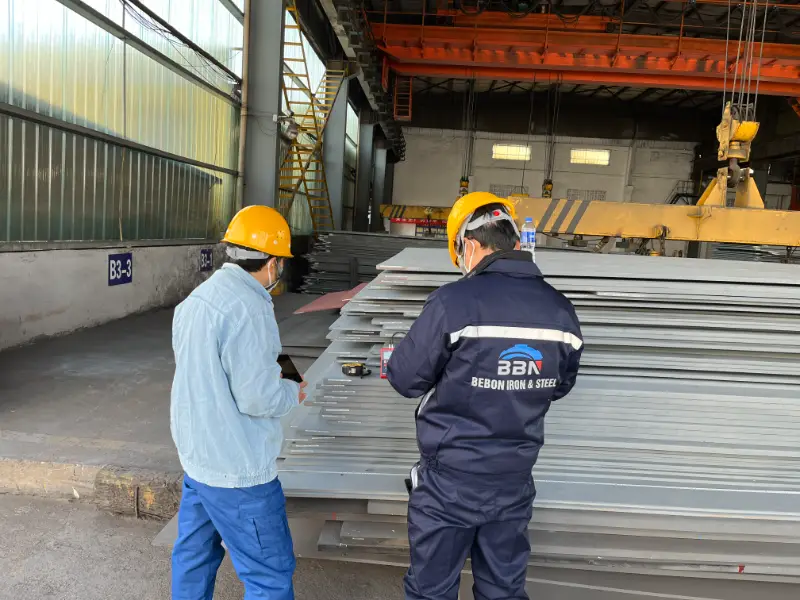
BP500 Protection Grade Steel Plate Sheet Material
BP500 Protection Grade Steel Plate Sheet: High-Hardness Ballistic Impact Resistant Alloy
Complete material data for BP500 protection grade steel plate sheet, covering chemical composition, mechanical and thermal properties, equivalent grades, and application guidance.
Welding, bending, machining (with suitable tooling)
- Phone : +8618037372205
- Email : [email protected]
- WhatsApp: Contact via Whtsapp
- WeChat: +8618037372205
BP500 Protection Grade Steel Plate Sheet Introduction
BP500 is a quenched and tempered high-hardness ballistic protection steel designed to defeat a wide range of projectile threats. With a nominal Brinell hardness of 500 HBW, it offers an excellent combination of strength, toughness, and wear resistance, making it suitable for both military and civilian security applications. The alloy is micro-alloyed with chromium, nickel, and molybdenum to ensure deep hardenability and uniform properties across plate thicknesses. Tight process controls guarantee consistent ballistic performance and reliable fabricability, including welding and limited cold forming. Typically supplied in as-quenched and tempered condition, BP500 meets the demanding requirements of modern armoring solutions.
BP500 Protection Grade Steel Plate Sheet Chemical Composition
The chemical composition of BP500 is optimized for achieving a homogeneous martensitic microstructure with high hardness and sufficient toughness after quenching and tempering. Key alloying elements:
- Carbon provides strength and hardness
- Chromium and nickel enhance hardenability and reduce transformation temperatures
- Molybdenum prevents temper embrittlement
- Boron, in small amounts, significantly improves hardenability
Strict limits on phosphorus and sulfur ensure steel cleanliness and impact toughness. The following values represent typical heat analysis for a 500 HBW protection steel.
| Chemical Element | Standard Value (wt%) | Remarks |
|---|---|---|
| Carbon (C) | 0.28 - 0.32 | Determines maximum hardness |
| Silicon (Si) | 0.15 - 0.40 | Deoxidation agent |
| Manganese (Mn) | 0.80 - 1.20 | Hardenability contributor |
| Phosphorus (P) | ≤ 0.015 | Maximum, harmful for toughness |
| Sulfur (S) | ≤ 0.005 | Maximum, minimizes inclusions |
| Chromium (Cr) | 1.00 - 1.50 | Increases hardenability and wear resistance |
| Nickel (Ni) | 0.50 - 1.00 | Improves low-temperature toughness |
| Molybdenum (Mo) | 0.25 - 0.50 | Resists softening during tempering |
| Boron (B) | 0.001 - 0.005 | Optional, enhances hardenability |
| Iron (Fe) | Balance | Remainder |
BP500 Protection Grade Steel Plate Sheet Thermal and Electrical Physical Properties
Thermal and electrical properties are provided for engineering calculations (e.g., heat transfer, thermal stress, and induction effects). These values are typical for low-alloy martensitic steels and are applicable at room temperature unless otherwise specified.
| Property | Standard Value | Unit | Test Conditions |
|---|---|---|---|
| Density (ρ) | 7.85 | g/cm³ | Room temperature |
| Young's Modulus (E) | 210 | GPa | Room temperature |
| Shear Modulus (G) | 80 | GPa | Room temperature |
| Poisson's Ratio (ν) | 0.3 | - | Room temperature |
| Thermal Expansion Coefficient (α) | 12.5 × 10⁻⁶ | 1/K | 20–200 °C |
| Thermal Conductivity (λ) | 35 | W/(m·K) | Room temperature |
| Specific Heat Capacity (cp) | 460 | J/(kg·K) | Room temperature |
| Electrical Resistivity (ρe) | 0.25 × 10⁻⁶ | Ω·m | Room temperature |
BP500 Protection Grade Steel Plate Sheet Mechanical Properties
Mechanical properties are guaranteed in the quenched and tempered condition and are verified on production samples. Hardness is the primary acceptance criterion; tensile and impact values are provided for design reference. Bending performance demonstrates the material's ability to be formed without cracking. Test directions are transverse unless otherwise noted. Properties are valid for plate thicknesses between 6 mm and 40 mm.
| Property | Standard Required Value | Unit | Test Conditions |
|---|---|---|---|
| Brinell Hardness (HBW) | 480 - 540 | HBW | EN ISO 6506-1, 3000 kgf load |
| Yield Strength (Rp0.2) | ≥ 1300 | MPa | Tensile test, transverse |
| Tensile Strength (Rm) | 1600 - 1900 | MPa | Tensile test, transverse |
| Elongation (A5) | ≥ 8 | % | Gauge length 5.65√So |
| Charpy Impact Energy (KV2) | ≥ 20 | J | at -40 °C, longitudinal |
| Bend Test (180°) | No cracks, mandrel Ø=3t | t = plate thickness (for t ≤ 20 mm) |
BP500 Protection Grade Steel Plate Sheet Internationally Recognized Equivalent Protection Steel Grades
| Country/Region | Standard/Grade Designation | Equivalent Grade | Remarks |
|---|---|---|---|
| Sweden | SSAB | Armox 500T | Proprietary grade, hardness 480-540 HBW, widely used |
| Germany | thyssenkrupp | PROTEC 500 | Commercial ballistic steel, equivalent performance |
| Luxembourg | ArcelorMittal | FORTAL 500 | Certified per MIL-A-46100 requirements |
| Germany | Dillinger | HHA 500 | High hardness armor, available in thick gauges |
| Global | MIL-DTL-46100E | High Hardness Armor (HHA) | Military specification covering 477-534 HBW plates |
BP500 Protection Grade Steel Plate Sheet Application Introduction
BP500 steel is engineered for ballistic protection applications where high hardness and shock resistance are critical. It is used extensively in military vehicles, security doors, and armored cash transport vehicles. The material can be cut using plasma, laser, or waterjet; flame cutting is possible with preheating. Welding must be performed with low-hydrogen consumables and appropriate preheat to avoid cold cracking. Post-weld heat treatment is not recommended as it can degrade ballistic performance. Cold forming is limited to large bend radii and should be done with caution.
Product Applications: Military vehicle hulls and turret armor, Add-on armor panels for tactical vehicles, Armored personnel carriers (APC), Security doors and window frames, Safe doors and vault panels, Blast containment walls
Processed into products: Vehicle floor armor plates, Side armor panels, Roof armor plates, Engine bay protection shields, Cash box lining plates, Security barrier plates
Application industries: Defense and security, Armored vehicle manufacturing, Cash-in-transit (CIT) vehicle production, Building protection (safe rooms, embassies), Marine security (patrol boat armor)
BP500 Protection Grade Steel Plate Sheet Similar Materials with Different Hardness Levels or Alternative Applications
| Country/Region | Standard/Grade | Designation | Remarks |
|---|---|---|---|
| Sweden | SSAB | Armox 440T | Lower hardness (420-480 HBW), better formability |
| Sweden | SSAB | Armox 600T | Higher hardness (570-640 HBW), superior ballistic resistance |
| Sweden | SSAB | Hardox 500 | Abrasion-resistant steel, not certified for ballistic protection |
| Germany | thyssenkrupp | PROTEC 450 | Softer protection grade, easier machining and welding |
| Global | MIL-A-46099 | Class 1 Armor | Rolled homogeneous armor, lower hardness (302-388 HBW) |
Notes:
Welding: Preheating to 150-200 °C is mandatory; use of low-hydrogen electrodes (AWS E11018-M or equivalent) is recommended. Interpass temperature should be kept below 250 °C. Oxy-fuel cutting requires preheating to avoid edge cracking. The steel is not intended for structural load-bearing applications without additional design verification. Impact performance may decrease after excessive welding heat input. Always refer to the specific manufacturer's datasheet for batch-specific properties.
- Share



