
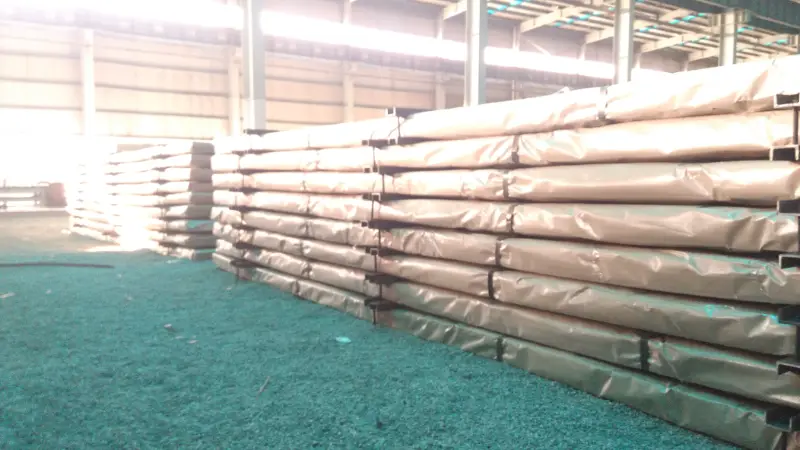
BP300 Protection Grade Ballistic Steel Plate Material
BP300 Protection Grade Ballistic Steel Plate - Ramor 300 Datasheet
Comprehensive data for BP300 protection grade steel plate (SSAB Ramor 300), including chemical, mechanical, and thermal properties, international equivalents, and processing guidelines.
Suitable for cutting (laser, plasma, waterjet), forming (press braking, rolling – limited due to high strength), machining, welding (with proper procedures), and surface coating.
- Phone : +8618037372205
- Email : [email protected]
- WhatsApp: Contact via Whtsapp
- WeChat: +8618037372205
BP300 Protection Grade Ballistic Steel Plate Introduction
BP300 protection grade steel (commercially known as SSAB Ramor 300) is a low-alloy, high-strength ballistic steel designed for protection against handgun and rifle threats. With nominal hardness in the 370–430 HBW range, it provides excellent resistance to 7.62×39 mm mild steel core projectiles when used at specified areal densities. The steel exhibits a minimum yield strength of 1000 MPa, high toughness at low temperatures, and good weldability.
It is supplied in quenched and tempered condition with thicknesses typically from 3 mm to 20 mm, offering a combination of high strength, good formability, and consistent ballistic performance. The material is widely used in armored vehicles, safe doors, ATM enclosures, and structural protection applications.
BP300 Protection Grade Ballistic Steel Plate Chemical Composition
The chemical composition is tailored for hardenability, strength, and ballistic performance. Typical ladle analysis limits are given for guaranteed properties. Maximum values unless stated otherwise.
| Element | Standard Value (%) | Remarks |
|---|---|---|
| C | ≤0.20 | Carbon for hardenability |
| Si | ≤0.50 | Silicon – deoxidation and strength |
| Mn | ≤0.70 | Manganese – toughness & hardenability |
| P | ≤0.020 | Phosphorus – impurity |
| S | ≤0.010 | Sulfur – impurity (low for cleanliness) |
| Cr | ≤0.80 | Chromium – improves hardenability |
| Ni | ≤1.00 | Nickel – toughness at low temperature |
| Mo | ≤0.40 | Molybdenum – enhances temper resistance |
| B | ≤0.005 | Boron – for hardenability in thin sections |
| Fe | Balance | Base element |
BP300 Protection Grade Ballistic Steel Plate Thermal & Electrical Physical Properties
Physical properties are average values for quenched and tempered low-alloy steel at room temperature, unless another temperature is stated.
| Property | Value | Unit | Test Condition / Temperature |
|---|---|---|---|
| Density (ρ) | 7850 | kg/m³ | 20 °C |
| Elastic Modulus (E) | 210 | GPa | 20 °C |
| Shear Modulus (G) | 81 | GPa | 20 °C |
| Poisson's Ratio (ν) | 0.3 | – | 20 °C |
| Thermal Expansion Coeff. (α) | 11.5 | 10⁻⁶/°C | 20–200 °C |
| Thermal Expansion Coeff. (α) | 12.0 | 10⁻⁶/°C | 20–400 °C |
| Thermal Conductivity (λ) | 38 | W/(m·K) | 100 °C |
| Thermal Conductivity (λ) | 36 | W/(m·K) | 400 °C |
| Specific Heat Capacity (cp) | 460 | J/(kg·K) | 20 °C |
| Electrical Resistivity (ρe) | 0.25 | Ω·mm²/m | 20 °C |
BP300 Protection Grade Ballistic Steel Plate Mechanical Properties
Properties are for quenched and tempered plates 6–20 mm thickness, tested in longitudinal direction according to SS-EN ISO 6892-1 (tensile) and SS-EN ISO 148-1 (impact). Hardness as per SS-EN ISO 6506-1.
| Property | Value | Unit | Test Condition |
|---|---|---|---|
| Yield Strength (ReH) | ≥1000 | MPa | Ambient, longitudinal |
| Tensile Strength (Rm) | 1300 – 1700 | MPa | Ambient, longitudinal |
| Elongation (A5) | ≥8 | % | Gauge length 5d |
| Hardness | 370 – 430 | HBW | Brinell, 3000 kgf |
| Impact Energy (KV2) | ≥20 | J | -40°C, longitudinal, average of 3 tests |
| Bend Test (min. recommended) | 2.0 × t | – | Bend angle 180°, t = plate thickness; for thickness > 12 mm use 3.0×t |
BP300 Protection Grade Ballistic Steel Plate Identical/Equivalent Material Standards and Substitutable Grades
| Country/Region | Standard | Grade | Remarks |
|---|---|---|---|
| Sweden | SSAB | Ramor 300 | Exact designation for BP300 protection level |
| – | – | – | No direct national/international standard equivalent exists; material is a proprietary grade |
BP300 Protection Grade Ballistic Steel Plate Application Introduction
BP300 (Ramor 300) is suited for applications where lightweight ballistic protection against small arms fire is required. It can be welded, formed to limited extents, and integrated into fabricated assemblies. Surface hardening treatments are typically unnecessary as the steel is delivered already tempered.
Key processing notes:
- Preheating for welding is usually not required for plate thicknesses below 20 mm; use austenitic or matching filler metals.
- Plasma and laser cutting are preferred; oxy-fuel cutting may require post-cut grinding.
- Forming must be done with adequate bend radii (≥2t) and preferably at ambient temperature to avoid risk of cracking.
Product Applications: Armored personnel carriers (APCs) and tactical vehicles, Cash-in-Transit Vehicles and Armored Vehicles, Ballistic shields and portable protective barriers, Bank vaults and safe doors, ATM enclosures and secure payment kiosks, Helicopter cockpit armor plates
Processed into products: Vehicle hull panels and doors, Defensive firearm shields, Blast-resistant panels, Armored cabin envelopes, Safety glass framing systems, Protective partitions in banks or embassies
Application industries: Defence and military vehicle manufacturing, Law enforcement and security vehicle upfitting, Banking and cash-handling equipment (vaults, ATM housings), Building and infrastructure security (blast shields, safe rooms), Marine and offshore (protection against small arms on patrol boats)
BP300 Protection Grade Ballistic Steel Plate Similar / Alternative Materials with Comparable Performance
| Country/Region | Standard | Grade | Remarks |
|---|---|---|---|
| Australia | Bisalloy Steels | Bisalloy Armour 250 | Nominal hardness ~300 HBW; similar ballistic protection for 7.62×39 MSC |
| Germany | thyssenkrupp | XABO 300 | Ballistic steel with comparable hardness and strength; process adjustments may apply |
| International | EN 1522 | FB4 (material class) | Performance specification; not a brand. Ramor 300 meets FB4 requirements for 7.62×39 MSC |
| France | ArcelorMittal | MLC 300 | Protection steel similar in concept; verify mechanical and ballistic equivalence |
Notes:
- Ballistic certification according to EN 1522 or equivalent must be performed on finished welded assemblies; plate-only data serves as a guideline.
- For thicknesses >20 mm, different material grades (e.g., Ramor 400, Ramor 500) are recommended.
- When exposed to temperatures above 200 °C (e.g., during hot forming or welding), mechanical properties may degrade; subsequent re-hardening is not standard.
- Surface protection (painting, hot-dip galvanizing with caution) should be applied after verification of no hydrogen embrittlement risk.
- Share



