
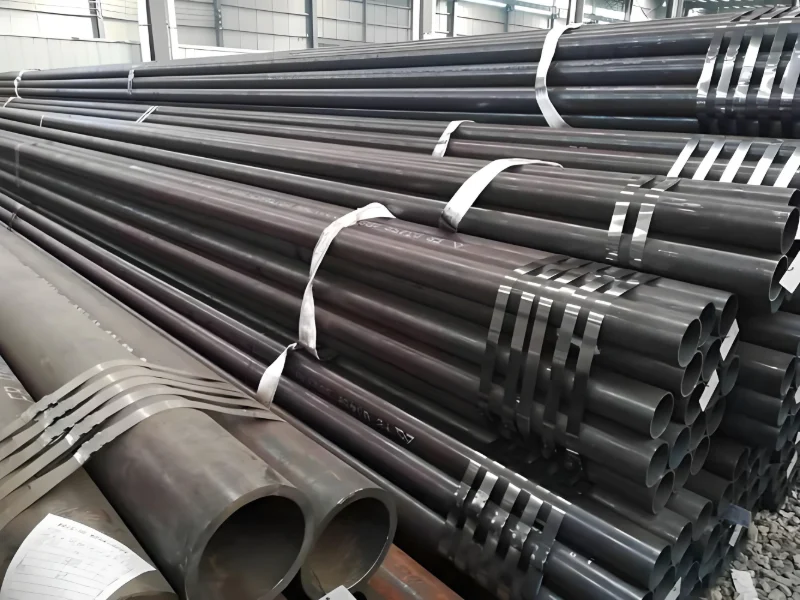
12Cr5Mo Seamless Steel Tube Material
12Cr5Mo Seamless Steel Tube to GB/T 9948 for Petroleum Cracking Service
Comprehensive technical data of 12Cr5Mo seamless steel tube according to GB/T 9948, including chemical composition, mechanical properties, thermal and electrical properties, and equivalent grades.
Hot-rolling, cold-drawing, welding (tube manufacturing); fabrication: bending, flanging, machining
- Phone : +8618037372205
- Email : [email protected]
- WhatsApp: Contact via Whtsapp
- WeChat: +8618037372205
12Cr5Mo Seamless Steel Tube Introduction
12Cr5Mo is a 5% chromium – 0.5% molybdenum ferritic alloy steel, widely used for seamless steel tubes in petroleum cracking applications under high temperature and hydrogen-containing environments. GB/T 9948 specifies the requirements for such tubes, typically used for furnace tubes, heat exchangers, and piping in refineries and petrochemical plants. The steel offers good resistance to oxidation, hydrogen attack, and sulfur corrosion up to approximately 550°C. It is supplied in heat-treated condition (annealed or normalized + tempered) to ensure adequate creep strength and toughness. The grade is noted for its weldability and structural stability under prolonged thermal exposure.
12Cr5Mo Seamless Steel Tube Chemical Composition
Chemical properties per GB/T 9948-2013 for grade 12Cr5Mo. All values are in weight percent. Residual elements are controlled to ensure high-temperature service integrity. Phosphorus and sulfur are kept low to enhance hot workability and corrosion resistance.
| Element | Standard Value (%) | Remarks |
|---|---|---|
| Carbon, C | ≤ 0.15 | Key for strength and hardenability |
| Silicon, Si | ≤ 0.50 | Deoxidizer, improves oxidation resistance |
| Manganese, Mn | ≤ 0.60 | Contributes to deoxidation and toughness |
| Phosphorus, P | ≤ 0.025 | Residual element, controlled for ductility |
| Sulfur, S | ≤ 0.015 | Residual, low for improved hot workability |
| Chromium, Cr | 4.00 – 6.00 | Provides oxidation and corrosion resistance |
| Molybdenum, Mo | 0.45 – 0.60 | Increases high-temperature strength and creep resistance |
| Nickel, Ni | ≤ 0.60 | Residual, not intentionally added |
| Copper, Cu | ≤ 0.20 | Residual, may affect hot shortness |
12Cr5Mo Seamless Steel Tube Thermal and Electrical Physical Properties
Typical physical properties for 5%Cr-0.5%Mo steel at various temperatures. Values are indicative for 12Cr5Mo in normalized + tempered condition. Density is relatively constant. Thermal expansion coefficients increase with temperature, which is important for design in high-temperature service. Thermal conductivity decreases slightly with temperature. Data are derived from commonly accepted reference materials for similar Cr-Mo alloys.
| Property | Typical Value | Unit | Test Condition |
|---|---|---|---|
| Density, ρ | 7.80 | g/cm³ | 20°C |
| Modulus of Elasticity, E | 215 | GPa | 20°C |
| Modulus of Elasticity, E | 210 | GPa | 100°C |
| Modulus of Elasticity, E | 205 | GPa | 200°C |
| Modulus of Elasticity, E | 198 | GPa | 300°C |
| Modulus of Elasticity, E | 190 | GPa | 400°C |
| Modulus of Elasticity, E | 180 | GPa | 500°C |
| Shear Modulus, G | 84 | GPa | 20°C (calculated) |
| Poisson's Ratio, ν | 0.29 | - | 20°C |
| Thermal Expansion Coefficient, α | 11.5 | 10⁻⁶/K | 20-100°C |
| Thermal Expansion Coefficient, α | 12.0 | 10⁻⁶/K | 20-200°C |
| Thermal Expansion Coefficient, α | 12.4 | 10⁻⁶/K | 20-300°C |
| Thermal Expansion Coefficient, α | 12.8 | 10⁻⁶/K | 20-400°C |
| Thermal Expansion Coefficient, α | 13.1 | 10⁻⁶/K | 20-500°C |
| Thermal Expansion Coefficient, α | 13.4 | 10⁻⁶/K | 20-600°C |
| Thermal Conductivity, λ | 38 | W/(m·K) | 100°C |
| Thermal Conductivity, λ | 37 | W/(m·K) | 200°C |
| Thermal Conductivity, λ | 36 | W/(m·K) | 300°C |
| Thermal Conductivity, λ | 35 | W/(m·K) | 400°C |
| Thermal Conductivity, λ | 34 | W/(m·K) | 500°C |
| Specific Heat Capacity, c | 460 | J/(kg·K) | 20°C |
| Specific Heat Capacity, c | 500 | J/(kg·K) | 100°C |
| Specific Heat Capacity, c | 530 | J/(kg·K) | 200°C |
| Specific Heat Capacity, c | 550 | J/(kg·K) | 300°C |
| Specific Heat Capacity, c | 580 | J/(kg·K) | 400°C |
| Specific Heat Capacity, c | 610 | J/(kg·K) | 500°C |
| Electrical Resistivity, ρe | 0.55 | μΩ·m | 20°C |
12Cr5Mo Seamless Steel Tube Mechanical Properties
Mechanical property requirements according to GB/T 9948-2013 for 12Cr5Mo seamless tubes. Testing is performed at room temperature on longitudinal specimens.
- Yield strength and tensile strength values apply for wall thickness ≤ 30 mm; a reduction of 10 MPa in yield strength is allowed for thickness > 30 mm.
- Impact test uses Charpy V-notch specimens, minimum absorbed energy 27 J at 20°C, longitudinal direction.
- Bend test: 180° bend over a mandrel with diameter equal to 4 times the wall thickness; no cracks allowed.
| Property | Required Value | Unit | Test Condition |
|---|---|---|---|
| Tensile Strength, Rm | 390 – 590 | MPa | Room temperature |
| Yield Strength, ReH | ≥ 195 | MPa | Room temperature, wall thickness ≤ 30 mm |
| Yield Strength, ReH | ≥ 185 | MPa | Room temperature, wall thickness > 30 mm |
| Elongation after fracture, A | ≥ 22 | % | Longitudinal, gauge length 5.65√S₀ |
| Brinell Hardness | ≤ 187 | HBW | As heat-treated condition |
| Rockwell Hardness | ≤ 97 | HRB | As heat-treated condition (alternative) |
| Impact Energy, KV2 | ≥ 27 | J | Charpy V-notch, 20°C, longitudinal |
| Bend Test | No cracks or defects | - | 180° bend, mandrel diameter = 4 x wall thickness |
12Cr5Mo Seamless Steel Tube Fully Equivalent Material Standards and Substitute Grades
| Country/Region | Standard | Grade | Remarks |
|---|---|---|---|
| China | GB/T 9948 | 12Cr5Mo | Original grade for petroleum cracking tubes |
| USA | ASTM A335/A335M | P5 | Seamless ferritic alloy-steel pipe for high-temperature service |
| Europe | EN 10216-2 | X11CrMo5 +NT/+A | Seamless steel tubes for pressure purposes, raised temperature |
| Japan | JIS G3458 | STPA25 | Alloy steel pipes for high temperature service |
| International | ISO 9329-2 | TS5 | Seamless steel tubes for pressure purposes |
12Cr5Mo Seamless Steel Tube Application Introduction
12Cr5Mo seamless tubes are primarily used in the petrochemical industry for elevated temperature and high-pressure hydrogen service. The alloy's chromium content provides resistance to oxidation and sulfidation, while molybdenum improves creep strength. Typical operating conditions range up to 550°C in non-corrosive or mildly corrosive environments.
Key applications include:
- Furnace tubes for crude oil cracking and reformers
- High-pressure steam pipelines
- Heat exchanger tubes and headers
- Hydroprocessing reactor internals
The material can be fabricated into various components using standard techniques. Welding requires preheating and post-weld heat treatment (PWHT) to avoid cracking and ensure toughness.
Product Applications: Ethylene cracking furnace coils, Catalytic reforming reactor tubes, Hydrocracking unit piping, Steam superheater tubes, Waste heat boiler tubes, High-temperature process piping systems
Processed into products: Furnace tubes (radiant and convection sections), Return bends and U-bends, Tube sheets and headers, Flanges and pipe fittings (elbows, tees, reducers), Heat exchanger tubes and baffles, Pressure vessel nozzles
Application industries: Petroleum refining, Petrochemical plants, Chemical processing, Power generation (boiler tubes), Fertilizer industry (syngas heaters)
12Cr5Mo Seamless Steel Tube Similar or Alternative Materials
| Country/Region | Standard | Grade | Remarks |
|---|---|---|---|
| China | GB/T 9948 | 12Cr1MoV (12Cr1Mo) | 1%Cr-0.5%Mo, lower oxidation resistance but higher strength at moderate temperatures |
| China | GB/T 9948 | 12Cr2Mo (2.25Cr-1Mo) | Slightly higher Cr content, better hydrogen resistance, commonly used in hydrocracking |
| USA | ASTM A335 | P9 (9Cr-1Mo) | Higher Cr for enhanced oxidation resistance up to 600°C |
| USA | ASTM A335 | P22 (2.25Cr-1Mo) | Similar to 12Cr2Mo, widely used in power plant piping |
| Europe | EN 10216-2 | X10CrMoVNb9-1 (P91) | High-creep-strength modified 9Cr steel for up to 600°C |
Notes:
Note regarding grade designation: The input referred to '12Cr5MoI', which may be a typographical variant; the official designation in GB/T 9948 is 12Cr5Mo. According to GB/T 9948-2013, the steel shall be killed and fully deoxidized. Hydrogen-induced cracking (HIC) and sulfide stress cracking (SSC) resistance can be enhanced by special heat treatment and restricted chemistry when required for sour service. Supplementary tests (e.g., ultrasonic examination, hydrostatic test) are typically performed according to the standard or purchase agreement.
- Share



