
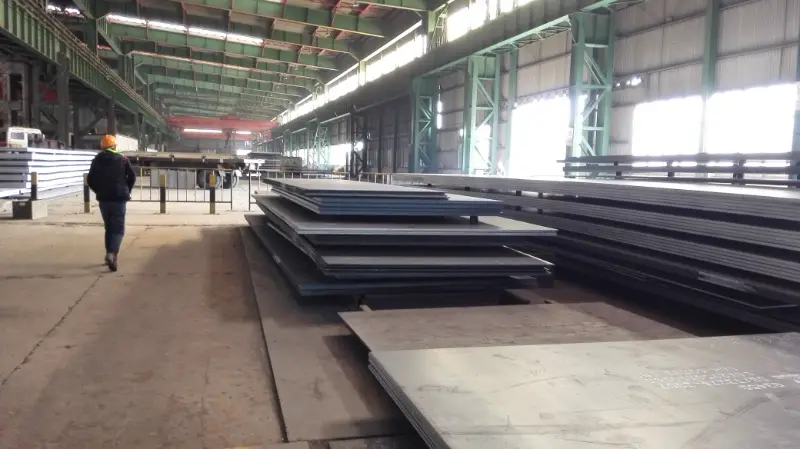
BP370 Ballistic Protection Steel Plate Material
Bisalloy BP370 Protection Grade Steel Plate: Ballistic & Blast Resistant High-Strength Solution
Detailed material data for Bisalloy BP370 protection grade steel plate including chemical composition, mechanical properties, thermal and electrical physical properties, international equivalents, applications, and processing guidelines.
Thermal cutting (plasma, laser, oxy-fuel), cold forming, welding, machining, shot blasting, painting
- Phone : +8618037372205
- Email : [email protected]
- WhatsApp: Contact via Whtsapp
- WeChat: +8618037372205
BP370 Ballistic Protection Steel Plate Introduction
Bisalloy BP370 is a quenched and tempered low-alloy steel plate specifically engineered for ballistic and blast protection. It offers a minimum yield strength of 370 MPa combined with excellent toughness and weldability. The steel provides reliable resistance against small arms fire, fragments, and explosive blasts, making it ideal for armoured vehicles, security doors, safe rooms, and military infrastructure. BP370 is supplied in thicknesses typically up to 80 mm and is characterized by good flatness, tight dimensional tolerances, and consistent mechanical properties through its entire cross-section. Its low carbon equivalent ensures ease of fabrication using conventional methods, including thermal cutting, bending, and welding without significant loss of protective performance.
BP370 Ballistic Protection Steel Plate Chemical Composition
The chemical composition of BP370 is controlled to provide an optimum combination of strength, toughness, and weldability. Low carbon and microalloying elements ensure the steel can be welded without preheating under normal conditions, while maintaining a hardness level suitable for ballistic resistance. All values are as per typical melt analysis.
| Element | Typical Value (max, %) | Remarks |
|---|---|---|
| Carbon (C) | 0.20 | max |
| Silicon (Si) | 0.50 | max |
| Manganese (Mn) | 1.60 | max |
| Phosphorus (P) | 0.020 | max |
| Sulfur (S) | 0.010 | max |
| Chromium (Cr) | 0.80 | max |
| Nickel (Ni) | 0.50 | max |
| Molybdenum (Mo) | 0.50 | max |
| Boron (B) | 0.005 | max |
| Iron (Fe) | Balance | - |
BP370 Ballistic Protection Steel Plate Thermal and Electrical Physical Properties
The physical properties of BP370 are typical for low-alloy quenched and tempered steels. They are calculated or measured on standard samples and may vary slightly depending on actual composition and microstructure. Data is useful for thermal and structural calculations.
| Property | Typical Value | Unit | Test Condition / Remarks |
|---|---|---|---|
| Density (ρ) | 7850 | kg/m³ | at 20°C |
| Modulus of elasticity (E) | 210 | GPa | tension |
| Shear modulus (G) | 81 | GPa | calculated from E and ν |
| Poisson's ratio (ν) | 0.3 | - | ambient temperature |
| Thermal expansion coefficient (α) | 11.7 | 10⁻⁶/K | over range 20 – 100°C |
| Thermal expansion coefficient (α) | 12.5 | 10⁻⁶/K | over range 20 – 200°C |
| Thermal conductivity (λ) | 45 | W/(m·K) | at 20°C |
| Thermal conductivity (λ) | 42 | W/(m·K) | at 200°C |
| Specific heat capacity | 460 | J/(kg·K) | at 20°C |
| Electrical resistivity (ρ_e) | 0.25 | μΩ·m | at 20°C, approximate |
BP370 Ballistic Protection Steel Plate Mechanical Properties
The mechanical properties of BP370 are ensured by the quenching and tempering process. Values presented are minima unless a range is specified; they apply to transverse test pieces taken from the plate. For thicknesses above 20 mm some strength reduction is allowed but toughness and elongation remain high. Testing is performed in accordance with EN ISO 6892-1 and EN ISO 148-1.
| Property | Standard Value | Unit | Test Condition / Remarks |
|---|---|---|---|
| Yield strength (ReH) | 370 | MPa | thickness ≤ 20 mm, min |
| Yield strength (ReH) | 350 | MPa | thickness > 20 ≤ 50 mm, min |
| Yield strength (ReH) | 330 | MPa | thickness > 50 ≤ 80 mm, min |
| Tensile strength (Rm) | 530 - 700 | MPa | all thicknesses |
| Elongation (A5) | 18 | % | gauge length 5.65√S₀, min, all thicknesses |
| Elongation (A50) | 14 | % | 50 mm gauge length, min, thickness ≤ 20 mm |
| Charpy impact energy (KV₂) | 27 | J | at -40 °C, min, longitudinal |
| Charpy impact energy (KV₂) | 40 | J | at -20 °C, min, transverse |
| Hardness | 170 - 230 | HBW | typical range, not guaranteed |
| Bend test (mandrel diameter) | 3t | - | 180° bend, t = plate thickness, crack-free |
BP370 Ballistic Protection Steel Plate Directly Equivalent International Standards and Replacement Grades
| Country/Region | Standard / Specification | Grade | Remarks |
|---|---|---|---|
| Sweden / Global | SSAB Armox Datasheet | Armox 370T | Same protective class, comparable yield and tensile strength; also Q&T |
| Australia | AS/NZS 1594 | HW350 / HW400 | Commercial equivalents but not specifically designed for ballistic protection; similar strength level |
| Germany | DIN EN 10025-6 | S460QL | High-strength structural steel with similar delivery condition; higher yield but can be used as alternative in some static applications |
| Thyssenkrupp / EU | Secure® | Secure 370 | Dedicated ballistic grade with almost identical mechanical properties |
BP370 Ballistic Protection Steel Plate Application Introduction
Bisalloy BP370 is primarily designed for ballistic and blast protection, but its balanced mechanical properties allow it to be used in a variety of safety-critical structures. Its good weldability and formability permit integration into complex assemblies without compromising protective capabilities. Typical application areas include:
Product Applications: Ballistic steel panels and appliqué armour kits, Armoured doors, windows, and wall panels, Blast-resistant containers and barriers, Military-grade guard houses and observation posts, Naval shipboard protection plates, Security partitions and counters for banks
Processed into products: Vehicle hulls and underbody blast shields, Door frames and window surrounds for armoured cars, Interchangeable armour modules (bolt-on kits), Protective liners for walls and ceilings, Ammunition storage magazine walls, Safety shields for explosive handling areas
Application industries: Defence and security, Armoured vehicle manufacturing (military and civilian), Cash-in-transit (CIT) vehicle production, Protective construction (embassies, government buildings, safe rooms), Mining and resources (blast-resistant cabins), Law enforcement equipment
BP370 Ballistic Protection Steel Plate Similar or Comparable Protection Steel Grades
| Country/Region | Standard / Specification | Grade | Remarks / Analysis |
|---|---|---|---|
| Sweden / Global | SSAB | Armox 440T | Higher strength (440 MPa yield), improved ballistic performance against rifles; suitable when more protection is needed but with slightly reduced formability |
| Sweden / Global | SSAB | Armox 500T | Significantly harder (500 HBW typical) for military applications; less ductile, requires careful welding |
| Australia | Bisalloy | BP440 | Bisalloy's next protection grade; yield 440 MPa, better multi-hit resistance; direct upgrade from BP370 |
| France | Industeel | Creusabro 4800 | Abrasion-resistant steel sometimes used in dual-purpose applications; not a dedicated ballistic steel but offers comparable hardness and strength |
Notes:
Welding recommendations: BP370 can be welded by all common methods (SMAW, MAG, SAW). Preheating is generally not required up to 40 mm thickness if low-hydrogen consumables are used and the joint is dry. For thicker sections (>40 mm), a preheat of 100-150°C is advised.
Cold forming: Minimum recommended bending radius is 2t (transverse) and 3t (longitudinal). Stress relief annealing after severe forming may be required.
Surface protection: Plates are supplied descaled; paint and coating systems for steel armor are recommended to prevent corrosion.
Certification: Products are accompanied by material certificates according to EN 10204 3.1, with optionally 3.2 upon agreement.
- Share



