
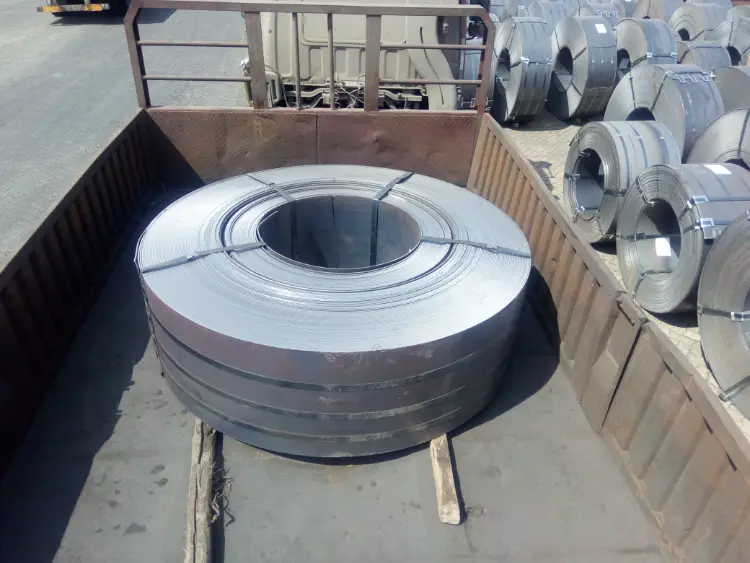
B380CL Hot Rolled Steel Coil
B380CL Hot Rolled Steel Coil for Cold Forming – Q/BQB 310-2009 Data Sheet
Comprehensive technical data for B380CL hot rolled steel coil per Baosteel standard Q/BQB 310-2009, including chemical composition, mechanical and physical properties, international equivalents, and application guidance.
Cold forming, bending, drawing, punching, welding, coating
- Phone : +8618037372205
- Email : [email protected]
- WhatsApp: Contact via Whtsapp
- WeChat: +8618037372205
B380CL Hot Rolled Steel Coil Introduction
B380CL is a hot-rolled, low-carbon steel grade designed for cold forming applications, specified in Q/BQB 310-2009 by Baosteel. It offers a minimum tensile strength of 380 MPa with excellent formability and weldability, making it suitable for automotive structural components and general engineering parts that require bending, drawing, or flanging operations. The alloy adopts a refined grain structure through microalloying, achieving a good balance between strength and ductility. Typical delivery condition is as-hot-rolled, with a pickled and oiled surface available upon request. This steel can replace conventional structural steels in weight-sensitive designs while ensuring reliable performance in forming processes.
B380CL Hot Rolled Steel Coil Chemical Composition
The chemical composition of B380CL is controlled to ensure good weldability, formability, and mechanical properties. Microalloying elements (Nb, V, Ti) may be added singly or in combination to refine the grain structure, their total not exceeding 0.22%. The values below are maximum unless a range is specified.
| Element | Value (wt%) | Remarks |
|---|---|---|
| Carbon, C | ≤0.12 | |
| Silicon, Si | ≤0.30 | |
| Manganese, Mn | ≤1.00 | |
| Phosphorus, P | ≤0.030 | |
| Sulfur, S | ≤0.025 | |
| Aluminium (total), Alt | ≥0.015 | |
| Microalloying elements (Nb, V, Ti, etc.) | ≥0.015 (total, if added) | Sum ≤0.22% |
B380CL Hot Rolled Steel Coil Physical Properties
The following physical properties are representative for low-carbon hot-rolled steel such as B380CL. They may vary slightly depending on exact composition and processing conditions. These values are useful for design calculations involving heat transfer, thermal expansion, and electrical conductivity.
| Property | Value | Unit | Condition |
|---|---|---|---|
| Density (ρ) | 7.85 | g/cm³ | 20 °C |
| Elastic Modulus (E) | 210 | GPa | Room temperature |
| Shear Modulus (G) | 81 | GPa | Room temperature |
| Poisson's Ratio (ν) | 0.30 | - | 20 °C |
| Thermal Expansion Coefficient (α) | 12.0 | 10⁻⁶/K | 20–100 °C |
| Thermal Conductivity (λ) | 50 | W/(m·K) | 20 °C |
| Specific Heat Capacity (c) | 460 | J/(kg·K) | 20 °C |
| Electrical Resistivity (ρ_e) | 0.15 | μΩ·m | 20 °C |
B380CL Hot Rolled Steel Coil Mechanical Properties
The mechanical properties listed are for material in the as-delivered (hot-rolled) condition. Transverse testing samples are taken from the strip. The elongation is measured on a gauge length of 50 mm (A50) with a specimen width of 25 mm. Bending test is performed at 180°.
| Property | Value | Unit | Condition |
|---|---|---|---|
| Yield Strength (ReH) | ≥260 | MPa | As-delivered |
| Tensile Strength (Rm) | 380 – 480 | MPa | As-delivered |
| Elongation after fracture (A50) | ≥25 | % | Thickness < 3.0 mm |
| Elongation after fracture (A50) | ≥23 | % | Thickness ≥ 3.0 mm |
| Bend Test (mandrel diameter) | d = 0a | - | Thickness < 3.0 mm, 180° bend |
| Bend Test (mandrel diameter) | d = 0.5a | - | Thickness ≥ 3.0 mm, 180° bend |
B380CL Hot Rolled Steel Coil Direct International Equivalent Standards and Substitute Grades
| Country/Region | Standard | Grade | Remarks |
|---|
B380CL Hot Rolled Steel Coil Application Introduction
B380CL is specifically developed for cold-formed structural parts, especially in the automotive industry. Its combination of good weldability, moderate strength, and excellent formability makes it suitable for components that undergo deep drawing, bending, and flanging. It can be processed using conventional press shop equipment without preheating. The steel is also compatible with typical post-processing such as phosphating, e-coating, and powder coating.
Product Applications: Longitudinal beams of truck frames, Cross members of chassis, Suspension control arms, Wheel rims and disc wheels, Brackets and reinforcements, Seat structures, Exhaust system hangers, Industrial shelving profiles
Processed into products: Stamped brackets and supports, Deep-drawn cups and housings, Bent profiles and channels, Welded assemblies for chassis, Cold-rolled-formed sections, Laser-cut blanks for structural nodes
Application industries: Automotive manufacturing, Transportation, Machinery, Tubular products, Agricultural equipment
B380CL Hot Rolled Steel Coil Closely Comparable / Alternative Materials
B380CL does not have a direct equivalent in international standards, but the following grades are functionally similar in terms of strength, formability, and application. They may be considered as substitutes after evaluating exact property requirements and dimensional tolerances.
| Country/Region | Standard | Grade | Remarks |
|---|---|---|---|
| Japan | JIS G3113 | SAPH370 | Minimum tensile 370 MPa; higher elongation, slightly lower strength; suitable for cold forming in automotive frames. |
| Japan | JIS G3113 | SAPH400 | Minimum tensile 400 MPa; yield ≥255 MPa; close strength match with slightly different composition limits. |
| European Union | EN 10149-2 | S315MC | Hot-rolled high strength steel for cold forming; yield ≥315 MPa, tensile 390-510 MPa; higher yield, similar tensile range. |
| European Union | EN 10149-2 | S355MC | Yield ≥355 MPa, tensile 430-550 MPa; higher strength; suitable for heavier sections but requires greater forming forces. |
| China (GB) | GB/T 3273 | 370L | Hot-rolled steel for automobile frame; tensile ≥370 MPa; similar application, but mechanical and chemical limits differ. |
Notes:
- The chemical composition and mechanical properties are in accordance with Q/BQB 310-2009 and apply to hot-rolled coils before any surface treatment.
- For thickness beyond the specified ranges, consult Baosteel technical agreements.
- The typical physical property values are for reference; actual values may vary with production conditions. Design calculations should incorporate safety factors.
- When substituting B380CL with international grades, verify weldability, fatigue performance, and forming limits through prototype trials.
- Share



