
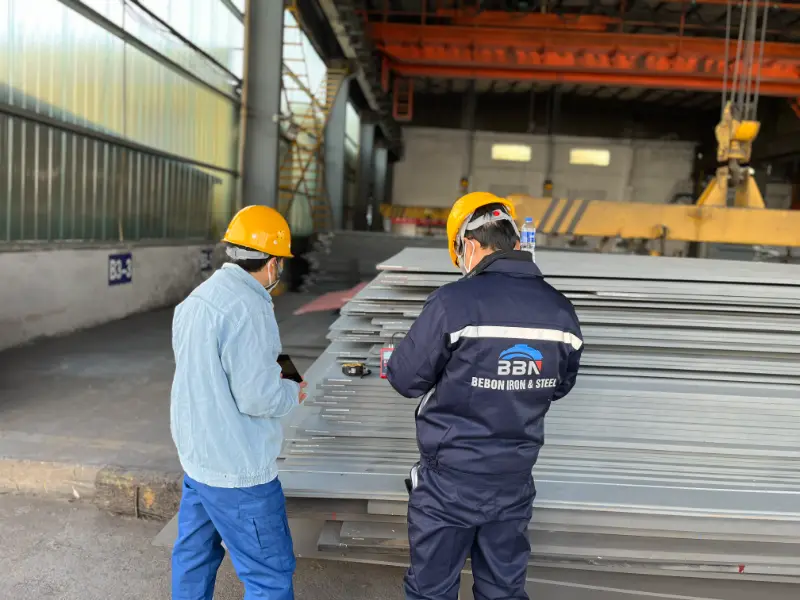
Austenitic Stainless Steel 317 (UNS S31700) Plate & Coil
Austenitic Stainless Steel 317 (UNS S31700) Plate & Coil - Data and Properties
Detailed material data for UNS S31700 austenitic stainless steel in plate and coil form, including chemical composition, mechanical properties, thermal and electrical characteristics, international equivalents, and application guidance.
Hot rolling, cold rolling, solution annealing, pickling, descaling
- Phone : +8618037372205
- Email : [email protected]
- WhatsApp: Contact via Whtsapp
- WeChat: +8618037372205
Austenitic Stainless Steel 317 Plate & Coil Introduction
UNS S31700 is a molybdenum-bearing austenitic stainless steel with higher nickel and molybdenum contents than the standard 316 grade. This composition provides significantly improved resistance to pitting, crevice corrosion, and general corrosion in chloride-containing environments and reducing acids. The alloy is non-magnetic in the annealed condition and offers excellent formability and weldability.
- Enhanced corrosion resistance compared to 304/316 grades
- Good high-temperature strength and oxidation resistance
- Commonly supplied as plate, sheet, or coil in solution-annealed condition
- Used in chemical processing, pulp & paper, and marine applications where 316 is insufficient
Austenitic Stainless Steel 317 Plate & Coil Chemical Composition
Heat analysis according to ASTM A240/A240M for UNS S31700. Iron is the remainder. Controlled sulfur and phosphorus ensure good hot workability and weldability.
| Element | Standard Value | Remarks |
|---|---|---|
| Carbon (C) | ≤ 0.08 | |
| Manganese (Mn) | ≤ 2.00 | |
| Phosphorus (P) | ≤ 0.045 | |
| Sulfur (S) | ≤ 0.030 | |
| Silicon (Si) | ≤ 1.00 | |
| Chromium (Cr) | 18.0 – 20.0 | |
| Nickel (Ni) | 11.0 – 15.0 | |
| Molybdenum (Mo) | 3.0 – 4.0 | |
| Iron (Fe) | Balance |
Austenitic Stainless Steel 317 Plate & Coil Thermal and Electrical Physical Properties
Typical physical properties for annealed UNS S31700 austenitic stainless steel at room temperature unless otherwise noted. These values are derived from standard references and are representative for general engineering calculations.
| Property | Typical Value | Unit | Test Condition / Temperature |
|---|---|---|---|
| Density (ρ) | 8.0 | g/cm³ | 20 °C |
| Modulus of Elasticity (E) | 193 | GPa | 20 °C |
| Shear Modulus (G) | 77 | GPa | 20 °C |
| Poisson's Ratio (ν) | 0.27 – 0.30 | — | 20 °C |
| Thermal Expansion (α) | 15.9 | µm/m·°C | 20 – 100 °C |
| Thermal Expansion (α) | 17.5 | µm/m·°C | 20 – 500 °C |
| Thermal Expansion (α) | 19.0 | µm/m·°C | 20 – 1000 °C |
| Thermal Conductivity (λ) | 14.6 | W/m·K | 100 °C |
| Thermal Conductivity (λ) | 18.9 | W/m·K | 500 °C |
| Specific Heat Capacity (cp) | 500 | J/kg·K | 0 – 100 °C |
| Electrical Resistivity (ρe) | 0.74 | µΩ·m | 20 °C |
Austenitic Stainless Steel 317 Plate & Coil Mechanical Properties
Room-temperature tensile and hardness requirements for annealed plate, sheet, and strip per ASTM A240/A240M. No impact or bend test is mandatory for this grade under the base specification unless supplementary requirements are invoked. Values shown are minimums (or maximums for hardness).
| Property | Standard Required Value | Unit | Test Condition |
|---|---|---|---|
| Tensile Strength (Rm) | ≥ 515 | MPa | Room temperature |
| Tensile Strength (Rm) | ≥ 75 | ksi | Room temperature |
| Yield Strength (Rp0.2) | ≥ 205 | MPa | Room temperature |
| Yield Strength (Rp0.2) | ≥ 30 | ksi | Room temperature |
| Elongation (A) in 50 mm (2 in.) | ≥ 35 | % | Room temperature |
| Brinell Hardness (HBW) | ≤ 217 | — | Room temperature |
| Rockwell Hardness (HRB) | ≤ 95 | — | Room temperature |
Austenitic Stainless Steel 317 Plate & Coil Fully Equivalent Material Standards & Substitutable Grades
| Country / Region | Standard | Grade | Remarks |
|---|---|---|---|
| USA | ASTM A240/A240M | 317 (UNS S31700) | Original grade |
| Japan | JIS G4304 / JIS G4305 | SUS 317 | Hot-rolled / Cold-rolled plate, sheet, strip |
| China | GB/T 3280 (Cold-rolled), GB/T 4237 (Hot-rolled) | 06Cr19Ni13Mo3 (new) / 0Cr19Ni13Mo3 (old) | Identical chemistry and properties |
Austenitic Stainless Steel 317 Plate & Coil Application Introduction
UNS S31700 is selected when standard 316 grades cannot provide sufficient corrosion resistance, especially in acidic chloride environments. It is often used for welded fabrications that require post-weld solution annealing to restore corrosion resistance. Typical industries and components include:
Product Applications: Storage tanks and pressure vessels, Heat exchangers and condensers, Piping systems, valves, and fittings, Column internals, trays, and demisters, Reactor and autoclave components, Welded tube and pipe
Processed into products: Process vessel shells and heads, Tube sheets for heat exchangers, Pump shafts and impellers (where cast equivalents are not used), Flanges, gaskets, and bolting (as plate material), Lining sheets for corrosion protection, Fabricated headers and manifolds
Application industries: Chemical and petrochemical processing, Pulp and paper manufacturing (digesters, bleach plants), Food and beverage processing (acidic, salty media), Marine and offshore engineering, Flue gas desulfurization (FGD) systems, Textile dyeing and finishing equipment, Pharmaceutical and cosmetic production
Austenitic Stainless Steel 317 Plate & Coil Similar / Near-Equivalent Material Recommendations
| Country / Region | Standard | Grade | Remarks |
|---|---|---|---|
| USA | ASTM A240/A240M | 317L (UNS S31703) | Low-carbon variant with better intergranular corrosion resistance but slightly lower strength. |
| EU | EN 10088-2 | X2CrNiMo18-15-4 (1.4438) | Corresponds to 317L; widely used as a 317 alternative in European practice. |
| USA | ASTM A240/A240M | 316 (UNS S31600) | Lower Mo content (2–3%); reduced pitting resistance but more economical. |
| USA | ASTM A240/A240M | 316L (UNS S31603) | Low-carbon 316; similar corrosion trade-off. |
| Japan | JIS G4304 | SUS 317L | Low-carbon version of SUS 317. |
Notes:
Typical heat treatment: solution anneal at 1040–1120 °C (1900–2050 °F) followed by rapid quenching in water or air. Welding: common processes (GTAW, GMAW, SMAW, SAW) easily applied; filler metal AWS ER317 or E317 is recommended. Intergranular corrosion may occur in the weld heat-affected zone in long-term high-temperature service; post-weld annealing restores full corrosion resistance. Surface condition: supplied as descaled and pickled; additional finishes such as bright annealed or #4 polish are available on request.
- Share



