
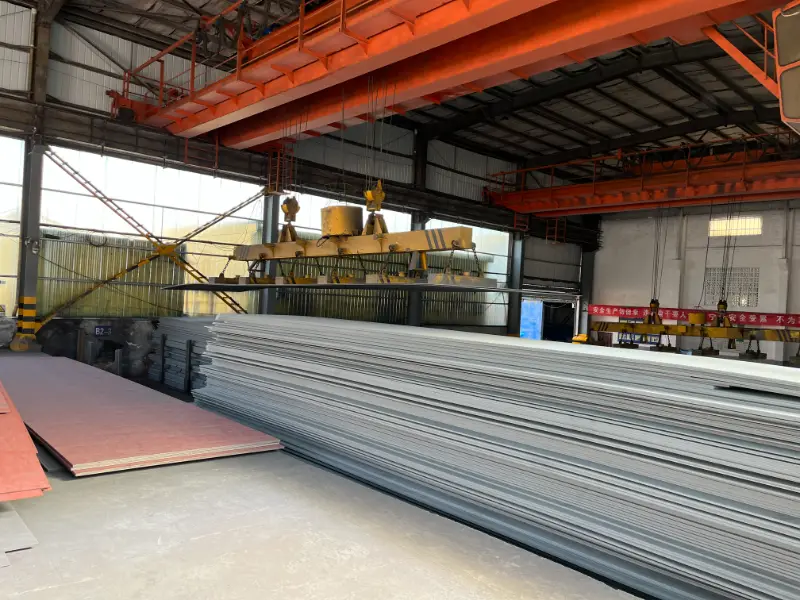
Austenitic Stainless Steel 309S (UNS S30908) Plate and Coil Material
Austenitic Stainless Steel 309S (UNS S30908) Plate and Coil: Properties, Equivalents & Applications
Explore the chemical composition, mechanical and thermal properties of 309S (UNS S30908) stainless steel plate and coil, along with international equivalents and application guide.
Hot rolling, cold rolling, annealing, pickling, slitting, shearing, forming
- Phone : +8618037372205
- Email : [email protected]
- WhatsApp: Contact via Whtsapp
- WeChat: +8618037372205
Austenitic Stainless Steel 309S Plate and Coil Introduction
Austenitic stainless steel 309S (UNS S30908) is a low-carbon variant of the 309 grade, developed to resist sensitization and intergranular corrosion during welding. It belongs to the heat-resistant chromium-nickel steel family, offering excellent oxidation resistance at temperatures up to 1000°C (1832°F) in continuous service and up to 1100°C (2012°F) in intermittent exposure. Key benefits include:
- Superior high-temperature strength and scaling resistance.
- Enhanced weldability due to low carbon content (max 0.08%), avoiding post-weld heat treatment in most cases.
- Good ductility and toughness at both room and elevated temperatures.
The material is commonly supplied as annealed plate, sheet or coil, with a smooth, descaled finish. Its balanced chromium (22-24%) and nickel (12-15%) composition ensures stable austenitic structure, making it ideal for furnace components, radiant tubes, and other high-temperature industrial equipment.
Austenitic Stainless Steel 309S Plate and Coil Chemical Composition
The following table presents the chemical composition of grade 309S (UNS S30908) per ASTM A240. These limits ensure optimal oxidation resistance, weldability, and structural stability. Iron constitutes the balance of the composition.
| Chemical Element | Standard Value (wt%) | Remarks |
|---|---|---|
| Carbon (C) | 0.08 max | |
| Manganese (Mn) | 2.00 max | |
| Phosphorus (P) | 0.045 max | |
| Sulfur (S) | 0.030 max | |
| Silicon (Si) | 1.00 max | |
| Chromium (Cr) | 22.0 – 24.0 | |
| Nickel (Ni) | 12.0 – 15.0 | |
| Iron (Fe) | Balance | Remainder |
Austenitic Stainless Steel 309S Plate and Coil Thermal and Electrical Physical Properties
These physical constants are typical for 309S in the annealed condition. Actual values may slightly vary depending on processing and exact composition. Data provided for general engineering calculations.
| Property | Typical Value | Unit | Test Condition / Temperature |
|---|---|---|---|
| Density (ρ) | 8.0 | g/cm³ | at 20 °C |
| Elastic Modulus (E) | 200 | GPa | at 20 °C |
| Shear Modulus (G) | 77 | GPa | at 20 °C |
| Poisson's Ratio (ν) | 0.30 | — | at 20 °C |
| Thermal Expansion Coefficient (α) | 16.0 | µm/m·°C | 0–100 °C |
| Thermal Expansion Coefficient (α) | 17.5 | µm/m·°C | 0–500 °C |
| Thermal Conductivity (λ) | 15.9 | W/m·K | at 100 °C |
| Thermal Conductivity (λ) | 18.4 | W/m·K | at 500 °C |
| Specific Heat Capacity | 500 | J/kg·K | 0–100 °C |
| Electrical Resistivity (ρₑ) | 0.78 | µΩ·m | at 20 °C |
Austenitic Stainless Steel 309S Plate and Coil Mechanical Properties
Mechanical properties of 309S plate, sheet, and coil are determined at room temperature in the annealed condition per ASTM A240. All values are minimum requirements unless stated otherwise. The bend test applies to plates not exceeding 19 mm thickness.
| Property | Standard Requirement | Unit | Test Condition |
|---|---|---|---|
| Yield Strength (0.2% offset) | min 205 | MPa | Room temperature |
| Tensile Strength | min 515 | MPa | Room temperature |
| Elongation (A) | min 40 | % | In 50 mm (2 in.) |
| Hardness (Brinell) | max 217 | HB | Room temperature |
| Hardness (Rockwell B) | max 95 | HRB | Room temperature |
| Bend Test (thickness ≤19 mm) | 180° bend around diameter = thickness, no cracking | — | Room temperature |
Austenitic Stainless Steel 309S Plate and Coil Exact Equivalent Material Standards and Substitutable Grades
| Country/Region | Standard | Grade | Remarks |
|---|---|---|---|
| USA | ASTM A240 / ASME SA240 | UNS S30908 | Low carbon, same chemistry |
| Europe | EN 10088-2 | 1.4950 (X6CrNi23-13) | Low carbon equivalent to 309S |
| Japan | JIS G4304/G4305 | SUS309S | Identical chemical limits |
| China | GB/T 3280 | 06Cr23Ni13 (S30908) | Corresponds to UNS S30908 |
| International | ISO 15510 | X5CrNi23-13 | Harmonized low‑carbon grade |
Austenitic Stainless Steel 309S Plate and Coil Application Introduction
309S is selected primarily for its outstanding resistance to high‑temperature oxidation and sulfidation. Its low‑carbon version allows welded fabrications to retain corrosion resistance without post‑weld heat treatment. Main application areas:
- Furnace parts exposed to intermittent or continuous high heat.
- Heat exchangers and boiler components handling hot gases.
- Radiant tubes, muffles, annealing boxes, and kiln furniture.
- Welded structures where carbide precipitation must be minimized.
Product Applications: Furnace radiant tubes and muffles, Annealing covers and bases, Recuperator tubes, Boiler baffles and flame holders, Conveyor belts and rollers for high‑temperature furnaces, Kiln furniture (shelves, props)
Processed into products: Burner nozzles and combustion chambers, Tube hangers and supports, Expansion bellows in hot gas ducts, Retorts and crucibles for heat treating, Walking beams and skids in reheat furnaces
Application industries: Petrochemical and Refining, Power Generation (fossil fuel and nuclear), Industrial Heat Treatment, Aerospace (engine and exhaust components), Mineral Processing (kiln linings), Metalworking (furnace hardware)
Austenitic Stainless Steel 309S Plate and Coil Similar or Alternative Material Recommendations
| Country/Region | Standard | Grade | Remarks |
|---|---|---|---|
| USA | ASTM A240 | 309 (UNS S30900) | Higher carbon; similar strength and oxidation resistance but lower weldability |
| USA | ASTM A240 | 310S (UNS S31008) | Higher Cr & Ni for superior oxidation resistance up to 1150°C; more expensive |
| Europe | EN 10088-2 | 1.4833 (X12CrNi23-13) | Standard 309 grade with max 0.15% C; used when welding sensitivity is less critical |
Notes:
Thickness tolerances and supplementary testing (e.g., intergranular corrosion tests) can be agreed with the mill. For plates above 19 mm, mechanical properties may deviate from nominal values, and specific bend or tensile requirements should be discussed with the supplier. Material is typically supplied with a No. 1 or No. 2D finish.
- Share



