
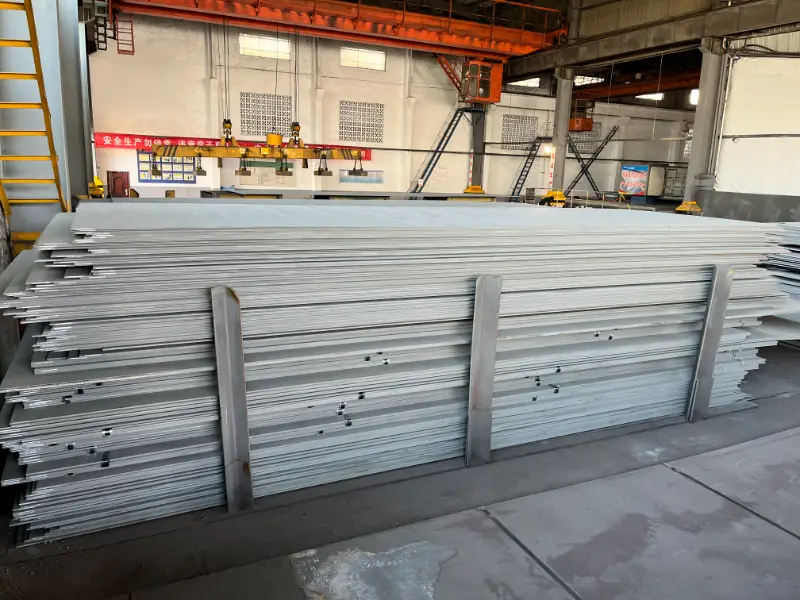
1Cr17Mn6Ni5N Austenitic Stainless Steel Material
1Cr17Mn6Ni5N (12Cr17Mn6Ni5N, AISI 201) Austenitic Stainless Steel Datasheet
Comprehensive material data for 1Cr17Mn6Ni5N austenitic stainless steel: chemical composition, mechanical and physical properties, equivalent grades, similar materials, and application guidance.
Solution annealing (1010–1120 °C, rapid cooling), hot working, cold working, machining, welding (all common methods except oxyacetylene), deep drawing, stamping
- Phone : +8618037372205
- Email : [email protected]
- WhatsApp: Contact via Whtsapp
- WeChat: +8618037372205
1Cr17Mn6Ni5N Austenitic Stainless Steel Introduction
1Cr17Mn6Ni5N (also designated 12Cr17Mn6Ni5N, UNS S20100) is a nickel-saving austenitic stainless steel in which a portion of nickel is replaced by manganese and nitrogen. It offers a favorable combination of strength, ductility, and corrosion resistance, comparable to Type 301 in many environments, but at lower cost due to reduced nickel content. This grade exhibits high work hardening rate during cold forming, good weldability, and excellent deep drawability. It is widely used for applications that require moderate corrosion resistance and high formability, such as kitchenware, architectural trim, automotive components, and general hardware. The steel is typically supplied in the solution-annealed condition.
1Cr17Mn6Ni5N Austenitic Stainless Steel Chemical Composition
The chemical composition of 1Cr17Mn6Ni5N in accordance with GB/T 1220-2007 and GB/T 20878-2007. The alloy relies on manganese and nitrogen to partially substitute nickel while maintaining the austenitic structure and achieving required mechanical properties.
| Element | Content (%) | Remarks |
|---|---|---|
| Carbon (C) | ≤0.15 | |
| Silicon (Si) | ≤0.75 | |
| Manganese (Mn) | 5.50–7.50 | |
| Phosphorus (P) | ≤0.060 | |
| Sulfur (S) | ≤0.030 | |
| Chromium (Cr) | 16.00–18.00 | |
| Nickel (Ni) | 3.50–5.50 | |
| Nitrogen (N) | ≤0.25 | |
| Iron (Fe) | Balance |
1Cr17Mn6Ni5N Austenitic Stainless Steel Thermal and Electrical Physical Properties
Typical physical properties for 1Cr17Mn6Ni5N (AISI 201 type) in the annealed condition. These values are provided as engineering references and may be influenced by specific heat treatment and product form.
| Property | Typical Value | Unit | Test Condition / Temperature |
|---|---|---|---|
| Density (ρ) | 7.80 | g/cm³ (7800 kg/m³) | At 20 °C |
| Modulus of Elasticity (E) | 197 | GPa | At 20 °C |
| Shear Modulus (G) | 78 | GPa | At 20 °C |
| Poisson's Ratio (ν) | 0.27–0.30 | — | At 20 °C |
| Thermal Expansion Coefficient (α) | 15.7 | 10⁻⁶ /K | 20–100 °C |
| Thermal Expansion Coefficient (α) | 16.5 | 10⁻⁶ /K | 20–300 °C |
| Thermal Expansion Coefficient (α) | 18.4 | 10⁻⁶ /K | 20–500 °C |
| Thermal Conductivity (λ) | 15.1 | W/(m·K) | At 100 °C |
| Thermal Conductivity (λ) | 18.3 | W/(m·K) | At 500 °C |
| Specific Heat Capacity (cₚ) | 500 | J/(kg·K) | At 20 °C |
| Electrical Resistivity (ρₑ) | 0.69 | µΩ·m (Ω·mm²/m) | At 20 °C |
1Cr17Mn6Ni5N Austenitic Stainless Steel Mechanical Properties
Mechanical properties after solution annealing at 1010–1120 °C followed by water quenching, as specified in GB/T 1220-2007 for bars. The actual properties may vary depending on product form and section size. This grade exhibits high ductility and good strength in the annealed condition.
| Property | Required Value | Unit | Test Condition |
|---|---|---|---|
| Yield Strength (Rp0.2) | ≥275 | MPa | At room temperature, after solution treatment |
| Tensile Strength (Rm) | ≥520 | MPa | At room temperature, after solution treatment |
| Elongation (A) | ≥40 | % | Gauge length 5.65√S₀ |
| Reduction of Area (Z) | ≥45 | % | At room temperature |
| Hardness (HBW) | ≤241 | HBW | Brinell hardness |
| Hardness (HRB) | ≤100 | HRB | Rockwell B hardness |
| Hardness (HV) | ≤253 | HV | Vickers hardness |
1Cr17Mn6Ni5N Austenitic Stainless Steel Fully Equivalent Grades and Substitution Recommendations
| Country/Region | Standard | Designation | Remarks |
|---|---|---|---|
| China | GB/T 1220, GB/T 20878 | 12Cr17Mn6Ni5N (1Cr17Mn6Ni5N, S35350) | Identical composition and requirements |
| USA | ASTM A240/A240M | 201 (UNS S20100) | Identical chemical composition |
| Japan | JIS G4304, JIS G4305 | SUS 201 | Identical composition, similar properties |
| International | ISO 15510 | X12CrMnNiN17-7-5 | Matching composition and grade |
1Cr17Mn6Ni5N Austenitic Stainless Steel Application Introduction
1Cr17Mn6Ni5N is an economical austenitic stainless steel suitable for moderate corrosion resistance and high formability applications. Its cost advantage over conventional Cr-Ni grades makes it attractive for mass-produced components. Key usage areas include:
Product Applications: Cookware (pots, pans, cutlery), Kitchen sinks and countertops, Architectural panels, cladding, and handrails, Automotive decorative trims and exhaust system parts, Food handling and storage equipment, Electrical appliance housings (dishwashers, washing machines), Structural weldments and thin-gauge tubes
Processed into products: Deep-drawn parts (sink bowls, containers), Stamped and pressed components, Welded tubes and pipes for low-pressure fluids, Fasteners (screws, nuts, bolts) for moderate environments, Springs and wire forms (cold-worked to higher strength), Decorative profiles and trims, Exhaust flanges and brackets
Application industries: Architecture and Decoration, Food Processing and Kitchenware, Automotive Manufacturing, General Engineering and Hardware, Household Appliances
1Cr17Mn6Ni5N Austenitic Stainless Steel Similar or Closely Related Alternative Grades
| Country/Region | Standard | Designation | Remarks |
|---|---|---|---|
| Europe | EN 10088-2 | 1.4372 (X8CrMnNiN18-7-5) | Slightly lower C (≤0.10), higher Cr (17.5–18.5), comparable properties and corrosion resistance |
| USA | ASTM A240 | 202 (UNS S20200) | Higher Mn (7.5–10.0) and lower Ni (4.0–6.0); higher strength but austenite less stable; may substitute where higher strength is needed |
| China | GB/T 1220 | Y12Cr18Ni9 (303) | Free-machining austenitic grade with higher sulfur; suitable for components requiring extensive machining |
Notes:
Cold working: This grade work hardens rapidly, which can be utilized to increase strength in deep-drawn or formed parts, but may require intermediate annealing for severe forming operations.
Corrosion resistance: Comparable to Type 301 in mild environments; however, in high-humidity chloride-containing conditions, stress corrosion cracking resistance is moderate and may require careful design or post-weld treatment.
Welding: Generally weldable by all common methods except oxyacetylene; filler metal matching (E/ER 201) or slightly alloyed (E/ER 308L) can be used. Post-weld annealing is not normally required for sheet products up to moderate thickness.
- Share



