
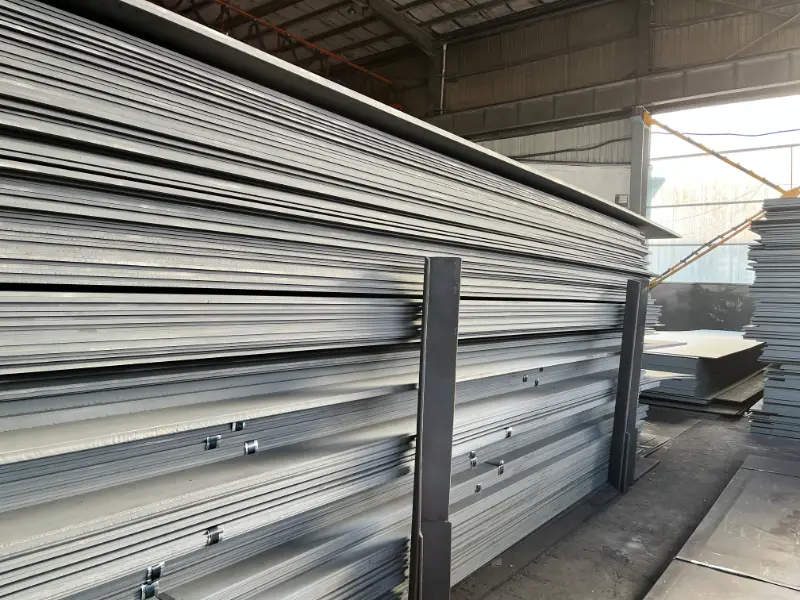
0Cr18Ni10Ti Stainless Steel Material (AISI 321)
0Cr18Ni10Ti Stainless Steel (AISI 321): Titanium Stabilized Austenitic Alloy for High-Temperature and Corrosion Resistance
Explore the chemical composition, mechanical properties, thermal performance, equivalent grades, and application guide of 0Cr18Ni10Ti (AISI 321) stainless steel for welded components and heat-resistant equipment.
Hot working, cold working, machining, welding (all common methods), solution annealing, and pickling
- Phone : +8618037372205
- Email : [email protected]
- WhatsApp: Contact via Whtsapp
- WeChat: +8618037372205
0Cr18Ni10Ti Stainless Steel Introduction
0Cr18Ni10Ti is a titanium-stabilized austenitic stainless steel corresponding to AISI 321 and UNS S32100. The addition of titanium (Ti ≥ 5×C%) prevents chromium carbide precipitation at grain boundaries during welding or elevated-temperature service, thereby providing excellent resistance to intergranular corrosion. It retains the good formability, weldability, and general corrosion resistance of 18-8 type stainless steels, while offering superior performance in the sensitization temperature range (425–815°C).
- Key features: stabilized against intergranular attack, good high-temperature strength and oxidation resistance up to 800°C, non-magnetic in annealed condition, excellent toughness and ductility.
- Common forms: plates, sheets, strips, bars, wires, pipes, and forgings.
0Cr18Ni10Ti Stainless Steel Chemical Composition
The chemical composition of 0Cr18Ni10Ti follows the old GB/T 1220-1992 standard. Titanium is added in a minimum amount of 5 times the carbon content to ensure complete stabilization against chromium carbide formation.
- Real heats may have Ti between 0.15% and 0.80% depending on carbon level.
- Nickel content is slightly higher than standard 304 to maintain austenite stability after Ti addition.
| Element | Standard Value (wt%) | Remarks |
|---|---|---|
| Carbon (C) | ≤0.08 | Lower carbon improves weldability; Ti stabilisation compensates for carbon |
| Silicon (Si) | ≤1.00 | Typical for austenitic grades |
| Manganese (Mn) | ≤2.00 | Austenite former, aids hot workability |
| Phosphorus (P) | ≤0.035 | Low P to avoid hot cracking |
| Sulfur (S) | ≤0.030 | Low S for improved toughness and pitting resistance |
| Chromium (Cr) | 17.00 – 19.00 | Primary element for corrosion and oxidation resistance |
| Nickel (Ni) | 9.00 – 12.00 | Austenite stabilizer; slightly higher than 304 to offset Ti ferrite tendency |
| Titanium (Ti) | ≥5×C% (typically 0.15–0.80) | Stabilizing element; binds carbon to prevent sensitization |
0Cr18Ni10Ti Stainless Steel Physical Properties
Physical properties are representative for 0Cr18Ni10Ti (321) in the annealed condition.
- The alloy is non-magnetic in annealed state but may become slightly magnetic after cold working due to martensite formation.
- Thermal conductivity is lower than carbon steel, requiring careful heat control during welding.
- Electrical resistivity is relatively high, making it suitable for heating elements but less efficient as an electrical conductor.
| Property | Typical Value | Unit | Test Condition |
|---|---|---|---|
| Density (ρ) | 7.93 | g/cm³ | At 20°C |
| Melting Range | 1400 – 1425 | °C | Approximate solidus/liquidus |
| Elastic Modulus (E) | 200 | GPa | Room temperature |
| Shear Modulus (G) | 77 | GPa | Room temperature |
| Poisson's Ratio (ν) | 0.30 | — | Room temperature |
| Thermal Expansion Coefficient (α) | 16.5 | 10⁻⁶/K (µm/m·°C) | 20–100°C |
| Thermal Expansion Coefficient (α) | 17.5 | 10⁻⁶/K | 20–400°C |
| Thermal Expansion Coefficient (α) | 18.5 | 10⁻⁶/K | 20–800°C |
| Thermal Conductivity (λ) | 16.3 | W/(m·K) | At 100°C |
| Thermal Conductivity (λ) | 21.5 | W/(m·K) | At 500°C |
| Specific Heat Capacity (c) | 500 | J/(kg·K) | At 20°C |
| Electrical Resistivity (ρ_e) | 0.72 | µΩ·m (Ω·mm²/m) | At 20°C, annealed |
0Cr18Ni10Ti Stainless Steel Mechanical Properties
The mechanical properties below are for solution-annealed condition (typical for bars and plates). Values are based on GB/T 1220 and ASTM A240 for AISI 321 (equivalent).
- Elevated temperature strength: at 500°C, tensile strength ~370 MPa; yield strength ~160 MPa.
- The material can be lightly cold-worked to increase strength, but severe cold working may induce martensite and reduce corrosion resistance.
- Hardness is typically measured as Brinell (HBW) or Rockwell B (HRB).
| Property | Required Value | Unit | Test Condition |
|---|---|---|---|
| Tensile Strength (Rm) | ≥520 | MPa | Room temperature, solution annealed |
| Yield Strength (ReH, 0.2% offset) | ≥205 | MPa | Room temperature, solution annealed |
| Elongation (A, 50 mm gauge) | ≥40 | % | Room temperature, solution annealed |
| Reduction of Area (Z) | ≥50 | % | Room temperature, for bars |
| Brinell Hardness (HBW) | ≤187 | HB | Solution annealed; equivalent to ~90 HRB |
| Rockwell Hardness (HRB) | ≤90 | HRB | Solution annealed |
| Charpy Impact Energy (KV2) | ≥100 (typical) | J | Transverse, room temperature; not always specified |
0Cr18Ni10Ti Stainless Steel Equivalent Material Standards and Replaceable Grades
| Country/Region | Standard | Designation | Remarks |
|---|---|---|---|
| China | GB/T 20878 | 06Cr18Ni11Ti | New GB designation, chemically equivalent to old 0Cr18Ni10Ti |
| USA | ASTM A240/A240M | 321 (UNS S32100) | Identical chemistry and performance |
| Germany | DIN EN 10088-2/-3 | X6CrNiTi18-10 (1.4541) | Contains Ti ≥5×C to 0.70%; dual certified with 321 |
| Japan | JIS G4304/G4305 | SUS321 | Same composition; widely used for welded structures |
| United Kingdom | BS 970 | 321S31 | Older BS grade, directly interchangeable |
| France | AFNOR NF A35-574 | Z6CNT18-10 | Chemical match, replaced by EN 1.4541 |
| ISO | ISO 15510 | X6CrNiTi18-10 | International specification identical in intent |
0Cr18Ni10Ti Stainless Steel Application Introduction
0Cr18Ni10Ti (AISI 321) is selected primarily where the risk of intergranular corrosion after welding cannot be avoided by solution annealing, and where service temperatures are in the sensitization range (425–815°C). It is widely used in chemical plants, oil refineries, and power generation for components that must withstand both corrosive fluids and moderate high temperatures.
Product Applications: Welded pipes and tubes for high-temperature service, Heat exchanger shells and tube sheets, Expansion joints and flexible metal hoses, Furnace components and radiant tubes, Aircraft exhaust manifolds, Catalytic converter shells
Processed into products: Flanges and fittings for corrosive piping systems (welded without subsequent heat treatment), Nozzles and manways in pressure vessels, Welded plate-type heat exchanger plates, Bolts, nuts, and fasteners for high-temperature flanges (when used with compatible materials), Distillation column internals (trays, demisters), Retorts and annealing boxes for heat treatment furnaces
Application industries: Chemical and petrochemical processing (heat exchangers, reactors, piping), Power generation (boiler tubes, superheater tubes, turbine parts), Aerospace (exhaust collectors, thermal shields, bellows), Food and beverage equipment (storage tanks, pasteurizers where welds cannot be re-annealed), Oil and gas (offshore platforms, flare systems, pressure vessels), Pulp and paper (digesters, bleach plant equipment)
0Cr18Ni10Ti Stainless Steel Related/Similar Alternative Materials
| Country/Region | Standard | Designation | Remarks |
|---|---|---|---|
| China | GB/T 20878 | 06Cr19Ni10 (304) | Unstabilized; lower cost but susceptible to intergranular corrosion after welding if not solution annealed |
| USA | ASTM A240 | 304L (UNS S30403) | Extra-low carbon to avoid sensitization; alternative to Ti stabilization for thin sections |
| USA | ASTM A240 | 321H (UNS S32109) | Higher carbon (0.04–0.10) 321 variant for better high-temperature strength; same Cr-Ni-Ti base |
| USA | ASTM A240 | 347 (UNS S34700) | Niobium-stabilized instead of Ti; similar weld corrosion resistance; often used interchangeably with 321 |
| Germany | EN 10088-2 | 1.4301 (X5CrNi18-10, 304) | Unstabilized; for ambient and mild temperature service only |
| Japan | JIS G4304 | SUS304 | Equivalent to 304; not stabilized; may require post-weld annealing |
Notes:
Welding: 0Cr18Ni10Ti can be welded by all common processes including TIG, MIG, SMAW, and SAW. Filler metal should be matching (ER321) or an extra-low carbon stabilized type to avoid fissuring. No post-weld annealing is necessary to restore corrosion resistance.
Stress corrosion cracking (SCC): Like all austenitic stainless steels, it is susceptible to stress corrosion cracking in chloride environments at temperatures above 60°C. Special precautions or alloy upgrades (duplex or higher Ni alloys) are needed for such conditions.
Pickling and passivation: After fabrication, a pickling pass with nitric-hydrofluoric acid may be required to restore the passive layer and remove heat tint. Simple passivation in nitric acid is common for machined parts.
Data reliability: All property values are sourced from published national and international standards (GB, ASTM, EN) and are considered accurate for the specified conditions.
- Share



