
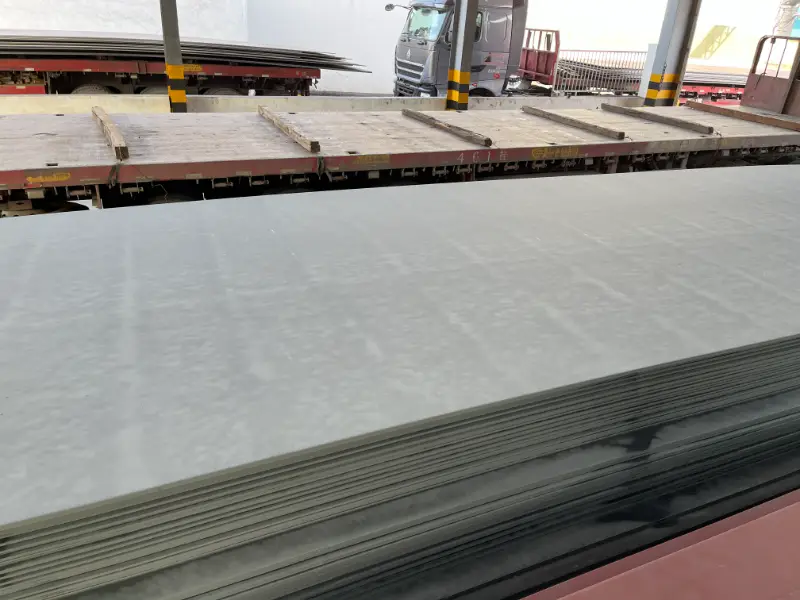
12Cr1MoV Alloy Steel Plates Material
12Cr1MoV Alloy Steel Plates: High-Temperature Strength for Pressure Vessels & Boilers
12Cr1MoV is a Chinese Cr-Mo-V pearlitic heat-resistant alloy steel plate designed for elevated temperature service. It delivers reliable creep strength, oxidation resistance, and excellent weldability, making it the material of choice for boiler and pressure vessel fabrication under GB/T 713.
Hot rolling, cold rolling, normalizing, tempering, stress relieving, welding, cutting, bending, forming
- Phone : +8618037372205
- Email : [email protected]
- WhatsApp: Contact via Whtsapp
- WeChat: +8618037372205
12Cr1MoV Alloy Steel Plates Introduction
12Cr1MoV (commonly supplied as 12Cr1MoVR per GB/T 713) is a low-alloy chromium-molybdenum-vanadium steel with a pearlitic–bainitic microstructure. Developed for prolonged service at temperatures up to approximately 580 °C, it offers an optimal balance of high-temperature tensile and creep strength, good thermal conductivity, and resistance to oxidation and hydrogen attack. The addition of vanadium refines the grain structure and enhances creep rupture strength through stable carbide precipitation.
This grade is predominantly produced as hot-rolled or normalised-plus-tempered plates for the construction of steam drums, superheater headers, and process vessels in power generation and petrochemical plants. Its weldability is well proven with low-hydrogen procedures and post-weld heat treatment, ensuring joint toughness and long-term structural integrity. The combination of moderate alloy content and robust fabrication properties makes 12Cr1MoV a cost-effective solution for critical high-temperature pressure applications.
12Cr1MoV Alloy Steel Plates Chemical Composition
The chemical composition of 12Cr1MoV plate is specified in GB/T 713. The balanced addition of chromium, molybdenum and vanadium provides high-temperature strength and oxidation resistance while maintaining good weldability. Residual elements are controlled to ensure mechanical properties and service performance.
| Element | Standard Value (wt%) | Remarks |
|---|---|---|
| C | 0.08 ~ 0.15 | |
| Si | 0.15 ~ 0.40 | |
| Mn | 0.40 ~ 0.70 | |
| P | ≤ 0.025 | |
| S | ≤ 0.010 | |
| Cr | 0.90 ~ 1.20 | Key element for oxidation resistance |
| Mo | 0.25 ~ 0.35 | Enhances high-temperature strength |
| V | 0.15 ~ 0.30 | Refines grain, improves creep strength |
| Ni | ≤ 0.30 | Residual element |
| Cu | ≤ 0.30 | Residual element |
| Nb | ≤ 0.05 | Microalloying; may be present as residual |
| Ti | ≤ 0.03 | Microalloying; may be present as residual |
| Alt | ≥ 0.020 | Required for fine-grain practice, if applicable |
12Cr1MoV Alloy Steel Plates Physical, Thermal and Electrical Properties
The physical constants listed are representative for 12Cr1MoV in the normalized + tempered condition. The thermal expansion and thermal conductivity vary with temperature. These data are essential for design calculations involving thermal stress and heat transfer in high-temperature service.
| Property | Standard Value | Unit | Temperature / Details |
|---|---|---|---|
| Density (ρ) | 7.85 | g/cm³ | at 20 °C |
| Modulus of Elasticity (E) | 211 | GPa | at 20 °C |
| Shear Modulus (G) | 82 | GPa | at 20 °C |
| Poisson's Ratio (ν) | 0.29 | - | at 20 °C |
| Coefficient of Thermal Expansion (α) | 11.5 | 10⁻⁶/K | 20 – 200 °C |
| Coefficient of Thermal Expansion (α) | 12.9 | 10⁻⁶/K | 20 – 400 °C |
| Coefficient of Thermal Expansion (α) | 13.7 | 10⁻⁶/K | 20 – 600 °C |
| Thermal Conductivity (λ) | 48 | W/(m·K) | at 20 °C |
| Thermal Conductivity (λ) | 42 | W/(m·K) | at 200 °C |
| Thermal Conductivity (λ) | 36 | W/(m·K) | at 400 °C |
| Thermal Conductivity (λ) | 32 | W/(m·K) | at 600 °C |
| Specific Heat Capacity (cp) | 460 | J/(kg·K) | at 20 °C |
| Electrical Resistivity (ρe) | 0.22 | μΩ·m | at 20 °C |
12Cr1MoV Alloy Steel Plates Mechanical Properties at Room Temperature
Mechanical properties of 12Cr1MoV plates in normalized + tempered condition. The values depend on plate thickness. Impact testing is performed at 0 °C on Charpy V-notch specimens. Bending test is conducted with a mandrel diameter of 3a (a = specimen thickness) to a 180° bend angle.
| Property | Standard Required Value | Unit | Test Condition |
|---|---|---|---|
| Yield Strength (ReH) | ≥ 280 | MPa | thickness 6 – 60 mm, transverse |
| Yield Strength (ReH) | ≥ 270 | MPa | thickness > 60 – 100 mm, transverse |
| Yield Strength (ReH) | ≥ 260 | MPa | thickness > 100 – 150 mm, transverse |
| Tensile Strength (Rm) | 450 – 590 | MPa | thickness ≤ 60 mm, transverse |
| Tensile Strength (Rm) | 440 – 580 | MPa | thickness > 60 – 150 mm, transverse |
| Elongation (A) | ≥ 22 | % | gauge length 5.65√S₀, thickness ≤ 60 mm |
| Elongation (A) | ≥ 21 | % | gauge length 5.65√S₀, thickness > 60 – 100 mm |
| Elongation (A) | ≥ 20 | % | gauge length 5.65√S₀, thickness > 100 – 150 mm |
| Impact Energy (KV₂, 0 °C) | ≥ 34 | J | transverse, average of three tests |
| Bend Test | D = 3a, 180° no cracks | - | transverse, mandrel diameter 3×thickness |
| Hardness (HBW) | ≤ 200 (typical) | HBW | for reference, not mandatory in GB/T 713 |
12Cr1MoV Alloy Steel Plates Completely Equivalent Material Standards and Replaceable Grades
| Country/Region | Standard | Grade | Remarks |
|---|---|---|---|
| China | GB/T 713 | 12Cr1MoVR | This is the steel plate grade; 12Cr1MoV is the commonly used designation. |
| Russia | GOST 5520 | 12Kh1MF | Similar Cr-Mo-V composition; widely used for boiler plates. |
| International | ISO 9328-2 | 13CrMoV9-10 | Comparable but with higher Cr (2.0-2.5%) and Mo (0.9-1.1%); used for similar pressure vessel applications. |
| EU | EN 10028-2 | 13CrMoV9-10 (1.7703) | Higher Cr-Mo-V; requires careful weldability assessment. Often considered an alternative for higher strength. |
| USA | ASTM A387 / A387M | Grade 11 Class 2 (1.25Cr-0.5Mo) | Base composition similar without V; lower creep strength. Not a direct substitute. |
12Cr1MoV Alloy Steel Plates Application Introduction
Due to its excellent balance of strength, toughness and long-term high-temperature stability, 12Cr1MoV plates are extensively used in the fabrication of pressure vessels and piping for power generation, petrochemical and chemical processing industries. The material is especially suited for thick-wall components that require reliable performance under sustained heat and pressure.
Product Applications: Boiler drums and superheater headers, Steam receivers and high-pressure steam piping, Hydrocracker and hydrotreater reactor shells, Heat exchanger shells and tube sheets, Process vessels for coal gasification and biomass plants
Processed into products: Ellipsoidal and hemispherical heads for pressure vessel, Flanges and nozzle reinforcement pads, Bolted manway covers and inspection doors, Support rings and skirt components for heavy reactors, Welded T-joints and Y-pieces for piping connections
Application industries: Thermal and nuclear power generation (boilers, steam systems), Petrochemical refineries and chemical plants (reactors, separators, heat exchangers), Pulp and paper industry (digesters, recovery boilers), Oil and gas processing (high-pressure vessels, hydrocrackers), Heavy machinery manufacturing (turbine parts)
12Cr1MoV Alloy Steel Plates Similar or Near-equivalent Material Recommendations
| Country/Region | Standard | Grade | Remarks |
|---|---|---|---|
| EU | EN 10028-2 | 10CrMo9-10 (1.7380) | 2.25Cr-1Mo steel without V; often used for high-temperature vessels. Slightly higher Cr but no vanadium. |
| USA | ASTM A387 / A387M | Grade 22 Class 2 (2.25Cr-1Mo) | Higher Cr, no V; good creep strength up to 600 °C. Weldability similar. |
| Japan | JIS G4109 | SCMV 4 (1.25Cr-0.5Mo-Si) | Similar to ASTM A387 Gr.11; lacks vanadium, used for boilers. |
| China | GB/T 713 | 15CrMoR (1Cr-0.5Mo) | Lower alloy content, no V; used at lower temperatures (< 560 °C). A cost-effective alternative when full strength is not required. |
| EU | EN 10028-2 | 13CrMoV9-10 (1.7703) | Already listed as equivalent; note the higher Cr content for improved high-temperature strength but requires careful heat treatment. |
Notes:
For fabrication, 12Cr1MoV requires low-hydrogen welding with preheating (typically 150–250 °C) and post-weld heat treatment (PWHT) at 680–720 °C to restore toughness and relieve residual stresses. The material is susceptible to reheat cracking; caution is needed during welding of thick sections. All components should be designed in accordance with applicable codes such as ASME Section VIII or GB150, taking full advantage of the elevated-temperature allowable stress values.
- Share



