
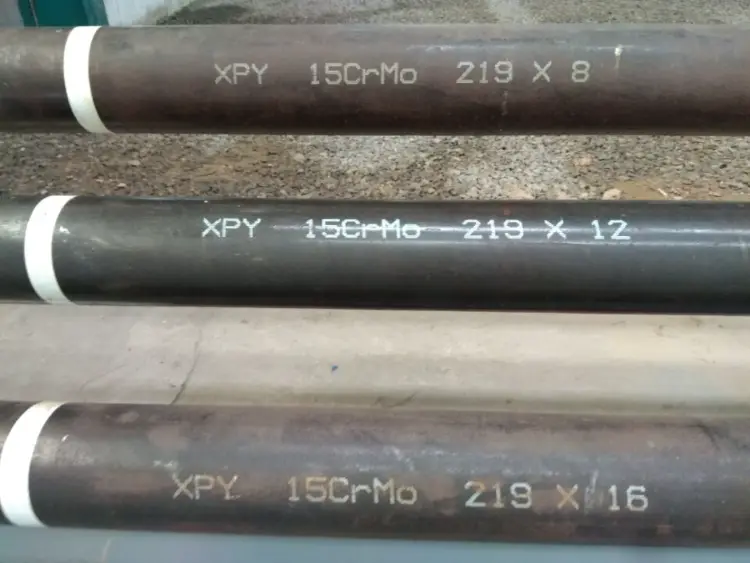
15CrMo Alloy Steel Plates Material
15CrMo Alloy Steel Plates: Properties, Equivalents & Applications in High-Temperature Service
Comprehensive material analysis for 15CrMo alloy steel plates including chemical composition, mechanical and physical properties, international equivalents, and application guidelines. Ideal for boiler and pressure vessel fabricators.
Hot rolling, normalizing, quenching & tempering, welding (with preheat/PWHT), machining
- Phone : +8618037372205
- Email : [email protected]
- WhatsApp: Contact via Whtsapp
- WeChat: +8618037372205
15CrMo Alloy Steel Plates Introduction
15CrMo is a chromium-molybdenum low-alloy structural steel widely used in the fabrication of boilers, pressure vessels, and high-temperature piping. Governed by Chinese standards GB/T 3077 (alloy structural steels) and also available as GB 713 15CrMoR for pressure vessel plates, this grade exhibits excellent heat resistance, creep strength, and oxidation resistance up to approximately 550°C.
Key attributes include:
- Good combination of strength and toughness at elevated temperatures
- Good weldability with appropriate preheating and post-weld heat treatment
- Resistance to hydrogen attack and corrosion in steam and sulfur-bearing environments
- Economical alternative to stainless steels for moderate temperature service
15CrMo plates are typically supplied in the normalized plus tempered condition, or quenched and tempered, to achieve a fine-grained bainitic/ferritic structure that balances mechanical properties and ductility. This grade is the workhorse for thermal power plants, petrochemical reactors, and heat exchangers where reliability under sustained thermal and mechanical loads is critical.
15CrMo Alloy Steel Plates Chemical Composition
Chemical composition as per GB/T 3077 and typical for GB 713 15CrMoR plates. The steel is intentionally alloyed with chrome and molybdenum to enhance high-temperature strength and oxidation resistance. Residual elements Ni, Cu are kept low to avoid adverse effects on weldability and creep ductility.
| Chemical Element | Standard Value | Remarks |
|---|---|---|
| Carbon (C) | 0.12 – 0.18 | GB/T 3077; similar for GB 713 |
| Silicon (Si) | 0.17 – 0.37 (0.15 – 0.40 for plates) | Deoxidizer; plate standard often allows upper limit 0.40 |
| Manganese (Mn) | 0.40 – 0.70 | Improves hardenability and strength |
| Phosphorus (P) | ≤ 0.035 (≤ 0.025 for GB 713) | Controlled for toughness |
| Sulfur (S) | ≤ 0.035 (≤ 0.015 for GB 713) | Minimized for cleanliness |
| Chromium (Cr) | 0.80 – 1.10 (0.80 – 1.20 for plate) | Primary carbide former; provides oxidation resistance |
| Molybdenum (Mo) | 0.40 – 0.55 (0.45 – 0.60 for plate) | Secondary hardener; improves hot strength |
| Nickel (Ni) | ≤ 0.30 | Residual limit unless specified |
| Copper (Cu) | ≤ 0.30 | Residual limit |
| Vanadium (V) | ≤ 0.08 (occasionally added) | Not always specified; can refine grain |
15CrMo Alloy Steel Plates Thermal & Electrical Physical Properties
Physical properties of 15CrMo steel at room temperature and elevated temperatures. Thermal conductivity decreases, and thermal expansion increases with temperature, typical for ferritic low-alloy steels. These values are essential for thermal stress analysis and heat exchanger design.
| Property | Standard Requirement Value | Unit | Test Condition / Remarks |
|---|---|---|---|
| Density (ρ) | 7.85 | g/cm³ | At 20 °C |
| Elastic Modulus (E) | 210 (at 20 °C) | GPa | Decreases to ~190 GPa at 300 °C |
| Shear Modulus (G) | 81 (approx.) | GPa | Calculated from E and ν |
| Poisson's Ratio (ν) | 0.3 | — | At 20 °C |
| Thermal Expansion Coeff. (α) | 11.5 (20–100 °C) | 10⁻⁶/K | Linear expansion |
| 12.5 (20–200 °C) | 10⁻⁶/K | ||
| 13.1 (20–300 °C) | 10⁻⁶/K | ||
| 13.7 (20–400 °C) | 10⁻⁶/K | ||
| 14.1 (20–500 °C) | 10⁻⁶/K | ||
| Thermal Conductivity (λ) | 44 (at 100 °C) | W/(m·K) | Conductivity decreases with temperature |
| 42 (at 200 °C) | W/(m·K) | ||
| 39 (at 300 °C) | W/(m·K) | ||
| 36 (at 400 °C) | W/(m·K) | ||
| 32 (at 500 °C) | W/(m·K) | ||
| Specific Heat Capacity (c) | 460 | J/(kg·K) | At 20–100 °C; increases to ~550 at 500 °C |
| Electrical Resistivity (ρₑ) | 0.20 – 0.25 | μΩ·m | At 20 °C |
15CrMo Alloy Steel Plates Mechanical Properties
Test values are for quenched and tempered condition (water/oil quench from 880–920 °C, temper at 540–720 °C) per GB/T 3077, or as-delivered normalized+tempered per GB 713 for plates ≤ 60 mm. Actual properties depend on section thickness and heat treatment. Bend test applies to plate products.
| Property | Standard Requirement Value | Unit | Test Condition / Remarks |
|---|---|---|---|
| Yield Strength (ReH) | ≥ 295 | MPa | Tensile test at room temperature, after heat treatment |
| Tensile Strength (Rm) | 440 – 640 | MPa | Minimum 440; typical range after Q&T |
| Elongation (A) | ≥ 22 | % | Gauge length L0 = 5.65√S0; for plate thickness ≤ 16 mm |
| Reduction of Area (Z) | ≥ 45 | % | Typically measured on round specimens |
| Impact Energy (KU2) | ≥ 94 | J | Charpy U-notch, 20 °C; for some standards KV2 ≥ 63 J |
| Impact Energy (KV2) | ≥ 63 | J | Charpy V-notch, 20 °C, when required by plate standard |
| Bend Test (180°) | d = 3a (for a ≤ 25 mm) | — | No cracks permitted; d = mandrel diameter, a = plate thickness |
| Hardness (HBW) | ≤ 163 (typical 140–170) | HBW | After heat treatment; depends on tempering temperature |
15CrMo Alloy Steel Plates Fully Equivalent Material Standards & Substitutable Grades
| Country / Region | Standard | Grade | Remarks |
|---|---|---|---|
| China | GB/T 3077; GB 713 | 15CrMo; 15CrMoR | Base grade; 15CrMoR is specifically for pressure vessel plates |
| Germany | DIN 17243; DIN EN 10028-2 | 15CrMo5 (1.7262); 13CrMo4-5 (1.7335) | 13CrMo4-5 is now the European standard grade; 15CrMo5 is older designation |
| Europe | EN 10028-2 | 13CrMo4-5 (1.7335) | Direct European equivalent for boiler & pressure vessel plates |
| USA | ASTM A387 / A387M | Grade 12 (Class 1 or 2) | Similar Cr-Mo range; ASTM A387 Gr12 is also used for pressure vessels, slight differences in C and Mo ranges |
| Japan | JIS G3103 | SB12 | JIS boiler plate; comparable chemistry |
| Japan | JIS G4105 | SCM415 | Carburizing steel; similar composition but lower Mo; not a full substitute in all applications |
15CrMo Alloy Steel Plates Application Introduction
15CrMo alloy steel plates are extensively used in the energy and process industries where components operate at elevated temperatures and moderate pressures. Their creep strength, thermal stability, and good weldability make them suitable for fabrication of thick-walled vessels and piping. The following lists typical application areas, products, and specific machined components.
Product Applications: Boiler drums and waterwalls, High-pressure steam piping and headers, Pressure vessels for hydrogen service (with appropriate evaluation), Tube sheets and baffles in heat exchangers, Flanges and gasketed joints, Superheater and reheater tube bundles
Processed into products: Superheater/reheater tubing (seamless tubes from 15CrMoG), Boiler drum shells and heads (plate fabrication), Steam turbine casing inserts, Valve bodies and bonnets for high-temperature service, Flanges, gaskets, and bolting (when forged), Reactor pressure vessel cladding supports, High-temperature fasteners (studs, nuts) when quenched & tempered, Heat exchanger tube plates (machined from thick plates)
Application industries: Thermal power generation (boilers, steam turbines), Petrochemical and oil refining (reactors, heat exchangers), Chemical processing (pipelines, columns), Nuclear power (secondary circuit piping), Industrial furnace construction (stokers, muffles), Shipbuilding (high-temperature exhaust components)
15CrMo Alloy Steel Plates Near / Similar Substitute Material Recommendations
| Country / Region | Standard | Grade | Remarks |
|---|---|---|---|
| China | GB/T 3077 | 12CrMo | Lower Cr (0.40-0.70) and Mo (0.40-0.55); used for lower temperature service |
| China | GB/T 3077 | 20CrMo | Higher carbon (0.17-0.24); stronger but less weldable; used for gears and shafts |
| China | GB/T 3077 | 12Cr1MoV | Contains V for improved high-temperature strength; used in superheater tubes up to 580°C |
| Europe | EN 10028-2 | 16Mo3 | Only Mo-alloyed; lower oxidation resistance; suitable up to 530°C |
| USA | ASTM A387 | Grade 11 (1.25Cr-0.5Mo) | Higher Cr content; often chosen for hydrogen service but more expensive |
Notes:
Welding considerations: Preheat (150–250°C) and post-weld heat treatment (650–700°C) are mandatory to avoid cold cracking and ensure stress relief. Forging temperature range: 1200–850°C, with slow cooling after forging. Non-destructive testing: Ultrasonic examination per GB/T 2970 or EN 10160 is typically required for pressure vessel plates. Creep data: Allowable stress values can be found in design codes like ASME BPVC Section II Part D or GB 150.2; 15CrMo typically retains room-temperature strength up to about 480°C, above which creep begins to significantly reduce load-carrying capacity.
- Share



