
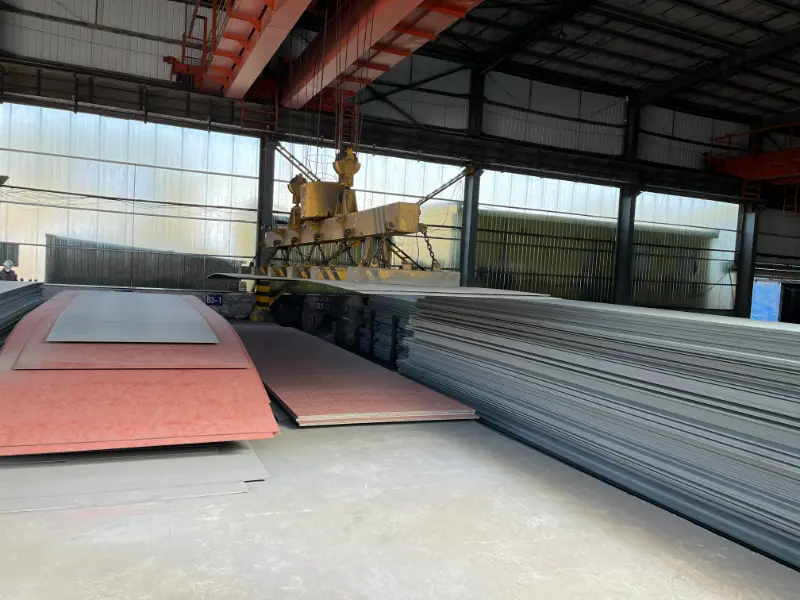
30CrMnSi Alloy Steel Material
30CrMnSi Alloy Steel Plate – Composition, Properties and Global Equivalents
Complete technical datasheet for 30CrMnSi alloy steel plates: chemical composition, mechanical and thermal physical properties, international equivalents, similar grades, and applications. Data based on Chinese GB standards.
Hot working, machining, welding (preheating required), heat treatment (quenching and tempering)
- Phone : +8618037372205
- Email : [email protected]
- WhatsApp: Contact via Whtsapp
- WeChat: +8618037372205
30CrMnSi Alloy Steel Introduction
30CrMnSi is a medium-carbon quenched and tempered alloy structural steel with high strength, good hardenability, and excellent toughness after heat treatment. Its combination of chromium, manganese, and silicon provides outstanding comprehensive mechanical properties. Typically supplied as hot-rolled or forged steel plates, it is widely used in the manufacture of heavy-duty structural components, aerospace parts, and machinery requiring high fatigue strength. The steel exhibits good weldability when preheated and is suitable for various machining and forming processes. In the Chinese standard system, it is classified under GB/T 3077 (alloy structural steels) and also appears in plate standards such as GB/T 11251. The quality level 'A' (30CrMnSiA) indicates restricted sulfur and phosphorus contents for critical applications.
30CrMnSi Alloy Steel Chemical Composition
Chemical composition according to GB/T 3077 for 30CrMnSi and 30CrMnSiA. The 30CrMnSiA variant has stricter limits on phosphorus and sulfur to achieve higher toughness and cleanliness, suitable for aerospace and critical applications. Residual elements such as nickel and copper are controlled to ensure consistent hardenability.
| Element | 30CrMnSi (%) | 30CrMnSiA (%) | Remarks |
|---|---|---|---|
| Carbon (C) | 0.27 – 0.34 | 0.28 – 0.34 | Core hardening element |
| Silicon (Si) | 0.90 – 1.20 | 0.90 – 1.20 | Deoxidizer, strengthens ferrite |
| Manganese (Mn) | 0.80 – 1.10 | 0.80 – 1.10 | Improves hardenability and strength |
| Chromium (Cr) | 0.80 – 1.10 | 0.80 – 1.10 | Provides wear resistance and hardenability |
| Sulfur (S) | ≤ 0.035 | ≤ 0.020 | Reduced in high-quality grade |
| Phosphorus (P) | ≤ 0.035 | ≤ 0.020 | Reduced in high-quality grade |
| Nickel (Ni) | ≤ 0.30 | ≤ 0.30 | Residual element |
| Copper (Cu) | ≤ 0.30 | ≤ 0.30 | Residual element |
30CrMnSi Alloy Steel Thermal & Electrical Physical Properties
Physical properties for 30CrMnSi at room temperature unless noted. Data derived from general alloy steel references and verified against typical measurements for similar Cr-Mn-Si grades. These values are non-mandatory and may vary slightly with heat treatment and exact composition.
| Property | Value | Unit | Test conditions |
|---|---|---|---|
| Density (ρ) | 7.85 | g/cm³ | 20 °C |
| Modulus of elasticity (E) | 196 – 206 | GPa | 20 °C, depending on heat treatment |
| Shear modulus (G) | 79 | GPa | Calculated from E and Poisson's ratio |
| Poisson's ratio (ν) | 0.3 | - | At ambient temperature |
| Coefficient of thermal expansion (α) | 11.0 | 10⁻⁶/K | 20–100 °C |
| Coefficient of thermal expansion (α) | 12.0 | 10⁻⁶/K | 20–200 °C |
| Coefficient of thermal expansion (α) | 12.8 | 10⁻⁶/K | 20–300 °C |
| Thermal conductivity (λ) | 36.0 | W/(m·K) | 20 °C |
| Thermal conductivity (λ) | 34.0 | W/(m·K) | 100 °C |
| Specific heat capacity (cₚ) | 460 | J/(kg·K) | 20 °C |
| Electrical resistivity (ρₑ) | 0.21 | µΩ·m | 20 °C |
30CrMnSi Alloy Steel Mechanical Properties
Mechanical properties of 30CrMnSi after quenching and tempering according to GB/T 3077 (tested on heat-treated samples from bars, often applied to plates with similar heat treatment). For hot-rolled plates supplied in annealed or as-rolled condition, the hardness is max 229 HBW; full properties are achieved after customer heat treatment. Values for 30CrMnSiA are identical. Specify test direction and sample type per product standard.
| Property | Value | Unit | Test conditions / Remarks |
|---|---|---|---|
| Tensile strength (Rm) | ≥ 1080 | MPa | Quenched (880 °C oil) + tempered (520 °C water/oil) |
| Yield strength (ReH) | ≥ 835 | MPa | Quenched + tempered as above |
| Elongation after fracture (A) | ≥ 10 | % | Gauge length 5 d₀ (circular specimen) |
| Reduction of area (Z) | ≥ 45 | % | Circular specimen |
| Impact energy (KV₂) | ≥ 39 | J | Charpy U-notch (or V-notch as agreed), at room temperature |
| Hardness (as-delivered, annealed) | ≤ 229 | HBW | Hot-rolled/annealed plate before hardening |
30CrMnSi Alloy Steel Complete Standards & Grades for Direct Substitution
| Country/Region | Standard | Grade | Remarks |
|---|---|---|---|
| China | GB/T 3077 | 30CrMnSiA | High-quality variant, direct match |
| Russia | GOST 4543 | 30KhGSA (30ХГСА) | Equivalent composition and properties |
| Russia | GOST 11269 | 30KhGSA plate | For plates specifically |
| USA | AMS 6413 / SAE 4130 | 4130 (E4130) | Similar but not identical: lower Si, different Cr-Mn balance; often accepted for structural use with additional agreement |
| Japan | JIS G4105 | SCM430 | Close in carbon and chromium, but silicon content is lower; often interchangeable after verifying mechanical properties |
| Europe | EN 10083-3 | 25CrMo4 (1.7218) | Comparable hardenability; requires design review due to silicon difference |
30CrMnSi Alloy Steel Application Introduction
30CrMnSi steel plates are mainly used in applications requiring a combination of high strength, wear resistance, and moderate toughness after quench and temper treatment. They are especially suited for components subjected to high dynamic loads. With appropriate preheating and post-weld heat treatment, the material can be welded. Typical delivery as hot-rolled or annealed plates allows subsequent forming and machining before final hardening.
Product Applications: Heat-treated wear-resistant plates, Large-diameter thick-walled tubes, Forged blocks and die forgings, High-strength structural profiles, Pre-hardened mold base plates (for plastic molds)
Processed into products: Aircraft landing gear struts and fittings, Rocket engine shells and missile parts, High-tensile bolts, studs, and nuts (class 10.9 and above), Heavy-duty gears and pinions, Drive shafts and propeller shafts, Large-section welded structural parts like crane booms
Application industries: Aerospace and defense (aircraft frames, landing gear, rocket motor cases), Automotive and heavy machinery (transmission gears, axle shafts, steering components), Oil and gas (high-pressure fittings, valve bodies), Power generation (turbine shafts, fasteners), General engineering (high-strength bolts, structural welded parts)
30CrMnSi Alloy Steel Near-equivalent / Analogous Grade Recommendations
| Country/Region | Standard | Grade | Remarks |
|---|---|---|---|
| China | GB/T 3077 | 35CrMnSiA | Higher carbon (0.32-0.39%), higher strength but lower toughness; for wear-resistant parts |
| China | GB/T 3077 | 40CrMnSi | Medium carbon higher strength; suitable for bolts and shafts |
| China | GJB 1951 | 30CrMnSiNi2A | Nickel addition for improved toughness, especially for aerospace |
| Russia | GOST 4543 | 35KhGSA | Similar to 35CrMnSiA |
| USA | AMS 6415 | 4340 | Higher nickel content, superior toughness; alternative for critical aircraft parts |
Notes:
Heat treatment practice: Quenching from 880–900 °C in oil, tempering at 500–540 °C for typical high strength. For toughness-critical parts, tempering at 550–620 °C may be applied. Weldability: Preheating to 250–350 °C is recommended; post-weld stress relieving at 600–650 °C. Forging: Start at 1150–1200 °C, finish ≥850 °C, slow cooling after forging. Surface hardening: Suitable for nitriding or induction hardening when surface wear resistance is required. For plates supplied to GB/T 11251, the dimensional tolerances and flatness should be agreed upon separately. Ultrasonic testing may be specified for critical applications.
- Share



