
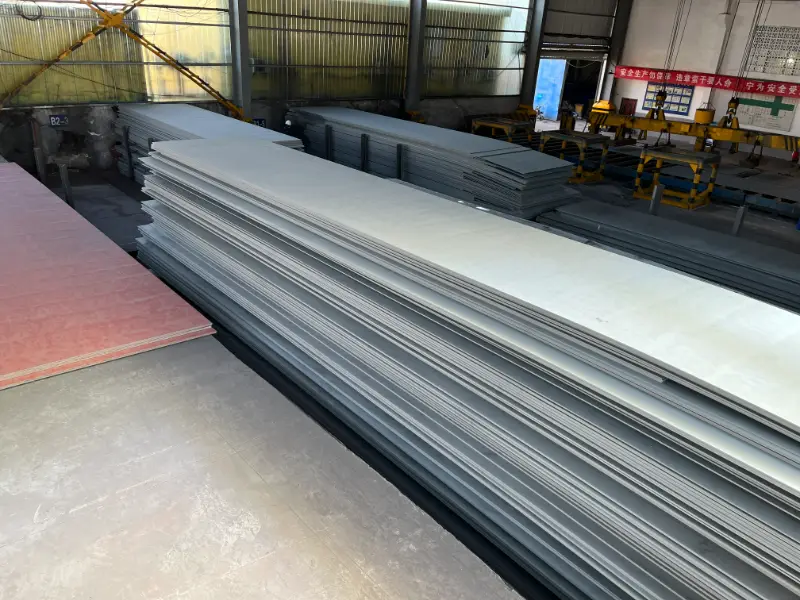
Austenitic 309Cb (S30940) Stainless Steel Plate/Coil
Austenitic 309Cb (S30940) Stainless Steel Plate/Coil - Niobium-Stabilized for High-Temperature Strength & Corrosion Resistance
Complete technical data for 309Cb (UNS S30940) stainless steel plate and coil: chemical composition, mechanical and physical properties, international equivalents, and application guidance.
hot rolling, cold rolling, solution annealing, pickling, descaling
- Phone : +8618037372205
- Email : [email protected]
- WhatsApp: Contact via Whtsapp
- WeChat: +8618037372205
Austenitic 309Cb Stainless Steel Plate/Coil Introduction
Alloy 309Cb (UNS S30940) is a niobium-stabilized austenitic stainless steel designed for outstanding high-temperature oxidation resistance and intergranular corrosion resistance. As a columbium-modified version of 309, the addition of niobium (with a minimum of 10× carbon content) effectively prevents the precipitation of chromium carbides during exposure in the 427–816°C temperature range. This ensures the alloy retains its corrosion resistance and mechanical integrity after long-term high-temperature service. The material is non-magnetic in the annealed condition, cannot be hardened by heat treatment, and exhibits good weldability. It is commonly supplied as plate, coil, sheet, and strip, meeting the stringent requirements of ASTM A240/A240M for pressure vessels and general applications.
Austenitic 309Cb Stainless Steel Plate/Coil Chemical Composition
Chemical composition in accordance with ASTM A240/A240M for grade 309Cb (UNS S30940). All values are maximum unless a range is indicated. Niobium is added at a level of at least ten times the carbon content to stabilize the alloy against intergranular corrosion.
| Element | Standard Value (wt.%) | Remarks |
|---|---|---|
| Carbon (C) | ≤0.08 | |
| Manganese (Mn) | ≤2.00 | |
| Silicon (Si) | ≤1.00 | |
| Phosphorus (P) | ≤0.045 | |
| Sulfur (S) | ≤0.030 | |
| Chromium (Cr) | 22.0 – 24.0 | |
| Nickel (Ni) | 12.0 – 15.0 | |
| Niobium (Nb/Columbium) | 10×C – 1.10 | Minimum Nb = 10 × carbon content |
| Nitrogen (N) | ≤0.10 | |
| Iron (Fe) | Balance |
Austenitic 309Cb Stainless Steel Plate/Coil Thermal & Electrical Physical Properties
Typical physical properties for 309Cb stainless steel in the annealed condition. Data are representative for engineering calculations and may vary slightly depending on exact composition, product form, and thermal history. Values at elevated temperatures are included where available.
| Property | Standard Value | Unit | Test Condition / Temperature |
|---|---|---|---|
| Density (ρ) | 8.0 | g/cm³ | Room temperature |
| Modulus of Elasticity (E) | 193 | GPa | Room temperature |
| Shear Modulus (G) | 77 | GPa | Room temperature |
| Poisson's Ratio (ν) | 0.30 | — | Room temperature |
| Thermal Expansion Coefficient (α) | 14.9 | µm/m·°C | 0–100°C |
| Thermal Expansion Coefficient (α) | 17.3 | µm/m·°C | 0–500°C |
| Thermal Expansion Coefficient (α) | 18.1 | µm/m·°C | 0–800°C |
| Thermal Conductivity (λ) | 15.0 | W/m·K | at 100°C |
| Thermal Conductivity (λ) | 18.8 | W/m·K | at 500°C |
| Specific Heat Capacity | 500 | J/kg·K | 0–100°C |
| Electrical Resistivity (ρ_e) | 0.78 | µΩ·m | at 20°C |
Austenitic 309Cb Stainless Steel Plate/Coil Mechanical Properties
Typical tensile and hardness values for solution-annealed plate at room temperature, conforming to ASTM A240/A240M. Properties are measured in the longitudinal direction. No impact test values are required by the standard, but the alloy retains excellent ductility.
| Property | Standard Value | Unit | Test Condition |
|---|---|---|---|
| Tensile Strength (Rm) | ≥515 | MPa | Room temperature, annealed |
| Yield Strength (ReH, 0.2% offset) | ≥205 | MPa | Room temperature, annealed |
| Elongation (A) in 2 in. (50 mm) | ≥30 | % | Room temperature, annealed |
| Hardness (Rockwell B) | ≤90 | HRB | Room temperature, annealed |
| Hardness (Brinell) | ≤217 | HBW | Room temperature, annealed, 3000 kgf |
Austenitic 309Cb Stainless Steel Plate/Coil Fully Equivalent Material Standards & Substitutable Grades
| Country/Region | Standard | Grade/Designation | Remarks |
|---|---|---|---|
| USA | ASTM A240/A240M | 309Cb (UNS S30940) | Original specification; plate, sheet, strip for pressure vessels and general applications. |
| Europe | EN 10028-7 / EN 10095 | X6CrNiNb24-14 (1.4953) | Niobium-stabilized heat‑resisting steel; slight differences in Cr range (23–26%) and Ni (13–16%). Functionally equivalent for high-temperature service. |
| Japan | JIS G 4304 / G 4312 | No exact equivalent; refer to SUS309J1 for similar base composition without Nb | SUS309J1 is a low-carbon 309 variant; not stabilized. Use 309Cb when Nb stabilization is required. |
Austenitic 309Cb Stainless Steel Plate/Coil Application Introduction
309Cb is engineered for long-term service in high-temperature oxidizing environments. Its niobium stabilization makes it ideal for components that experience thermal cycling or prolonged exposure in the carbide precipitation range, where unstabilized grades would suffer from intergranular attack. The material is readily formable and weldable, and can be fabricated into a wide variety of shapes.
Product Applications: Plates, coils, and sheets for pressure vessel fabrication, Welded pipes and tubes for high-temperature fluid transport, Expansion joints and bellows that must withstand thermal cycling, Furnace spare parts: radiant tubes, rollers, and walking beams, Structural components in heat treatment furnaces
Processed into products: Radiant tubes and heating elements, Annealing boxes and baskets, Muffles and retorts for heat treatment, Boiler baffles and supports, Kiln linings and burner nozzles, Fired heater tubes in petrochemical plants, Expansion joints in hot gas ducts
Application industries: Petrochemical processing (furnace tubes, flue gas ducting), Power generation (boiler components, superheater supports), Heat treatment equipment (annealing boxes, radiant tubes, retorts), Industrial furnace manufacturing (kiln linings, burners, muffles), Chemical processing (heat exchangers, reactor internals)
Austenitic 309Cb Stainless Steel Plate/Coil Closely Related / Similar Alternative Materials
| Country/Region | Standard | Grade/Designation | Analysis / Remarks |
|---|---|---|---|
| USA | ASTM A240 | 309 (S30900) / 309S (S30908) | Similar base chemistry (Cr 22–24%, Ni 12–15%) without niobium stabilization. Susceptible to intergranular corrosion after sensitization. |
| USA | ASTM A240 | 310 (S31000) / 310S (S31008) | Higher Cr (24–26%) and Ni (19–22%) for superior oxidation resistance up to 1150°C, but no niobium stabilization. |
| USA | ASTM A240 | 347 (S34700) | Niobium-stabilized austenitic stainless steel with lower chromium (17–19%) and nickel (9–12%), often used for similar high-temperature applications. |
| Europe | EN 10088-2 / EN 10095 | 1.4828 (X15CrNiSi20-12) | Heat‑resisting austenitic grade with comparable oxidation resistance, no niobium addition. |
Notes:
Heat Treatment: Solution anneal at 1040–1120°C followed by water quenching or rapid air cooling. Do not expose to service temperatures between 500–900°C for prolonged periods without considering the precipitation kinetics of sigma phase, which can form after long-term aging and reduce toughness. Welding: Use matching filler metal ER309Cb or ER309 for gas tungsten arc welding (GTAW); post-weld heat treatment is generally not required for thicknesses below 6 mm. Preheating is not necessary, but interpass temperature should be kept below 150°C. Machining: The alloy work-hardens; use rigid tool setups, slow speeds, and heavy feeds with appropriate cutting fluids.
- Share



