
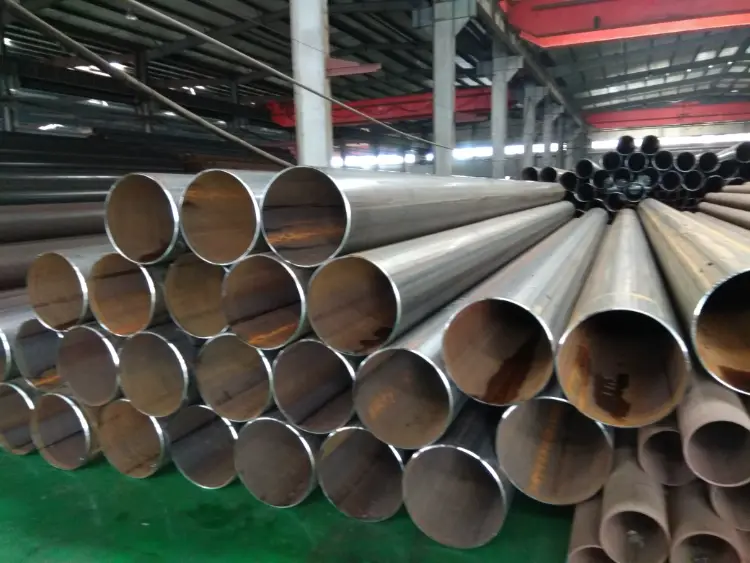
ASTM A789 S32004 Duplex Stainless Steel Pipe
ASTM A789 UNS S32004 Duplex Stainless Steel Pipe: Composition, Properties & Applications
Complete data sheet for ASTM A789 S32004 duplex stainless steel pipe, including chemical composition, mechanical and physical properties, equivalent grades, and application guidelines.
Cold pilgering, cold drawing, hot extrusion, welding (GTAW, PAW), and solution annealing
- Phone : +8618037372205
- Email : [email protected]
- WhatsApp: Contact via Whtsapp
- WeChat: +8618037372205
ASTM A789 S32004 Duplex Stainless Steel Pipe Introduction
ASTM A789 UNS S32004 is a low-alloy duplex stainless steel (ferritic-austenitic) developed for general corrosion-resistant service. It offers a balanced combination of high strength, excellent resistance to chloride stress corrosion cracking, and good weldability. With a nominal composition of 25Cr-6Ni-1.5Mo-2Cu and controlled nitrogen addition, this grade provides superior pitting and crevice corrosion resistance compared to conventional 304L or 316L stainless steels, while maintaining cost-effectiveness through lower nickel content. It is typically supplied in the annealed condition for seamless and welded tubular products.
ASTM A789 S32004 Duplex Stainless Steel Pipe Chemical Composition per ASTM A789
The chemical requirements for UNS S32004 duplex stainless steel as defined in ASTM A789 Table 1. All values are in weight percent. Nitrogen is intentionally added to enhance strength and pitting resistance while stabilizing the austenitic phase.
| Element | Composition (wt%) | Notes |
|---|---|---|
| Carbon (C) | ≤ 0.030 | |
| Manganese (Mn) | ≤ 2.50 | |
| Phosphorus (P) | ≤ 0.035 | |
| Sulfur (S) | ≤ 0.020 | |
| Silicon (Si) | ≤ 1.00 | |
| Chromium (Cr) | 24.0 – 26.0 | |
| Nickel (Ni) | 5.5 – 7.0 | |
| Molybdenum (Mo) | 1.20 – 2.00 | |
| Copper (Cu) | 1.00 – 3.00 | |
| Nitrogen (N) | 0.10 – 0.25 | |
| Iron (Fe) | Balance | Approximately 60% |
ASTM A789 S32004 Duplex Stainless Steel Pipe Physical Properties
Representative physical properties for UNS S32004 duplex stainless steel at 20°C (68°F) unless otherwise noted. These values are typical and may vary slightly with product form and final heat treatment.
| Property | Typical Value | Unit | Condition/Notes |
|---|---|---|---|
| Density (ρ) | 7.8 | g/cm³ | At 20°C |
| Modulus of Elasticity (E) | 200 | GPa | Room temperature |
| Shear Modulus (G) | 77 | GPa | Calculated |
| Poisson's Ratio (ν) | 0.30 | — | Room temperature |
| Coefficient of Thermal Expansion (α) | 13.0 | µm/m·°C | 20–100°C |
| Thermal Conductivity (λ) | 15.0 | W/m·K | At 20°C |
| Specific Heat Capacity | 500 | J/kg·K | At 20°C |
| Electrical Resistivity (ρ_e) | 0.80 | µΩ·m | At 20°C |
ASTM A789 S32004 Duplex Stainless Steel Pipe Mechanical Properties
Minimum tensile requirements for ASTM A789 S32004 tubing at room temperature. The material shall be capable of meeting these values after final heat treatment. No hardness limits are mandated by the standard.
| Property | Specified Value | Unit | Test Condition |
|---|---|---|---|
| Yield Strength (0.2% offset) | ≥ 485 | MPa | Annealed, room temperature |
| Tensile Strength | ≥ 690 | MPa | Annealed, room temperature |
| Elongation (2 in. or 50 mm) | ≥ 25 | % | Annealed, room temperature |
ASTM A789 S32004 Duplex Stainless Steel Pipe Identical UNS S32004 Under Alternative ASTM Standards
| Region | Standard | Grade | Remarks |
|---|---|---|---|
| USA | ASTM A240 | S32004 | Plate, sheet, and strip |
| USA | ASTM A276 | S32004 | Bar and shapes |
| USA | ASTM A479 | S32004 | Bar and shapes for boilers and pressure vessels |
| USA | ASTM A789 | S32004 | Seamless and welded tubing (primary reference) |
ASTM A789 S32004 Duplex Stainless Steel Pipe Application Introduction
ASTM A789 S32004 duplex stainless steel pipe is designed for moderate to severe corrosive environments where a combination of high strength and resistance to stress corrosion cracking is required. Its low alloy content compared to super duplex grades makes it a cost-effective choice for many industrial services.
Product Applications: Heat exchanger tubes and tube bundles, Seamless and welded process piping, Seawater cooling systems and condensers, Hydraulic and instrumentation tubing, Structural hollow sections for corrosive atmospheres
Processed into products: Pipe fittings (elbows, tees, reducers), Flanges and blind flanges, Valve bodies and trim components, Compression tube connectors, Spool pieces and pup joints, Pressure vessel shells and heads (when used with A240 plate)
Application industries: Chemical processing (acid handling, storage tanks), Petrochemical and refining (heat exchangers, coolers), Marine and offshore (seawater piping, firefighting systems), Desalination (evaporators, brine lines), Pulp and paper (bleaching equipment, digester tubes), Oil and gas (instrumentation tubing, flowlines)
ASTM A789 S32004 Duplex Stainless Steel Pipe Similar/Alternative Duplex Stainless Steels
| Region | Standard | Grade | Remarks |
|---|---|---|---|
| USA | ASTM A789 | S32304 (UNS S32304) | Lean duplex with lower Cr, Mo, Cu, and N; slightly lower strength and lower pitting resistance. Suitable for less aggressive environments. |
| USA | ASTM A789 | S32205 (UNS S32205) | Standard duplex (22Cr-5Ni-3Mo-0.15N); higher Mo and N provide superior pitting resistance but at higher cost. Suitable for more corrosive chloride environments. |
| Europe | EN 10088-3 | 1.4362 (X2CrNiN23-4) | European lean duplex similar to S32304; lower alloy content than S32004. Used in structural applications where moderate corrosion resistance is needed. |
| Europe | EN 10088-3 | 1.4462 (X2CrNiMoN22-5-3) | Standard duplex equivalent to S32205; widely available but higher alloy cost compared to S32004. |
Notes:
Welding: UNS S32004 can be welded by GTAW, GMAW, and SMAW using over-alloyed fillers (e.g., ER2209, ER2594) to maintain corrosion resistance. No preheat or post-weld heat treatment is required for thin sections.
Corrosion resistance: Pitting Resistance Equivalent Number (PREN) is typically 28–33, providing better pitting resistance than 304L and 316L.
Forming: Good cold formability; hot working range is 950–1150°C followed by rapid cooling to avoid sigma phase precipitation.
Standards referenced: ASTM A789/A789M-21 (or latest edition).
- Share



