
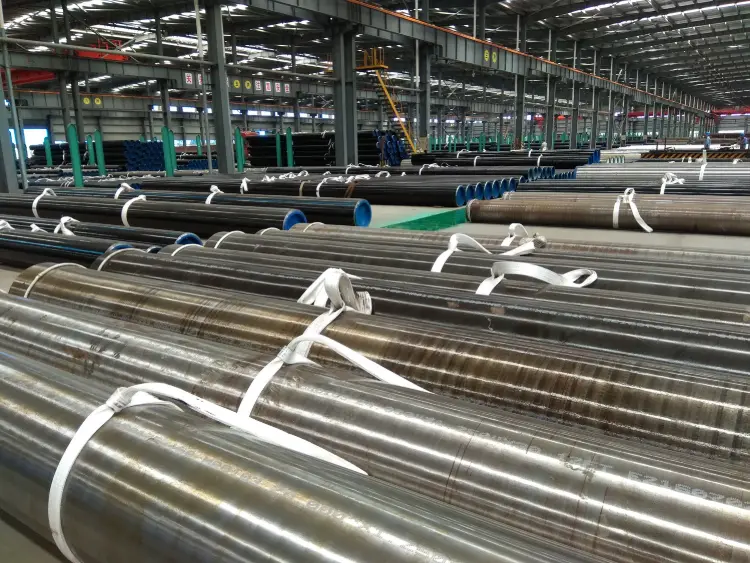
ASTM A789 S31260 Duplex Stainless Steel Pipe
ASTM A789 S31260 Duplex Stainless Steel Pipe: High-Strength Corrosion Resistance for Severe Environments
Detailed material data for ASTM A789 S31260 duplex stainless steel pipe, including chemical composition, mechanical properties, physical performance, equivalent grades, and industrial applications.
Hot working, cold drawing, welding, machining, solution annealing
- Phone : +8618037372205
- Email : [email protected]
- WhatsApp: Contact via Whtsapp
- WeChat: +8618037372205
ASTM A789 S31260 Duplex Stainless Steel Pipe Introduction
ASTM A789 S31260 is a duplex (austenitic-ferritic) stainless steel designed for use in welded and seamless pipe form. This grade combines high mechanical strength with excellent resistance to pitting, crevice corrosion, and chloride stress-corrosion cracking. The balanced dual-phase microstructure provides yield strength approximately twice that of conventional austenitic stainless steels, while maintaining good ductility and toughness.
- Superior corrosion resistance in chloride-containing environments, seawater, and a wide range of chemicals.
- High tensile and yield strength, enabling reduced wall thickness and weight savings in piping systems.
- Good weldability with proper filler metals and heat input control.
- Cost-effective alternative to nickel-base alloys in many corrosive applications.
The alloy is typically supplied in the solution-annealed condition, ensuring an optimal microstructural balance and corrosion resistance.
ASTM A789 S31260 Duplex Stainless Steel Pipe Chemical Composition
The chemical composition conforms to the requirements of ASTM A789 for UNS S31260. All values are maximum unless a range is indicated. The deliberate addition of nitrogen enhances strength and pitting resistance while stabilizing the austenite phase.
- Key alloying elements: High chromium (Cr) for corrosion resistance, molybdenum (Mo) for pitting resistance, nitrogen (N) for strength and phase balance, and copper (Cu) for acid resistance.
- Impurity control: Low carbon content minimizes carbide precipitation during welding, improving intergranular corrosion resistance.
| Element | Content (%) | Remarks |
|---|---|---|
| Carbon (C) | ≤ 0.03 | Max |
| Manganese (Mn) | ≤ 1.00 | Max |
| Phosphorus (P) | ≤ 0.030 | Max |
| Sulfur (S) | ≤ 0.030 | Max |
| Silicon (Si) | ≤ 0.75 | Max |
| Chromium (Cr) | 24.0 – 26.0 | Range |
| Nickel (Ni) | 5.5 – 7.5 | Range |
| Molybdenum (Mo) | 2.5 – 3.5 | Range |
| Copper (Cu) | 0.20 – 0.80 | Range |
| Nitrogen (N) | 0.10 – 0.30 | Range |
| Iron (Fe) | Balance (~60.3–66.7) | Remainder |
ASTM A789 S31260 Duplex Stainless Steel Pipe Physical Properties
The following physical properties are representative for S31260 duplex stainless steel in the annealed condition. These values are useful for design calculations involving thermal expansion, heat transfer, and electrical applications. Slight variations may occur depending on exact product form and processing history.
- Thermal conductivity is lower than carbon steel but adequate for many heat-exchanger services.
- Thermal expansion coefficient lies between ferritic and austenitic grades, reducing thermal stress when joining with carbon steel.
- Electrical resistivity is relatively high, typical of corrosion-resistant alloys.
| Property | Typical Value | Unit | Test Condition |
|---|---|---|---|
| Density (ρ) | 7.8 | g/cm³ | 20°C |
| Elastic Modulus (E) | 200 | GPa | 20°C, tension |
| Shear Modulus (G) | 77 | GPa | 20°C, calculated |
| Poisson's Ratio (ν) | 0.30 | - | 20°C |
| Thermal Expansion Coefficient (α) | 12.5 | µm/m·°C | 20–100°C |
| Thermal Conductivity (λ) | 15 | W/m·K | 100°C |
| Specific Heat Capacity (cp) | 460 | J/kg·K | 20°C |
| Electrical Resistivity (ρe) | 0.85 | µΩ·m | 20°C |
ASTM A789 S31260 Duplex Stainless Steel Pipe Tensile Properties
Mechanical properties are determined on annealed pipe specimens in accordance with ASTM A370. The table shows the minimum acceptance criteria as specified in the standard. Actual typical values often exceed these minima, with yield strength often reaching 550–620 MPa and elongation values up to 25–30%.
- High yield strength allows for design with thinner walls.
- Good ductility permits cold working and bending operations.
- Impact toughness and hardness are not mandatory in the standard but typical Charpy V-notch impact values exceed 100 J at room temperature.
| Property | Required Value | Unit | Test Condition |
|---|---|---|---|
| Tensile Strength (Rm) | ≥ 690 | MPa | Room temperature, longitudinal specimen |
| Yield Strength (ReH 0.2% offset) | ≥ 485 | MPa | Room temperature, longitudinal specimen |
| Elongation (A) | ≥ 15 | % | Gauge length 50 mm (or 2 in.), round specimen |
ASTM A789 S31260 Duplex Stainless Steel Pipe Exact Equivalent Material Standards and Substitutable Grades
| Country/Region | Standard | Grade | Remarks |
|---|---|---|---|
| International | - | - | No directly equivalent grade exists in major international standards due to unique low-copper chemistry. The closest chemical matches are UNS S32550 (Ferralium 255) and EN 1.4507, both containing higher copper (1.5–2.5%). |
ASTM A789 S31260 Duplex Stainless Steel Pipe Application Introduction
S31260 duplex stainless steel pipe finds extensive use where high mechanical strength and corrosion resistance must be combined. Its excellent pitting resistance equivalent number (PREN) typically above 38 makes it suitable for challenging aqueous environments.
- Ideal for seawater and brackish water systems where austenitic grades may suffer chloride pitting and stress corrosion cracking.
- Preferred for reducing wall thickness and weight in large-diameter piping, offering capital expenditure savings.
- Well suited for sour service in oil and gas production, meeting NACE MR0175/ISO 15156 requirements under appropriate hardness conditions.
Product Applications: Seamless and welded pipe for process piping, Heat exchanger tubes, Pipe fittings (elbows, tees, reducers), Flanges and connectors, U-bent tubes for boiler applications
Processed into products: Seawater intake and discharge piping, Hydraulic and instrumentation tubing, Pump shafts and impellers (machined from pipe stock), Valve stems and bodies, Pressure vessel internals and external piping, Offshore riser and flowline segments
Application industries: Oil and Gas (offshore platforms, subsea piping, topside process lines), Chemical Processing (reactors, storage tanks, heat exchangers), Marine and Shipbuilding (ballast water systems, exhaust scrubbers), Desalination (RO pressure vessels, brine piping), Pulp and Paper (digesters, bleach plant equipment), Pollution Control (flue gas desulfurization, waste water treatment)
ASTM A789 S31260 Duplex Stainless Steel Pipe Similar or Alternative Materials with Close Performance
| Country/Region | Standard | Grade | Remarks |
|---|---|---|---|
| USA | ASTM A789/A789M | S32550 (Ferralium 255) | Higher copper (1.5–2.5%) provides slightly better resistance in sulfuric acid; similar strength and chloride pitting resistance. Often interchangeable in many applications. |
| Europe | EN 10088-3 / EN 10216-5 | 1.4507 (X2CrNiMoCuN25-6-3) | Mo 3.0–4.0%, Cu 1.0–2.0%, offering comparable corrosion resistance but with different phase balance. Verify weldability and service conditions. |
| USA/Global | ASTM A789/A789M | S32205 / S31803 (2205) | Lower alloy content (22% Cr, 3% Mo, 5–6% Ni) reduces cost and provides good corrosion resistance; used when full S31260's higher strength/PREN is not required. Limited in very aggressive chloride media. |
Notes:
Welding: S31260 should be welded with matching or over-alloyed duplex consumables (e.g., ER2594 or similar) to maintain corrosion resistance and phase balance. Pre-heating is normally not required; however, interpass temperature should be kept below 150°C. Post-weld solution annealing may be necessary if maximum corrosion resistance is demanded.
Heat Treatment: Solution annealing at 1040–1120°C followed by rapid water quenching is essential to dissolve harmful intermetallic phases and restore the proper duplex structure. Slow cooling or exposure to 300–950°C can cause sigma and 475°C embrittlement.
Corrosion Notes: Resistant to pitting and crevice corrosion in neutral and acidic chloride solutions up to moderate temperatures. Not recommended for strongly oxidizing environments (e.g., hot concentrated nitric acid) without prior evaluation.
- Share



