
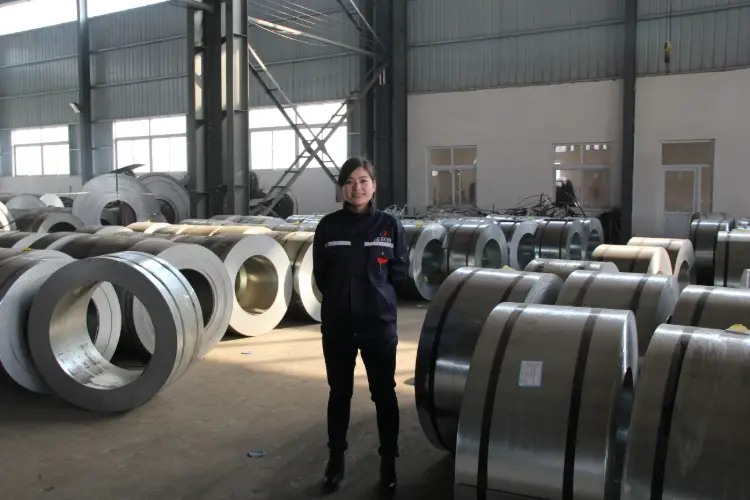
ASTM A656/A656M Grade 50 High-Strength Low-Alloy Steel Coil
ASTM A656/A656M Grade 50 High-Strength Low-Alloy Steel Coil – Properties & Equivalents
Detailed material data for ASTM A656/A656M Grade 50 carbon and low-alloy high-strength steel coil: chemical composition, mechanical properties, thermal and electrical reference values, equivalent grades and application guide.
Hot rolling, pickling and oiling, cold forming, welding, stamping
- Phone : +8618037372205
- Email : [email protected]
- WhatsApp: Contact via Whtsapp
- WeChat: +8618037372205
ASTM A656/A656M Grade 50 High-Strength Low-Alloy Steel Coil Introduction
ASTM A656/A656M Grade 50 is a hot-rolled, high-strength low-alloy (HSLA) steel designed for structural applications that require improved formability and high yield strength. The grade guarantees a minimum yield strength of 345 MPa (50 ksi) and is microalloyed with elements such as niobium, vanadium or titanium to achieve fine grain structure and enhanced mechanical properties. Its low carbon content and controlled sulfur/phosphorus levels ensure excellent weldability and cold forming characteristics, making it suitable for heavy bending, stamping and roll forming without cracking. Typically supplied as coil, plate or strip, this material is widely used in the automotive, agricultural equipment, construction and crane industries where weight reduction and structural integrity are critical. The standard ASTM A656/A656M covers several types (Type 2, Type 3, Type 4, Type 7) with specific chemical restrictions; Grade 50 can be ordered under any of these types depending on the desired combination of strength and formability.
ASTM A656/A656M Grade 50 High-Strength Low-Alloy Steel Coil Chemical Composition
The chemical composition of ASTM A656 Grade 50 is controlled to achieve high strength and excellent formability. Values below correspond to Type 3 (the most common microalloyed variant) per ASTM A656/A656M. Other types may have different limits; all must meet the carbon equivalent requirement when specified.
| Element | Standard Value | Remarks |
|---|---|---|
| C | ≤0.18 | Heat analysis |
| Mn | ≤1.65 | Heat analysis |
| P | ≤0.025 | Heat analysis |
| S | ≤0.035 | Heat analysis |
| Si | ≤0.60 | Heat analysis |
| Cu | ≤0.35 | Residual element |
| Ni | ≤0.25 | Residual element |
| Cr | ≤0.25 | Residual element |
| Mo | ≤0.08 | Heat analysis |
| V | ≤0.10 | Microalloy |
| Nb | 0.005 – 0.05 | Microalloy |
| Ti | ≤0.02 | Heat analysis |
ASTM A656/A656M Grade 50 High-Strength Low-Alloy Steel Coil Thermal and Electrical Physical Properties
The following physical properties are typical for microalloyed HSLA steel of this strength level. They are not mandatory requirements of ASTM A656/A656M but are commonly used for engineering calculations.
| Property | Typical Value | Unit | Condition |
|---|---|---|---|
| Density (ρ) | 7850 | kg/m³ | At 20 °C |
| Elastic modulus (E) | 205 | GPa | At 20 °C |
| Shear modulus (G) | 80 | GPa | At 20 °C |
| Poisson's ratio (ν) | 0.29 | – | At 20 °C |
| Thermal expansion coefficient (α) | 11.7 | 10⁻⁶/K | 20–100 °C |
| Thermal conductivity (λ) | 50 | W/(m·K) | At 100 °C |
| Specific heat capacity | 470 | J/(kg·K) | At 20 °C |
| Electrical resistivity (ρ_e) | 0.15 | μΩ·m | At 20 °C |
ASTM A656/A656M Grade 50 High-Strength Low-Alloy Steel Coil Mechanical Properties
Mechanical properties are tested at room temperature in accordance with ASTM A656/A656M. The values below correspond to the as-rolled or annealed condition. Impact testing is not mandatory but can be specified as a supplementary requirement.
| Property | Value | Unit | Condition |
|---|---|---|---|
| Yield Strength (ReH) | ≥345 | MPa | t ≤ 50 mm, room temperature |
| Tensile Strength (Rm) | ≥450 | MPa | t ≤ 50 mm, room temperature |
| Elongation (A50) | ≥22 | % | Gauge 50 mm, t ≤ 19 mm |
| Elongation (A200) | ≥18 | % | Gauge 200 mm, t ≤ 12.5 mm |
| Bend Test (180°) | d = t | – | t ≤ 19 mm |
| Bend Test (180°) | d = 1.5t | – | 19 mm < t ≤ 25.4 mm |
ASTM A656/A656M Grade 50 High-Strength Low-Alloy Steel Coil Directly Equivalent Standards and Substitute Grades
| Country/Region | Standard | Grade | Remarks |
|---|---|---|---|
| Europe | EN 10149-2 | S355MC | Thermomechanically rolled, cold-forming HSLA; yield strength 355 MPa minimum, close to Grade 50, widely interchangeable in formed parts. |
| Japan | JIS G 3134 | SPFH590 | Hot-rolled high-strength steel for automobile structural uses; yield strength approx. 440 MPa, slightly higher strength but similar formability. |
| International | ISO 4995 | HR355F | Hot-rolled structural steel sheet with high yield and improved formability; yield strength 355 MPa, used as an alternative when available. |
ASTM A656/A656M Grade 50 High-Strength Low-Alloy Steel Coil Application Introduction
ASTM A656 Grade 50 is optimized for structural components that require a high strength-to-weight ratio combined with cold-forming operations. Its low carbon content and microalloy composition allow tight-radius bends, deep drawing and stamping without risk of cracking. The material is readily weldable with common processes (SMAW, GMAW, FCAW) and may be painted or galvanized after appropriate surface preparation.
Product Applications: Automotive chassis and subframes, Suspension control arms and cross members, Truck frames and trailer beams, Crane booms and outrigger pads, Agricultural implement frames and hitches, Stamped structural brackets and reinforcements
Processed into products: Stamped and bent brackets, Welded tubular assemblies, Roll-formed channels and profiles, Draw-formed arms and links, Laser-cut and pressed plates
Application industries: Automotive and transportation, Agricultural machinery, Construction and earthmoving equipment, Crane and lifting equipment, General manufacturing and metal fabrication
ASTM A656/A656M Grade 50 High-Strength Low-Alloy Steel Coil Similar/Near Equivalent Materials
| Country/Region | Standard | Grade | Remarks |
|---|---|---|---|
| United States | ASTM A572/A572M | Grade 50 | General structural HSLA; similar yield strength but less restrictive formability requirements, often used for welded construction. |
| United States | ASTM A1011/A1011M | HSLAS Class 1 Grade 50 | Hot-rolled sheet HSLA; similar strength, but formability may be somewhat lower than A656 Grade 50. |
| Europe | EN 10025-2 | S355JR | Structural steel with comparable yield; lower formability, not specifically designed for severe cold bending. |
| China | GB/T 1591 | Q345D | Low-alloy structural steel; minimum yield 345 MPa, similar strength level but fewer formability guarantees. |
Notes:
- For thicknesses above 50 mm, mechanical properties can be agreed upon between supplier and purchaser.
- Welding: preheat is generally not required for sections under 25 mm; for thicker sections or highly restrained joints, a low-hydrogen practice is recommended.
- Carbon equivalent (CEV) is often limited to ensure weldability; typical CEV ≤ 0.40% for thickness ≤ 12.5 mm.
- The steel is not normally intended for heat treatment, but stress-relief annealing at 550–600 °C may be applied.
- Share



