
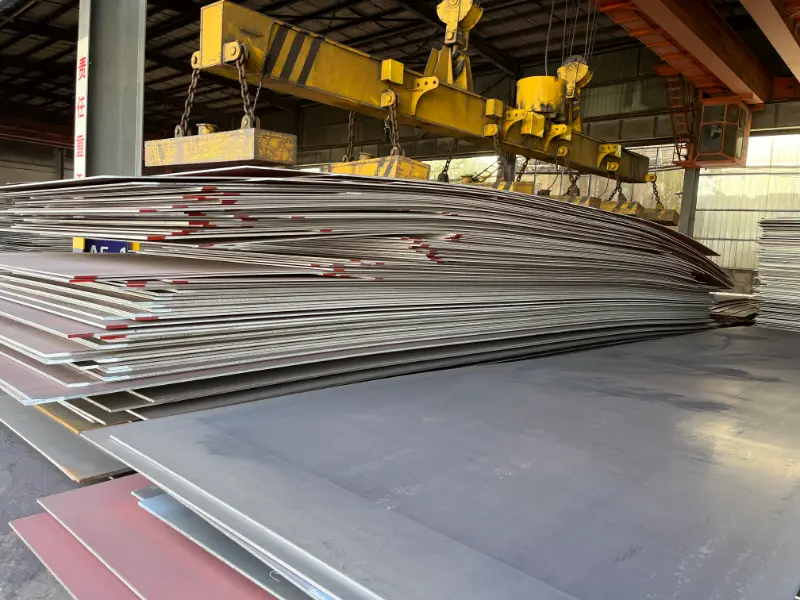
ASTM A572 Grade 65 High-Strength Low-Alloy Steel
ASTM A572 Grade 65 High-Strength Low-Alloy Steel: Full Data, Equivalents & Applications
Explore ASTM A572 Grade 65 carbon and low-alloy high-strength steel coil specifications, chemical composition, mechanical and thermal properties, international equivalents, and typical applications in structural engineering.
Hot rolling, controlled rolling, normalizing rolling, welding, machining, forming
- Phone : +8618037372205
- Email : [email protected]
- WhatsApp: Contact via Whtsapp
- WeChat: +8618037372205
ASTM A572 Grade 65 High-Strength Low-Alloy Steel Introduction
ASTM A572/A572M Grade 65 is a high-strength low-alloy (HSLA) structural steel that provides a minimum yield strength of 65 ksi (450 MPa) for thicknesses up to 32 mm. It belongs to the carbon and low-alloy high-strength steel family, designed for weight reduction without sacrificing durability. Key features include excellent weldability, good formability, and high strength-to-weight ratio, making it ideal for bridges, buildings, and heavy equipment. The steel is typically supplied in the hot-rolled or controlled-rolled condition and can be used in riveted, bolted, or welded structures. Grade 65 offers enhanced atmospheric corrosion resistance compared to plain carbon steel due to its micro-alloying elements. Its balanced chemistry ensures consistent mechanical properties and reliable performance under static and dynamic loads.
ASTM A572 Grade 65 High-Strength Low-Alloy Steel Chemical Composition
The standard chemical composition for ASTM A572 Grade 65 (Type 1) is based on maximum limits for the principal elements. The steel is typically silicon-killed and may contain micro-alloying additions (Nb, V, Ti) up to agreed amounts to achieve the required mechanical properties. The table below shows the specified maximum mass fractions. Residual elements like Cu, Ni, Cr, Mo are not explicitly restricted except by the product analysis requirements.
| Element | Standard Value (max %) | Remarks |
|---|---|---|
| Carbon (C) | 0.23 | For thickness ≤ 40 mm; for structural shapes 0.26 max |
| Manganese (Mn) | 1.35 | Can be reduced if other strengthening elements are used |
| Phosphorus (P) | 0.030 | Strict control for weldability and toughness |
| Sulfur (S) | 0.030 | Low sulfur improves formability and reduces hot shortness |
| Silicon (Si) | 0.40 | Deoxidation element; higher Si may be used for killed fine grain practice |
| Vanadium (V)* | 0.01–0.15 | Optional micro-alloy; by agreement |
| Niobium (Nb)* | 0.005–0.05 | Optional micro-alloy; by agreement |
| Titanium (Ti)* | 0.006–0.04 | Optional micro-alloy; by agreement |
ASTM A572 Grade 65 High-Strength Low-Alloy Steel Thermal and Electrical Physical Properties
The following physical properties are typical for low-alloy structural steels of similar composition and density. They are not specified by ASTM A572 standard but are provided for design and engineering calculations. The values apply at room temperature unless otherwise noted. Variations up to ±10% may occur depending on exact chemistry and heat treatment.
| Property | Typical Value | Unit | Test Condition |
|---|---|---|---|
| Density (ρ) | 7.85 | g/cm³ | 20°C |
| Modulus of Elasticity (E) | 205 | GPa | 20°C |
| Shear Modulus (G) | 78 | GPa | 20°C |
| Poisson's Ratio (ν) | 0.30 | - | 20°C |
| Thermal Expansion Coefficient (α) | 11.7 × 10⁻⁶ | /K | 20–100°C |
| Thermal Expansion Coefficient (α) | 12.5 × 10⁻⁶ | /K | 20–200°C |
| Thermal Expansion Coefficient (α) | 13.2 × 10⁻⁶ | /K | 20–300°C |
| Thermal Conductivity (λ) | 51.9 | W/(m·K) | 20°C |
| Specific Heat Capacity | 486 | J/(kg·K) | 20°C |
| Electrical Resistivity (ρ_e) | 0.22 | µΩ·m | 20°C |
ASTM A572 Grade 65 High-Strength Low-Alloy Steel Mechanical Properties
The mechanical properties of ASTM A572 Grade 65 are thickness-dependent. The standard specifies minimum yield and tensile strengths, elongation, and bend test criteria. Impact testing (Charpy V-notch) is not mandatory unless specified at the time of order by the purchaser. The values listed below are the minimum required properties as per ASTM A572/A572M. Elongation is measured either on a 200 mm (8 in.) or 50 mm (2 in.) gauge length.
| Property | Standard Requirement | Unit | Test Condition / Thickness |
|---|---|---|---|
| Yield Strength (ReH) | ≥ 450 | MPa | Thickness ≤ 32 mm |
| Yield Strength (ReH) | ≥ 380 | MPa | Thickness > 32 mm to 100 mm |
| Tensile Strength (Rm) | ≥ 550 | MPa | Thickness ≤ 32 mm |
| Tensile Strength (Rm) | ≥ 450 | MPa | Thickness > 32 mm to 100 mm |
| Elongation (A) in 200 mm | ≥ 15 | % | Thickness ≤ 50 mm |
| Elongation (A) in 50 mm | ≥ 19 | % | Thickness ≤ 50 mm |
| Elongation (A) in 200 mm | ≥ 14 | % | Thickness > 50 mm |
| Elongation (A) in 50 mm | ≥ 18 | % | Thickness > 50 mm |
| Bend Test (Bend Diameter) | ≤ 1.5t | - | Thickness ≤ 20 mm, 180° bend, t = specimen thickness |
| Bend Test (Bend Diameter) | ≤ 2.0t | - | Thickness > 20 mm, 180° bend, t = specimen thickness |
ASTM A572 Grade 65 High-Strength Low-Alloy Steel Exact Equivalent Standards and Replaceable Grades
The following table lists the standard that exactly defines ASTM A572 Grade 65. There is no international standard that is completely identical in chemical and mechanical requirements; however, the ASTM designation itself is globally recognized and used. A direct equivalent does not exist elsewhere; alternative materials listed under similar materials are approximations.
| Country/Region | Standard Designation | Grade/Designation | Remarks |
|---|---|---|---|
| USA | ASTM A572/A572M | Grade 65 [450] | Original specification; full compliance guaranteed |
ASTM A572 Grade 65 High-Strength Low-Alloy Steel Application Introduction
ASTM A572 Grade 65 steel is widely used in structural applications where high strength and reduced weight are critical. It can be processed by cutting, bending, welding, and machining using conventional methods. Preheating may be required for thicker sections during welding. The material is suitable for both dynamic and static loading environments.
Key application sectors:
Product Applications: Welded bridge girders and trusses, High-rise building columns and beams, Transmission towers and poles, Offshore platform decks and jack-up legs, Excavator booms and arms, Truck chassis frames, Railway car underframes, Crane runway beams
Processed into products: Welded built-up I- and H-sections, Structural hollow sections (SHS, RHS), Flitch plates and splice plates, Gusset plates and stiffeners, Base plates and anchor brackets, Boom and stick weldments for excavators, Wind tower shells and door frames, Heavy-duty support brackets
Application industries: Civil engineering and construction, Bridge and highway infrastructure, Offshore and marine structures, Mining and earthmoving machinery, Transportation (railway wagons, heavy trucks), Wind energy (turbine towers), Industrial crane and material handling equipment
ASTM A572 Grade 65 High-Strength Low-Alloy Steel Similar / Alternative Materials
The following grades from other standards provide comparable minimum yield strength (around 450–460 MPa) and can be considered for many applications with careful review of chemistry and additional requirements. They are not identical and may require supplementary testing or agreement. Particularly, toughness classes (e.g., NL, ML, C, D, E) differ in delivery conditions and impact energy requirements.
| Country/Region | Standard Designation | Grade/Designation | Remarks |
|---|---|---|---|
| Europe | EN 10025-3 | S460N, S460NL | Normalized / normalized rolled; yield 460 MPa; notch toughness classes differ |
| Japan | JIS G3106 | SM570 | 460 MPa min yield; common in bridges and welding structures |
| China | GB/T 1591 | Q460C/D/E | 460 MPa min yield; quality grades determine impact requirements |
| India | IS 8500 | Fe570 | 570 MPa tensile, similar strength range; check chemistry |
| Russia | GOST 19281 | 17G1S (17Г1С) | Approx. 450 MPa yield; older standard, verify equivalent |
Notes:
Welding: ASTM A572 Grade 65 has good weldability using all common processes (SMAW, GMAW, FCAW, SAW). Low-hydrogen electrodes are recommended. Preheating (typically 100-200°C) should be applied for thicknesses over 50 mm or when carbon equivalent (CE) exceeds 0.45%. Corrosion protection: The steel offers limited atmospheric corrosion resistance; painting or galvanizing is recommended for exposed applications. Formability: The material can be cold formed with a minimum internal radius of 1.5t to 2.5t, depending on thickness and orientation.
- Share



